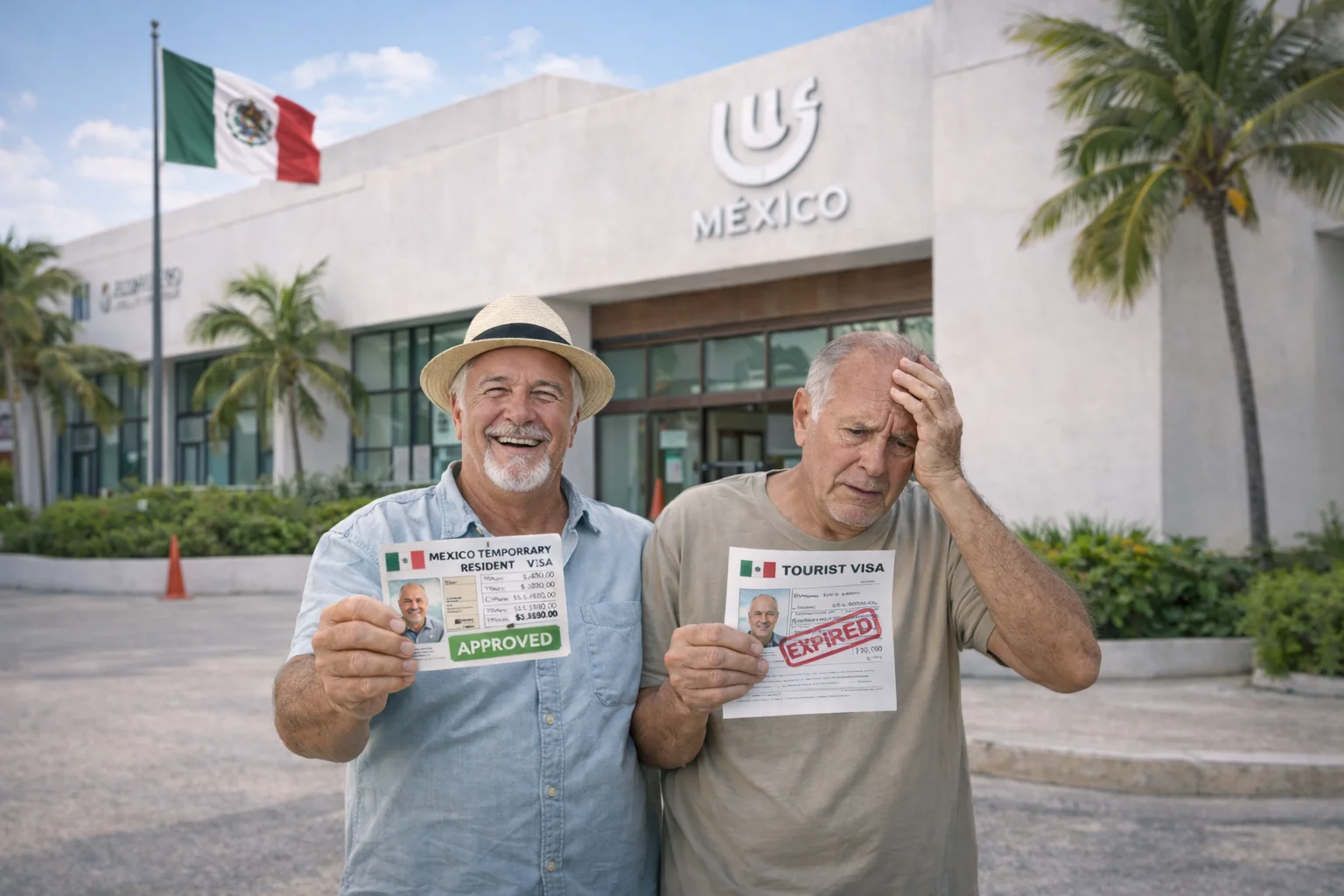
If you’re planning to apply for Mexico’s temporary resident visa, one question usually matters more than anything else:
do you meet the income requirement?
Before you think about housing or lifestyle, you need clarity on the numbers. Mexico requires proof of either consistent monthly income or sufficient savings, calculated under official financial guidelines used by its consulates.
In 2026, the thresholds are specific. The documentation standards are structured. Approval depends on demonstrating financial stability in a way that aligns with those rules.
Here’s how the income requirement actually works and how most Americans position themselves to qualify with confidence.
What Is the Mexico Temporary Resident Visa?
Mexico’s Temporary Resident Visa allows foreign nationals to live in Mexico for more than 180 days and up to four years. It is commonly used by retirees, remote workers with foreign income, and individuals with sufficient passive income or savings.
The legal framework for temporary residency is established under Mexico’s Ley de Migración (Immigration Law) and corresponding regulations issued by the Instituto Nacional de Migración (INM) (Government of Mexico, Ley de Migración).
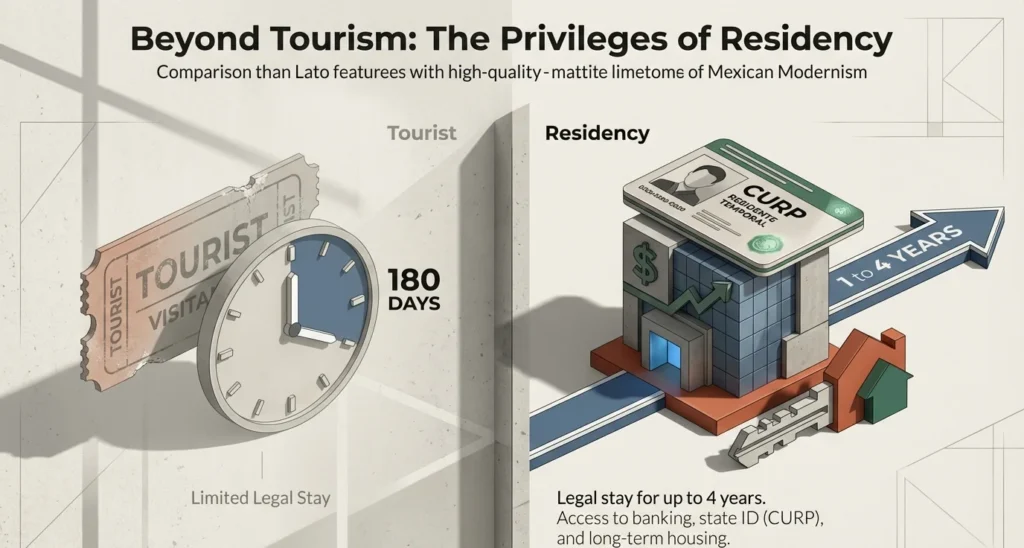
Unlike a tourist permit, temporary residency provides legal stay beyond six months and allows residents to obtain a CURP (Mexican ID number), open bank accounts, sign long-term leases, and register utilities.
Who Qualifies for Temporary Residency?
Temporary residency is generally available to applicants who can demonstrate one of the following:
• Sufficient monthly income from abroad
• Substantial savings or investment balances
• Property ownership in Mexico (in limited cases)
• Family ties to a Mexican citizen or resident
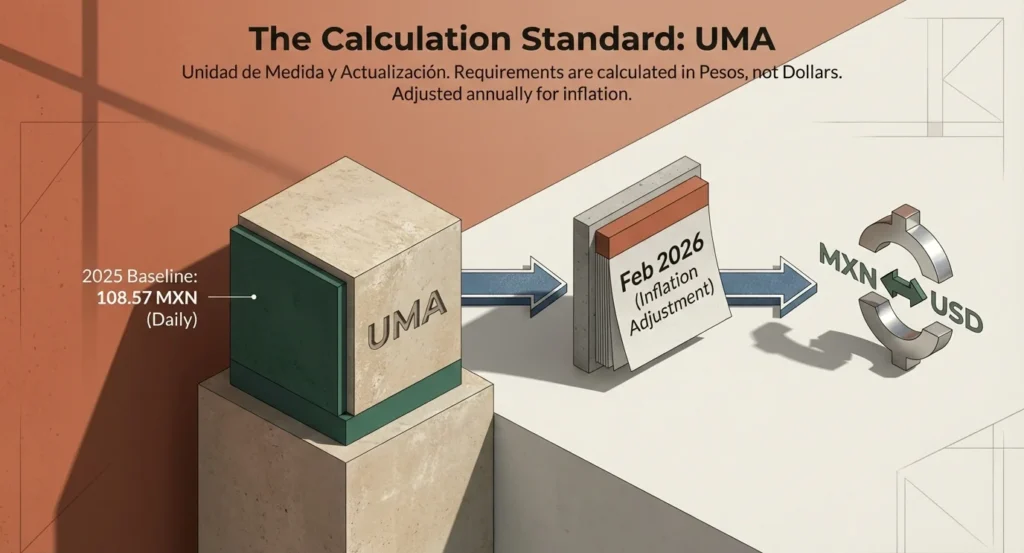
For most Americans, the qualifying route is financial solvency. The official financial criteria are tied to Mexico’s UMA (Unidad de Medida y Actualización), a government-published daily measurement unit used to calculate legal thresholds (Instituto Nacional de Estadística y Geografía – INEGI, UMA values: https://www.inegi.org.mx/temas/uma/).
The visa does not automatically authorize employment in Mexico. Separate work authorization is required if income will be generated locally.
How Long Is It Valid?
The temporary resident visa is initially issued for one year. After arrival in Mexico, the applicant converts the visa into a temporary resident card through INM. The card can then be renewed annually for up to a total of four years (INM official procedures: https://www.gob.mx/inm).
After four years of temporary residency, individuals may apply for permanent residency without needing to re-qualify financially.
For a broader overview of long-term visa categories, see the TAKVIEWER Retirement & Visa hub: https://takviewer.com/retirement-long-term-visa/
Mexico Temporary Resident Visa Income Requirement (2026)
The mexico temporary resident visa income requirement is calculated using multiples of the UMA. Because the UMA is updated annually and consulates convert the requirement into U.S. dollars, the final number varies slightly depending on exchange rates and local consular interpretation.
According to official guidelines published by multiple Mexican consulates in the United States, applicants must demonstrate either:
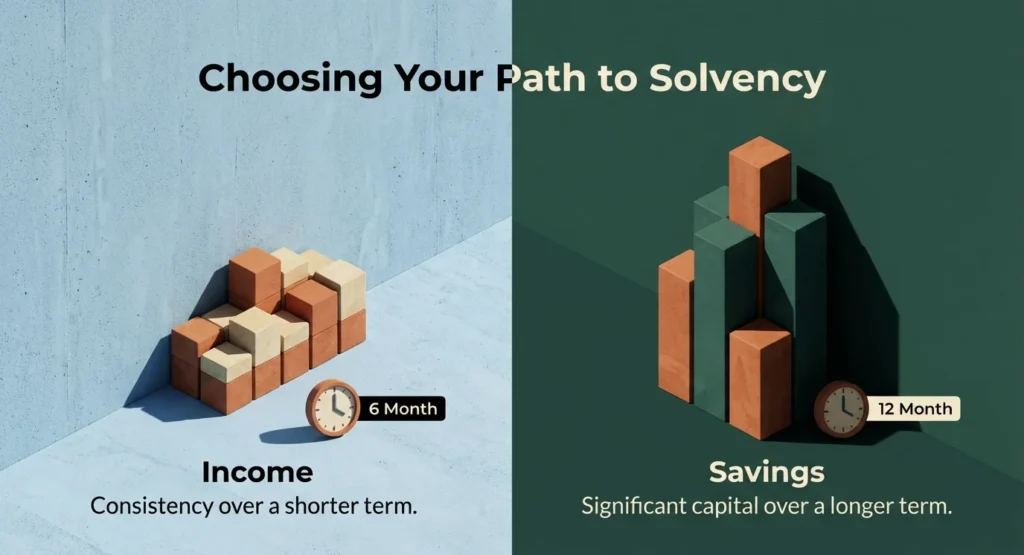
- Monthly income equivalent to approximately 300 times the daily UMA over the last six months
OR - Savings or investments equivalent to approximately 5,000 times the daily UMA over the last 12 months
(Example reference: Mexican Consulate in Los Angeles financial requirements page)
Minimum Monthly Income Requirement
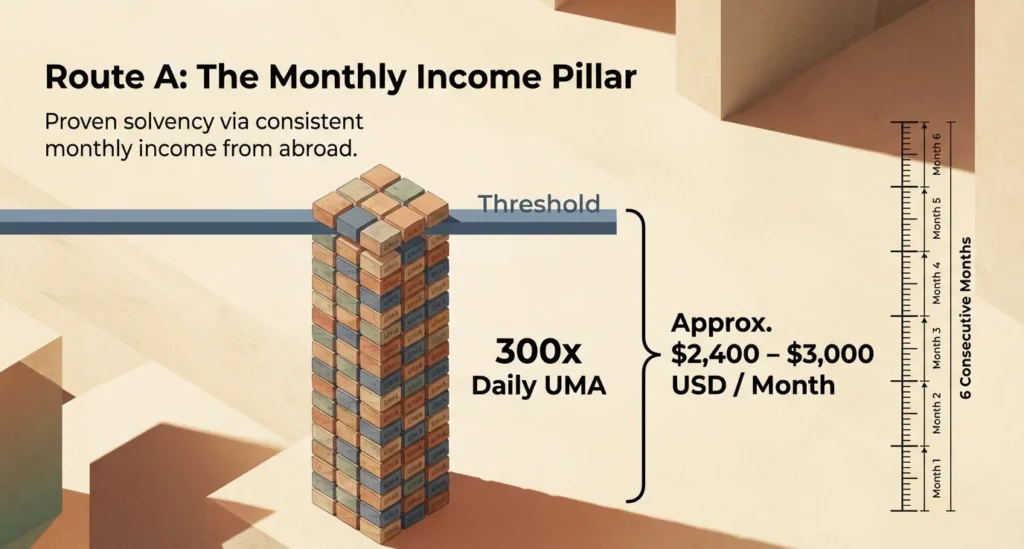
The UMA daily value is published annually by INEGI. For 2025, the daily UMA was set at 108.57 MXN (INEGI official publication). The 2026 value will be adjusted for inflation in February 2026.
Using the 300× multiplier framework commonly applied by consulates:
300 × Daily UMA ≈ Required monthly income threshold (in MXN)
Converted to U.S. dollars, recent consular thresholds have generally ranged between:
$2,400 – $3,000 USD per month (depending on consulate and exchange rate)
Most consulates require proof covering the previous six consecutive months.
Important clarification:
Some consulates apply slightly higher multipliers (e.g., 400× UMA), particularly in high-demand locations such as Los Angeles or Houston. Applicants should always verify directly with their selected consulate before scheduling an appointment.
Savings / Bank Balance Requirement
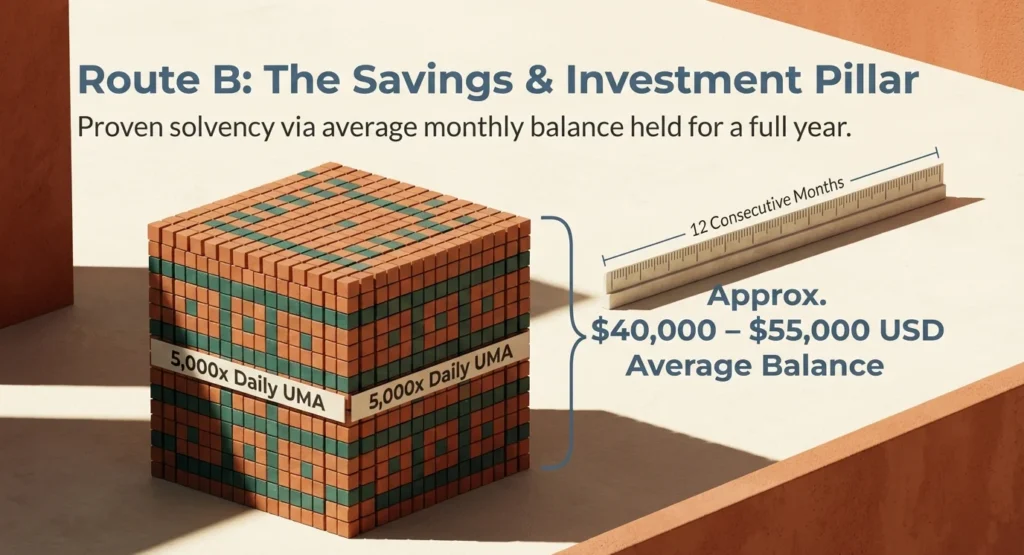
Applicants who do not meet the monthly income threshold may qualify based on savings.
The savings route is commonly calculated using approximately 5,000× the daily UMA.
This typically translates to a required average balance in the range of:
$40,000 – $55,000 USD maintained over the past 12 months
Consulates generally look at the average monthly balance, not just the closing balance of the most recent statement.
Eligible accounts may include:
• Checking accounts
• Savings accounts
• Brokerage accounts
• Retirement accounts (IRA, 401k)
Some consulates require that retirement accounts be fully vested and accessible.
Income Requirements for Married Couples
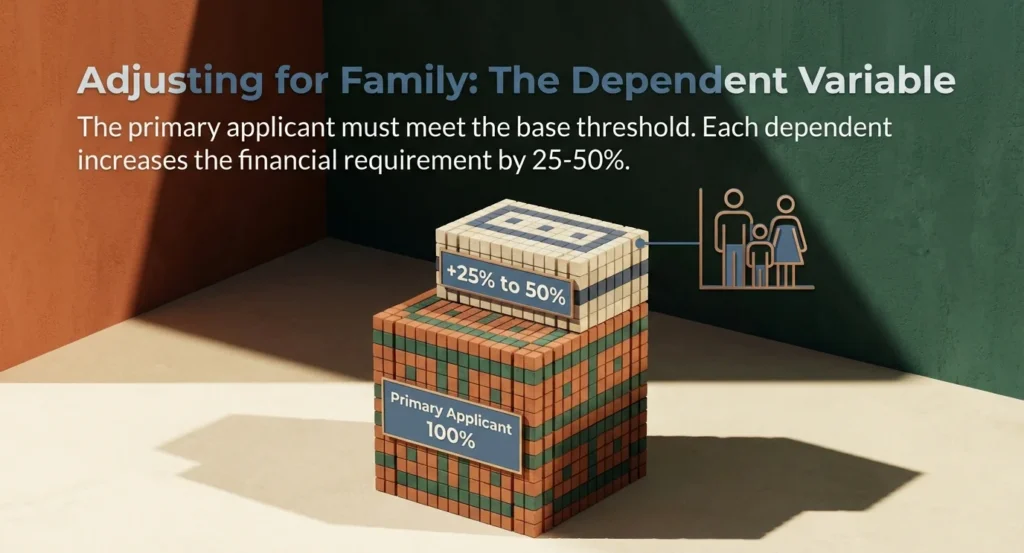
If applying with a spouse, the primary applicant must meet the base threshold. Most consulates require an additional percentage (commonly 25%–50%) for each dependent.
Example scenario:
If the base income threshold is $2,800 per month and a consulate requires an additional 25% for a spouse, the combined requirement would be approximately $3,500 per month.
Policies differ by consulate, and some do not allow two applicants to combine partial income amounts unless one clearly qualifies as the primary applicant.
Social Security as Proof of Income
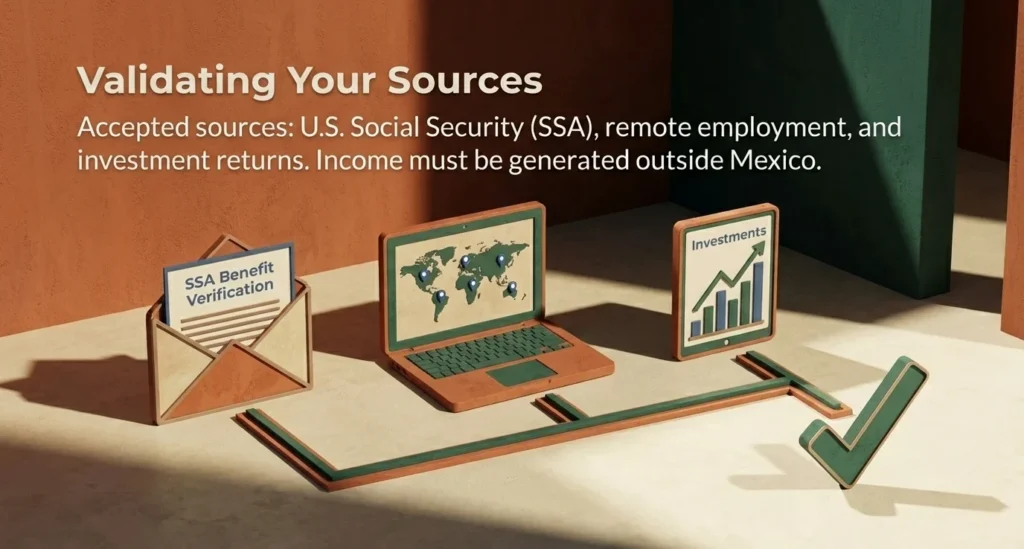
U.S. Social Security retirement benefits are widely accepted as qualifying income, provided the monthly amount meets the required threshold.
Consulates typically request:
• Official SSA benefit verification letter
• Bank statements showing direct deposit
• Six months of payment history
Applicants receiving Social Security below the required threshold may supplement with savings.
For a detailed breakdown, see: https://takviewer.com/cost-of-living/mexico/mexico-retirement-visa-cost
Required Financial Documents for the Mexico Temporary Resident Visa
Meeting the mexico temporary resident visa income requirement is only part of the process. Consulates require structured financial documentation that clearly demonstrates solvency under Article 44 of the Reglamento de la Ley de Migración (Government of Mexico, Reglamento de la Ley de Migración).
Documentation standards vary slightly by consulate, but the core financial evidence framework is consistent across Mexican consulates in the United States.
Bank Statements
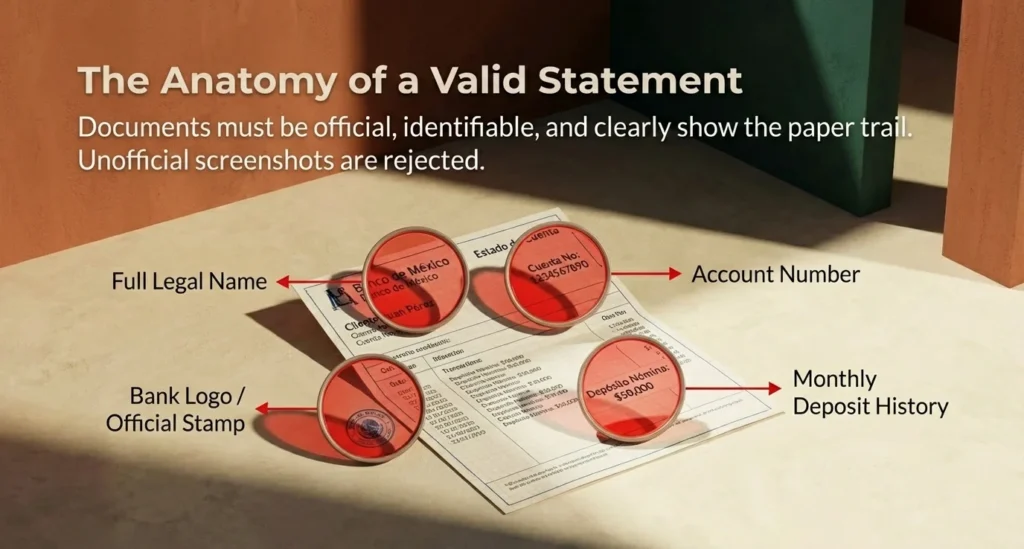
Most consulates require six consecutive months of bank statements when qualifying through income. When qualifying through savings, twelve months of statements are typically required to verify the average balance.
If you’re transferring funds internationally to build your qualifying balance, Wise offers transparent exchange rates with lower fees than traditional banks – https://takviewer.com/go/wise
According to the Mexican Consulate in Los Angeles visa guidelines , statements must:
• Show the applicant’s full legal name
• Display account numbers
• Be officially issued by the financial institution
• Clearly show monthly deposits and balances
Online screenshots without bank identification are commonly rejected. Many consulates request printed statements stamped by the bank or downloaded official PDF statements directly from the institution.
Consular officers focus on average balances, not just the most recent closing balance. A temporary spike in funds shortly before the appointment can trigger additional scrutiny.
Investment Accounts
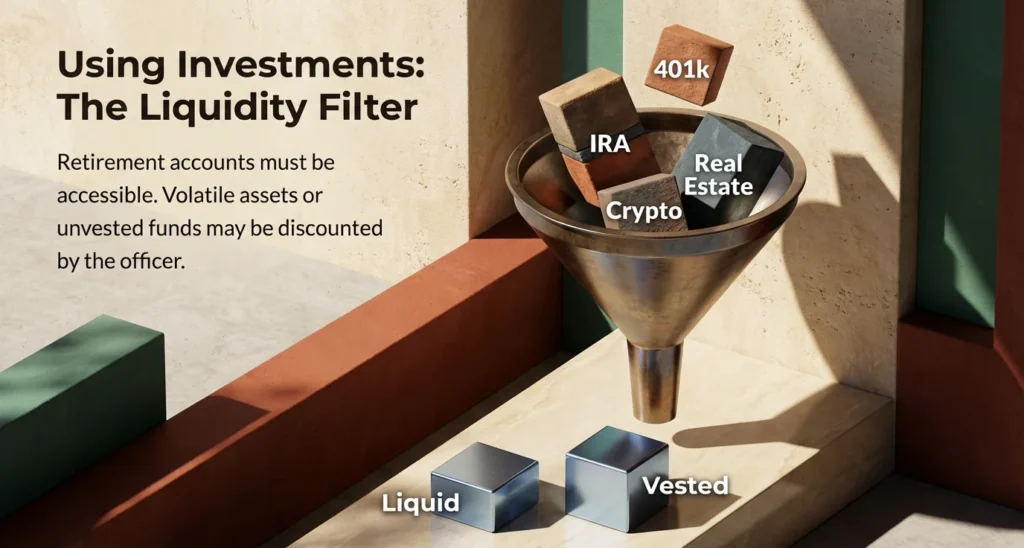
Brokerage accounts, retirement accounts, and other investment portfolios are frequently accepted if they meet liquidity standards.
The Mexican Consulate in Houston notes that investment accounts must show stable value over the required review period (https://consulmex.sre.gob.mx/houston/index.php/). Volatile accounts that fluctuate below the required threshold during the 12-month period may not qualify.
Acceptable accounts typically include:
• Brokerage accounts
• Mutual fund accounts
• IRA and 401(k) accounts
• Trust accounts with documented ownership
Some consulates request confirmation that retirement funds are vested and accessible. If early withdrawal penalties apply, officers may still accept the account as long as ownership and balance are clear.
Pension and Retirement Income Proof
Applicants qualifying through pension income must provide official verification documents.
For U.S. Social Security recipients, the Social Security Administration provides a Benefit Verification Letter that confirms monthly income (SSA official documentation page: https://www.ssa.gov/myaccount/proof-of-benefits.html).
Consulates generally require:
• SSA benefit letter
• Six months of bank deposits showing consistent receipt
• Identification matching the financial documents
Private pensions and annuities require formal statements from the issuing institution confirming monthly payout amounts. Lump sum distributions usually do not qualify as monthly income unless structured as recurring payments.
Translations and Certification Rules
Most Mexican consulates in the United States accept financial documents in English without requiring certified Spanish translations. However, if applying outside the U.S., translation rules may differ.
The Secretaría de Relaciones Exteriores confirms that consulates retain discretion over documentation review standards (Official SRE visa information).
Applicants should bring both original documents and printed copies. Digital-only documentation can delay processing if the consular officer cannot verify authenticity during the appointment.
Common Reasons Applications Get Rejected
Understanding refusal patterns reduces risk. Most denials occur due to documentation inconsistencies rather than complete ineligibility.
Inconsistent Income
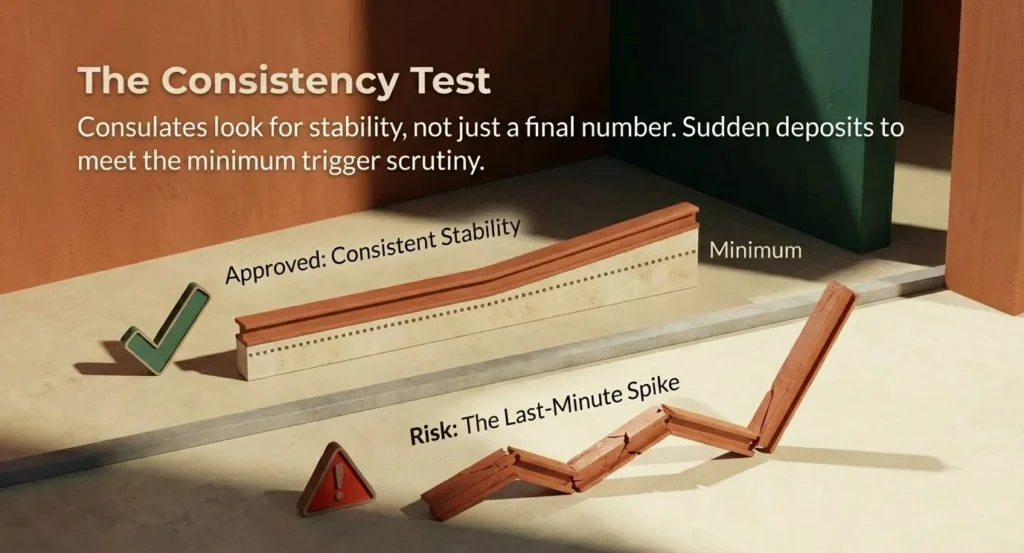
Irregular income deposits can create concern even when the total average meets the threshold.
Consular officers evaluate consistency over the required six-month period. Large gaps between deposits, fluctuating freelance payments, or unclear sources of income often require additional explanation.
Providing employer letters or contract documentation can reduce uncertainty when income varies.
Insufficient Savings
Applicants using the savings route must maintain the required average balance for the full 12-month review period.
If the balance falls below the required multiplier during any month, some consulates may determine that financial solvency has not been demonstrated for the full period.
This is particularly relevant for applicants who temporarily withdraw funds before their appointment.
Missing Documentation
Applications are frequently delayed due to:
• Incomplete statement history
• Illegible copies
• Name mismatches between passport and financial records
• Failure to provide required photocopies
Each consulate publishes its own checklist. Reviewing the specific checklist of the selected consulate before scheduling reduces administrative errors.
Temporary vs Permanent Residency Income Differences
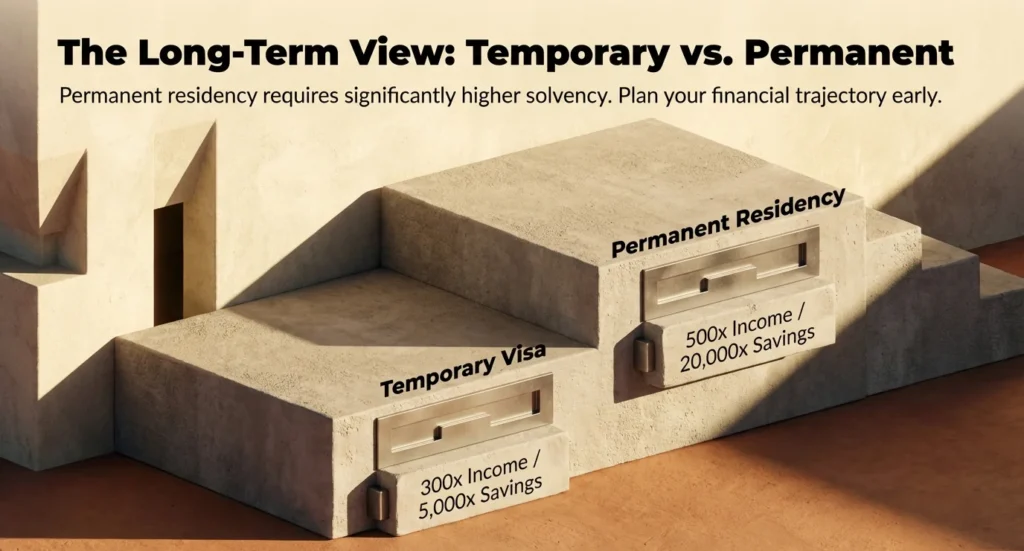
Financial thresholds differ significantly between temporary and permanent residency categories.
Under guidance published by the Mexican Consulate in New York (https://consulmex.sre.gob.mx/nuevayork/index.php), permanent residency typically requires a higher income or savings multiplier compared to temporary residency.
Financial Threshold Comparison
Temporary Residency (Typical Range):
• Approximately 300× daily UMA for monthly income
• Approximately 5,000× daily UMA for savings
Permanent Residency (Typical Range):
• Approximately 500× daily UMA for monthly income
• Approximately 20,000× daily UMA for savings
Because UMA values are updated annually by INEGI (https://www.inegi.org.mx/temas/uma/), these thresholds adjust each year based on inflation.
For a full breakdown of permanent residency requirements, see: https://takviewer.com/retirement-long-term-visa/
Which Option Is Better for Retirees?
Temporary residency offers lower initial financial requirements and a four-year pathway before transitioning to permanent status.
Permanent residency eliminates renewal requirements but demands significantly higher upfront financial qualification.
For retirees relying primarily on Social Security, temporary residency is often the more accessible starting point. Those with substantial investment assets may consider applying directly for permanent residency to avoid annual renewals.
Tax implications should also be reviewed before selecting a category. Mexico taxes residents on worldwide income under certain residency definitions (Servicio de Administración Tributaria guidance). U.S. citizens remain subject to worldwide taxation under IRS rules (IRS international taxation overview: https://www.irs.gov/individuals/international-taxpayers).
For broader financial planning considerations, see: https://takviewer.com/taxes-and-financial/
Is the Mexico Temporary Resident Visa Income Requirement Likely to Change?
The mexico temporary resident visa income requirement is tied directly to the UMA (Unidad de Medida y Actualización), which is updated annually by Mexico’s national statistics agency, INEGI. The official UMA value is published each February (INEGI official UMA index).
Because the financial thresholds are calculated as multiples of the daily UMA, any annual increase automatically raises the qualifying income and savings levels.
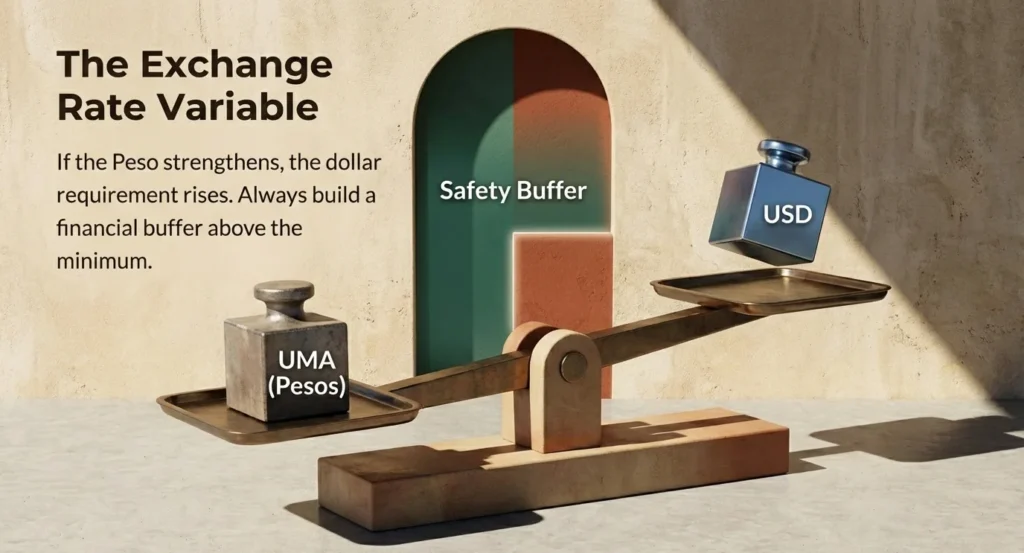
In addition to UMA adjustments, exchange rate fluctuations between the Mexican peso and the U.S. dollar can materially affect the dollar equivalent required by U.S.-based consulates. Consulates convert the UMA-based requirement into USD using internal calculation dates, which means two consulates may publish slightly different dollar figures at the same time.
Consular discretion also plays a role. Under Mexico’s Reglamento de la Ley de Migración, consulates retain authority to evaluate financial solvency. Some high-volume consulates apply higher multipliers than the baseline referenced in federal guidance.
For this reason, applicants should:
• Verify the requirement directly on their selected consulate’s website
• Confirm whether income, savings, or a combination will be evaluated
• Avoid relying on outdated blog figures
Because UMA adjustments are inflation-linked, gradual increases are expected over time. Sudden structural changes are less common unless federal migration policy is amended by Congress.
Strategic Planning Considerations Before Applying
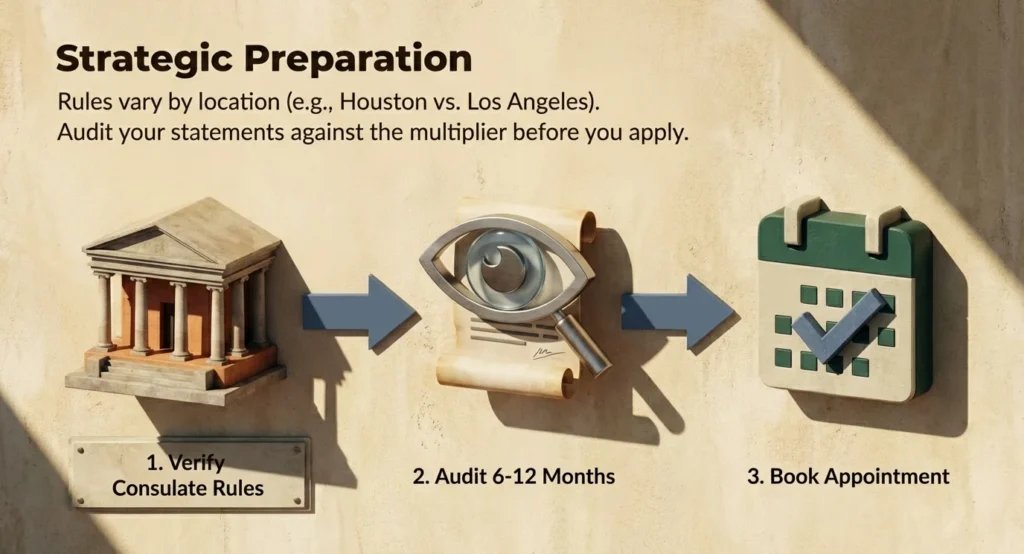
Meeting the published threshold does not automatically guarantee approval. Financial presentation and timing matter.
Applicants relying on monthly income should ensure that deposits are consistent and clearly traceable. Sudden deposits that elevate the average shortly before application may prompt additional review.
Those qualifying through savings should maintain the required balance comfortably above the threshold for the full 12-month review period. Maintaining a margin above the minimum reduces risk if exchange rates shift before the appointment.
Retirees should also evaluate broader relocation costs beyond visa qualification. Housing, healthcare, and lifestyle costs vary significantly by region. A full breakdown of living expenses is available in TAKVIEWER’s Cost of Living in Mexico guide: https://takviewer.com/cost-of-living/mexico/cost-of-living-in-mexico-2026-breakdown
For those evaluating whether their income level supports long-term relocation, see: https://takviewer.com/cost-of-living/mexico/monthly-budget-mexico
Applicants comparing visa categories should review the Permanent Residency financial thresholds here: https://takviewer.com/retirement-long-term-visa/
Frequently Asked Questions
How much monthly income do you need for Mexico temporary residency?
Most Mexican consulates calculate the requirement using a multiplier of the daily UMA published by INEGI . In recent years, this has translated to roughly $2,400–$3,000 USD per month depending on the consulate and exchange rate. Applicants must typically demonstrate six consecutive months of qualifying income.
Can Social Security qualify as proof of income?
Yes. U.S. Social Security benefits are generally accepted if the monthly amount meets the required threshold. Consulates typically request an official SSA Benefit Verification Letter along with bank statements showing consistent deposits.
How much money do you need in savings instead of income?
The savings route is commonly calculated using a multiplier of approximately 5,000× the daily UMA. Depending on the exchange rate and consulate interpretation, this often results in a required 12-month average balance in the range of $40,000–$55,000 USD. Applicants must show stability across the entire review period.
Do the requirements differ by Mexican consulate?
Yes. While the federal legal basis is the same nationwide under Mexico’s migration regulations , individual consulates may apply slightly higher multipliers or publish different USD equivalents. Always confirm directly with the consulate where you intend to apply.
Can a couple combine income to qualify?
Policies vary. In most cases, one primary applicant must independently meet the base income threshold. Some consulates allow partial income supplementation for dependents, often requiring an additional percentage above the base requirement. Applicants should verify the dependent calculation formula with their selected consulate before scheduling an appointment.
Does remote work income qualify for Mexico temporary residency?
Yes, as long as the income is earned outside Mexico and meets the required monthly threshold. Consulates generally accept remote employment income if it is consistent and documented through six months of bank statements and employer verification letters. The visa does not authorize working for a Mexican employer without separate permission under INM regulations .
How is the Mexico visa proof of income calculated exactly?
The calculation is based on a multiple of the daily UMA (Unidad de Medida y Actualización), which is published annually by INEGI . Consulates multiply the daily UMA by a set factor (commonly 300× for temporary residency) to determine the required monthly income. The final USD figure depends on exchange rate conversion at the time the consulate sets its internal threshold.
Can rental income be used to meet the mexico residency income requirement?
Yes, rental income may qualify if it is documented, stable, and supported by tax returns or lease agreements. Consulates typically require six months of consistent deposits that match the declared rental contracts. Irregular or undocumented rental income may require supplemental financial evidence.
Do you need to show income again when renewing temporary residency in Mexico?
In most cases, financial proof is required at the initial consulate application stage. Renewals conducted inside Mexico through INM generally do not require re-qualifying under the same financial multipliers unless status changes occur.
What happens if exchange rates change before your visa appointment?
Because the mexico visa financial requirements are based on UMA multiples converted into U.S. dollars, exchange rate shifts can affect the dollar equivalent. Some consulates update their published figures periodically, while others maintain a fixed USD threshold for administrative simplicity. Maintaining a financial buffer above the minimum reduces risk if currency fluctuations occur before approval.
To monitor and manage USD to MXN transfers in real time, many expats use Wise for predictable conversion rates – https://takviewer.com/go/wise