Table of Contents
- Who qualifies for a Thailand retirement visa?
- What financial requirements must you meet
- Required financial documents immigration actually checks
- Application process step by step
- Full cost breakdown for retirement visa holders
- Realistic monthly living cost for visa holders
- Comparison with other long-stay visa options
- Healthcare pricing retirees actually pay
- Tax reality for American retirees
- Financial mistakes that cause visa denial
- Renewal rules most applicants misunderstand
- Realistic financial scenarios
- Banking realities foreigners learn after arrival
- Risks and legal realities
- Practical cost comparison versus living in the United States
- How These Estimates Are Calculated
- Who This Guide Is For
- Internal planning resource
- Sources and Official References
- Frequently Asked Questions
This guide explains Thailand retirement visa financial requirements for foreigners who need exact income thresholds, proof rules, cost structures, and long-term financial realities before applying.
Who qualifies for a Thailand retirement visa?
Thailand offers retirement visas to foreigners age 50 or older who can prove stable finances and meet immigration screening standards.
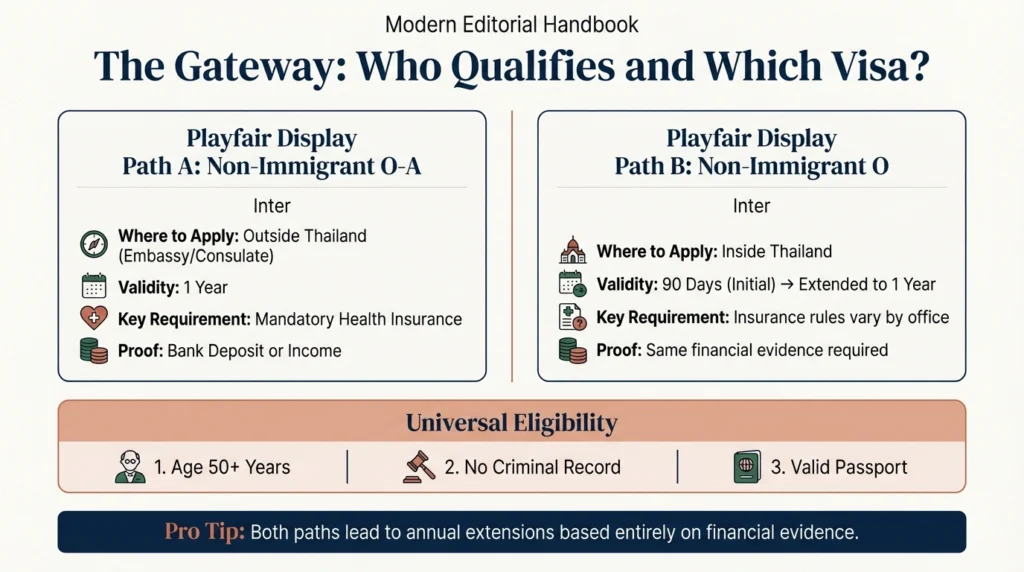
Basic eligibility:
- Age 50+
- No criminal record
- Valid passport
- Proof of financial capacity
- Health insurance if applying under certain visa Category
Both lead to annual extensions based entirely on financial evidence.
What financial requirements must you meet
Thailand immigration accepts three financial methods. Applicants must choose one.
Option 1. Bank deposit method
You must maintain:
- 800,000 THB in a Thai bank account
- About $22,500 USD
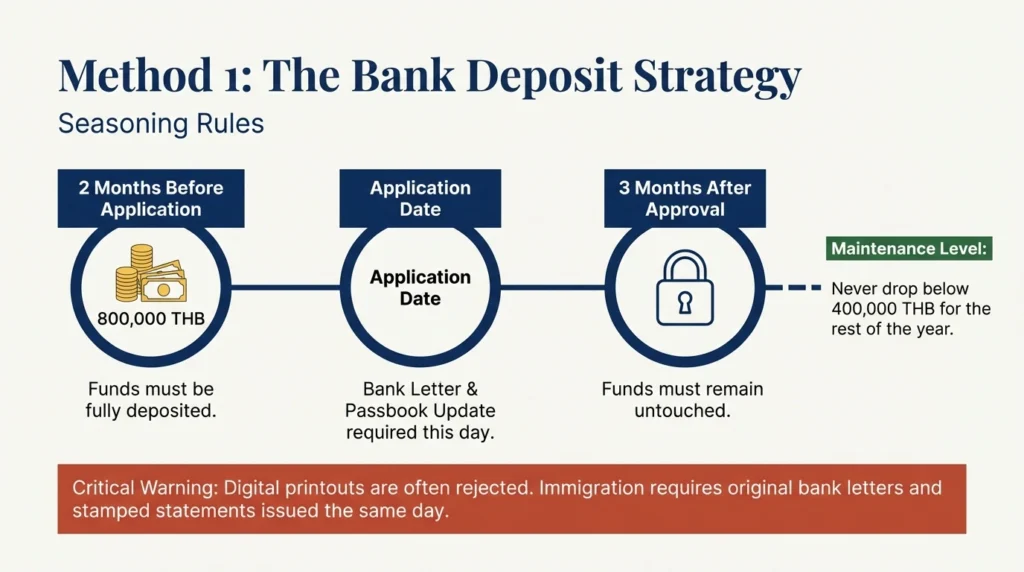
Rules:
Immigration checks bank letters and stamped statements. Digital printouts are rejected at many offices.
Option 2. Monthly income method
You must prove:
- 65,000 THB monthly income
- About $1,800 USD per month
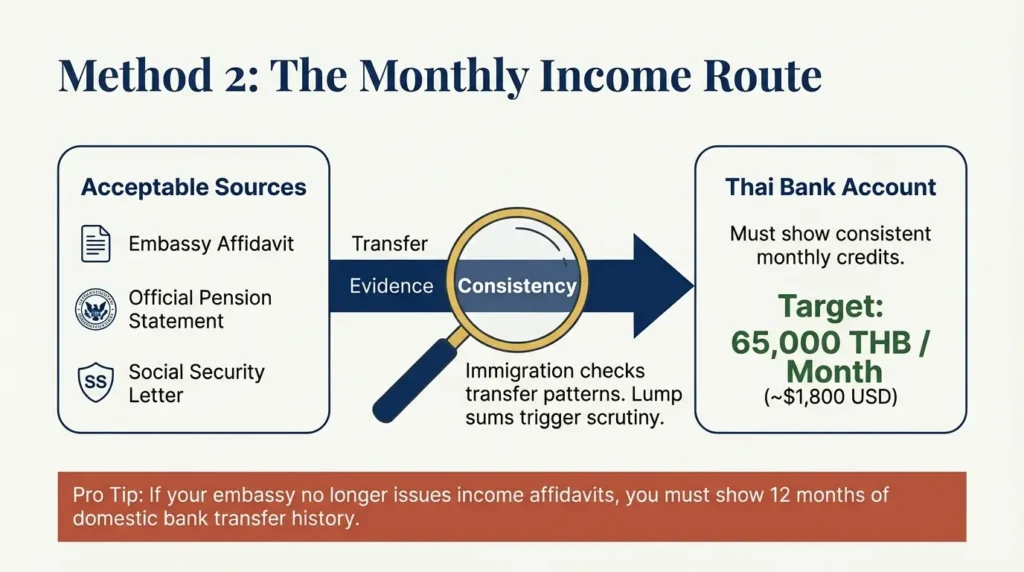
Proof methods accepted:
- Embassy income affidavit if available
- Pension statements
- Social Security letters
- Bank transfers showing monthly deposits
Immigration wants consistent deposits. Lump sums often trigger questions.
Here is where most people quietly lose money without realizing it.
You send $1,800. Your bank takes a spread on the exchange rate. By the time it lands in Thailand, you are at 63,400 THB instead of 65,000 and your renewal is suddenly a conversation instead of a stamp.
Most long-term expats we know solved this early by switching to Wise for monthly transfers. The rate you see is the rate that arrives, with no markup hidden in the conversion.
Option 3. Combination method
You can combine income and savings.
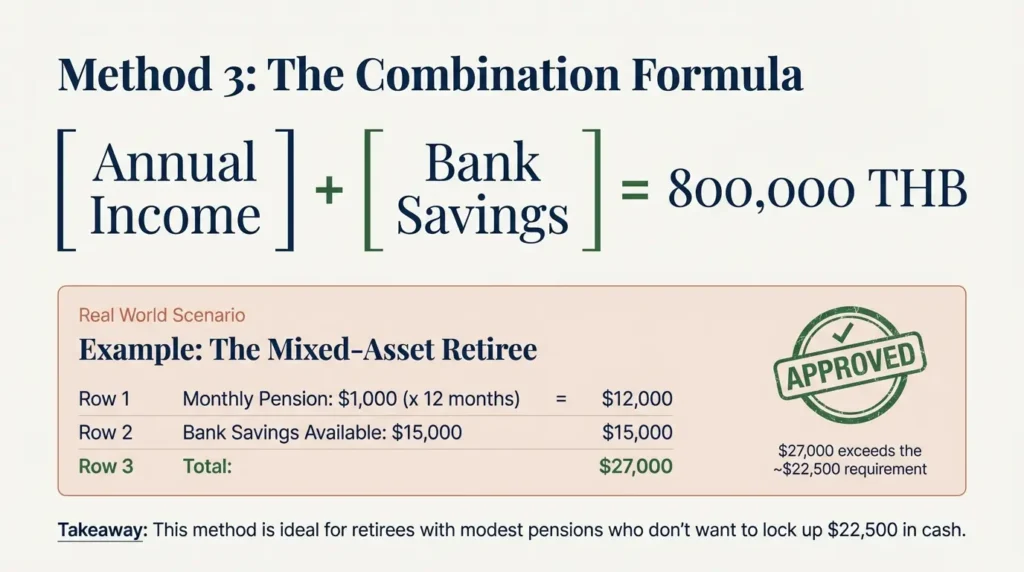
Example:
- Bank savings 400,000 THB
- Annual income 400,000 THB
This method is common for retirees with modest pensions.
Required financial documents immigration actually checks
Applicants often underestimate documentation standards. Immigration offices verify more than totals.
Required financial proof:
- Bank letter issued same day as application
- Updated passbook pages
- Certified bank statements
- Income proof originals
- Embassy certification if used
Photocopies without certification are rejected.
Some offices call banks to verify balances. Others check transfer patterns to confirm real income.
Application process step by step
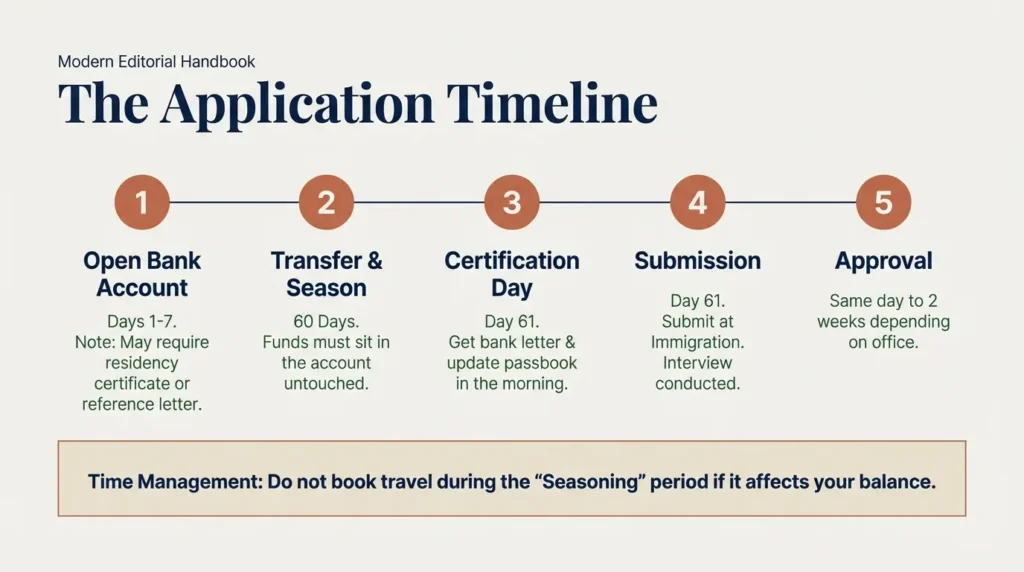
Financial proof affects approval speed more than paperwork volume.
Process:
- Open Thai bank account
- Transfer required funds
- Wait required seasoning period
- Obtain bank certification letter
- Submit visa application
- Attend immigration interview
- Receive approval stamp
Typical processing time:
| Stage | Time |
|---|---|
| Bank account opening | 1 to 7 days |
| Fund seasoning | 60 days |
| Immigration processing | Same day to 2 weeks |
Full cost breakdown for retirement visa holders
Visa cost is not the main expense. Compliance costs accumulate yearly.
Visa and immigration fees
| visa | Cost THB | USD |
|---|---|---|
| Initial visa fee | 2,000 | $55 |
| Annual extension | 1,900 | $52 |
| Re-entry permit | 1,000 | $27 |
| Multiple re-entry | 3,800 | $105 |
Banking and document costs
| letters | Typical Cost |
|---|---|
| Bank certification letter | $3 to $6 |
| Statement printing | $2 to $5 |
| Notary or certification | $10 to $25 |
Healthcare insurance costs
Required for O-A visa holders.
| Age | Annual Premium |
|---|---|
| 50–60 | $800 to $1,500 |
| 60–70 | $1,600 to $3,000 |
| 70+ | $3,500 to $6,000 |
Insurance is often the largest recurring cost for retirees.
Realistic monthly living cost for visa holders
Financial requirements only show minimum eligibility. Real living costs matter more.
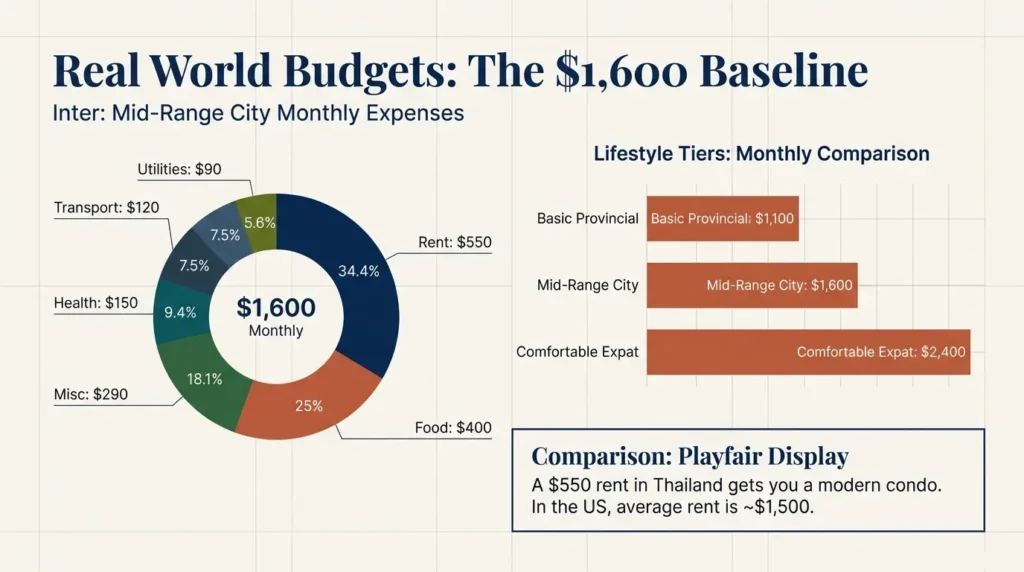
Typical monthly budgets:
| Lifestyle | Monthly Cost USD |
|---|---|
| Basic provincial | $1,100 |
| Mid-range city | $1,600 |
| Comfortable expat | $2,400 |
Breakdown example for $1,600 budget:
- Rent: $550
- Utilities: $90
- Food: $400
- Health: $150
- Transport: $120
- Misc: $290
Immigration does not assess living expenses. They only verify financial thresholds.
Comparison with other long-stay visa options
Some retirees choose alternatives with different financial rules.
| Visa | Deposit Requirement | Income Requirement | Notes |
|---|---|---|---|
| Retirement Visa | $22,500 | $1,800/mo | Annual renewal |
| LTR Wealthy Pensioner | $80,000 assets | $40,000 income | 10-year visa |
| Elite Visa | None | None | Pay fee instead |
Retirement visa remains the lowest financial entry path.
Healthcare pricing retirees actually pay
Medical cost matters because insurance is optional for some visa types but medical bills are not.
Typical private hospital prices:
| Treatment | Cost USD |
|---|---|
| Doctor visit | $25 to $60 |
| MRI scan | $300 to $900 |
| Hospital night | $150 to $500 |
| Minor surgery | $1,200 to $4,000 |
Many retirees choose insurance until age 70 then self-insure using savings.
Tax reality for American retirees
Thailand taxes residents on locally earned income. Foreign income rules depend on remittance timing and residency status.
Important facts:
- U.S. citizens must file U.S. taxes regardless of residence
- Social Security often remains taxable in U.S.
- Thailand does not tax foreign pensions if not remitted same year under current interpretation
Tax treaties exist but do not remove filing obligations.
CLICK HERE TO LEARN MORE ABOUT TAXES .
Financial mistakes that cause visa denial
Immigration rarely denies retirees for age or paperwork. Most rejections come from financial errors.
Common mistakes:
Depositing funds too late
Using borrowed money
Inconsistent income deposits
Missing bank certification
Incorrect balance duration
Officers check transaction history. Sudden large transfers before application can lead to rejection.
Renewal rules most applicants misunderstand
The annual extension process requires structured documentation and timing discipline.
A full step-by-step breakdown is explained in the Thailand visa renewal process for Americans guide.
You must:
- Maintain minimum bank balance after approval
- Provide updated statements yearly
- Repeat income verification
- Show residence address
Dropping below required balance before renewal can void eligibility.
Realistic financial scenarios
Scenario 1. Pension-only retiree
Income: $2,100 per month
Savings: $10,000
Outcome:
Qualifies using income method. No large deposit required.
Scenario 2. Savings-based retiree
Income: none
Savings: $50,000
Outcome:
Deposit method works. Must keep 800,000 THB in Thai bank yearly.
Scenario 3. Mixed income retiree
Income: $1,000/month
Savings: $15,000
Outcome:
Combination method allowed. Must show annual total equals 800,000 THB.
Banking realities foreigners learn after arrival
Opening a Thai bank account is not automatic.
Possible requirements:
- Local address
- Visa type
- Reference letter
- Minimum deposit
Branch discretion matters. Some branches refuse foreigners while others approve same day.
Risks and legal realities
Retirement visas are conditional status, not residency.
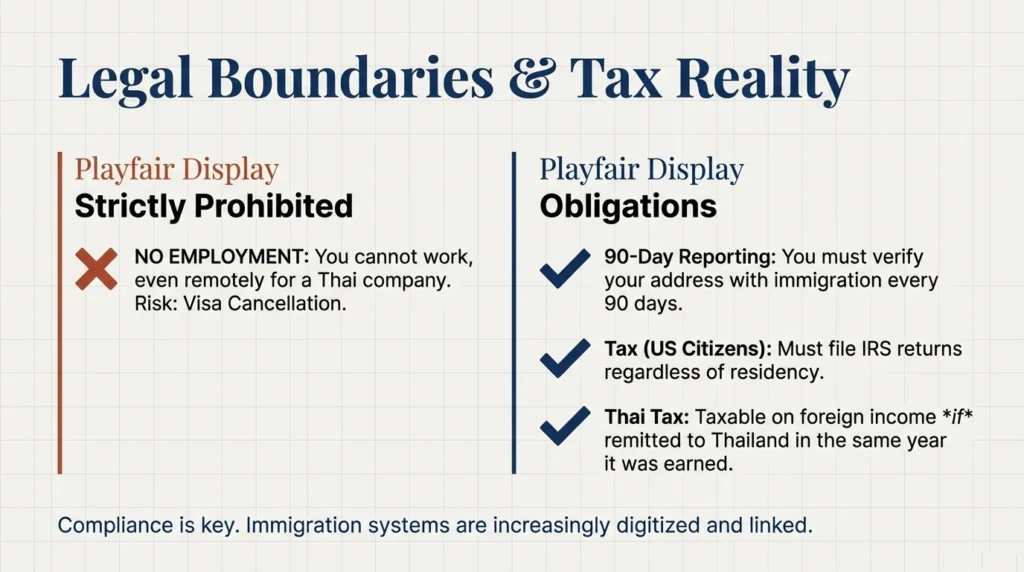
Limitations:
- Cannot legally work
- Must report address every 90 days
- Must maintain financial proof
- Must renew yearly
Failure to meet financial rules cancels extension.
Practical cost comparison versus living in the United States
| Expense | Thailand | U.S. Average |
|---|---|---|
| Rent | $550 | $1,500 |
| Doctor visit | $40 | $180 |
| Meal | $3 to $8 | $15 to $25 |
| Utilities | $90 | $220 |
Financial thresholds for visas look high but daily living costs are lower than U.S. averages.
How These Estimates Are Calculated
Retirement visa financial estimates are based on officially published income requirements, savings thresholds, government fee schedules, and renewal cost structures. Documentation rules are reviewed across multiple consulates where applicable. Healthcare pricing and cost of living assumptions are aligned with current market data and expat-reported expense ranges to ensure practical planning accuracy.
Who This Guide Is For
This guide is designed for Americans considering a retirement visa and long-term residency abroad. It focuses on income requirements, savings qualification, tax exposure, healthcare costs abroad, and financial sustainability. It is not intended for short-term visitors or casual travel planning.
Internal planning resource
Serious applicants should review the full Thailand Relocation Guide before choosing a visa route. It outlines banking, housing contracts, tax setup, and healthcare decisions in correct order.
Sources and Official References
This article is based on official regulations and publicly available government sources:
- Thai Immigration Bureau – Retirement Visa Extension Requirements
https://www.immigration.go.th - Ministry of Foreign Affairs of Thailand – Non-Immigrant Visa Category O-A
https://www.mfa.go.th - Royal Thai Embassy Washington D.C. – Non-Immigrant O-A Visa Requirements
https://thaiembdc.org - U.S. Embassy Bangkok – Notarial Services and Income Affidavit Guidance
https://th.usembassy.gov - Thai Revenue Department – Personal Income Tax Overview
https://www.rd.go.th - Bangkok Hospital – International Patient Pricing Information
https://www.bangkokhospital.com
Financial thresholds reflect officially published 800,000 THB deposit or 65,000 THB monthly income requirements enforced by Thai Immigration.
Frequently Asked Questions
How much money do you need in the bank for a Thailand retirement visa?
You need 800,000 THB or about $22,500 USD deposited in a Thai bank account. Funds must be there at least two months before application and cannot drop below required levels during the year.
Can Social Security count as income for the visa?
Yes. Immigration accepts Social Security as proof if you show official statements and consistent monthly transfers into your Thai account.
Do you have to keep 800,000 THB in the account forever?
No. After approval you can reduce the balance to 400,000 THB, but you must restore it before renewal and meet timing rules again.
Is health insurance mandatory?
Insurance is mandatory for O-A visas. Extensions inside Thailand may not require it, but medical costs without coverage can be high.
Can you work with a retirement visa?
No. Any employment violates visa conditions and can lead to cancellation.
What is the cheapest way to qualify financially?
The income method is usually cheapest. If your pension exceeds 65,000 THB per month, you do not need a large bank deposit.

Thailand Retirement Visa Income Requirement 2026
This guide explains Thailand retirement visa income requirement 2026, including exact monthly income thresholds, proof standards, document rules, cost implications,…

Can Americans Use Savings for Thailand Retirement Visa Financial Requirements?
This guide explains whether Americans can use savings for Thailand retirement visa financial requirements, how much is required, what proof…

Thailand Visa Extension Cost Breakdown for Americans in 2026
This guide explains the Thailand visa extension cost breakdown for Americans living long term, including official immigration fees, financial proof…
Thailand Overstay Fine Explained Real Costs for Americans
This guide explains the Thailand overstay fine real costs, including daily penalties, maximum caps, detention risk, deportation consequences, visa extension…