Table of Contents
- What income amount must you prove?
- What types of income does Thai immigration accept?
- What documents are required to prove income?
- How should income be transferred into Thailand?
- Cost breakdown of income-based retirement extension
- Income method vs savings method comparison
- What if your income fluctuates?
- Renewal rules for income-based retirement
- Healthcare cost planning when using income method
- Tax clarity for Americans using income qualification
- Real income scenarios
- Common income proof mistakes
- When income method makes more sense?
- Frequently Asked Questions
This guide explains how to show income proof for Thailand retirement visa, including accepted income sources, document standards, bank verification rules, cost breakdown, renewal procedures, tax clarity, and common rejection reasons Americans face.
This applies to retirement extensions based on the monthly income method.
What income amount must you prove?
To qualify using income instead of savings, you must show:
65,000 THB per month
Approximately $1,800 USD per month
Annual equivalent:
780,000 THB per year
Approximately $21,600 USD
Official criteria are published by the Thai Immigration Bureau.
Income must be consistent and verifiable.
What types of income does Thai immigration accept?
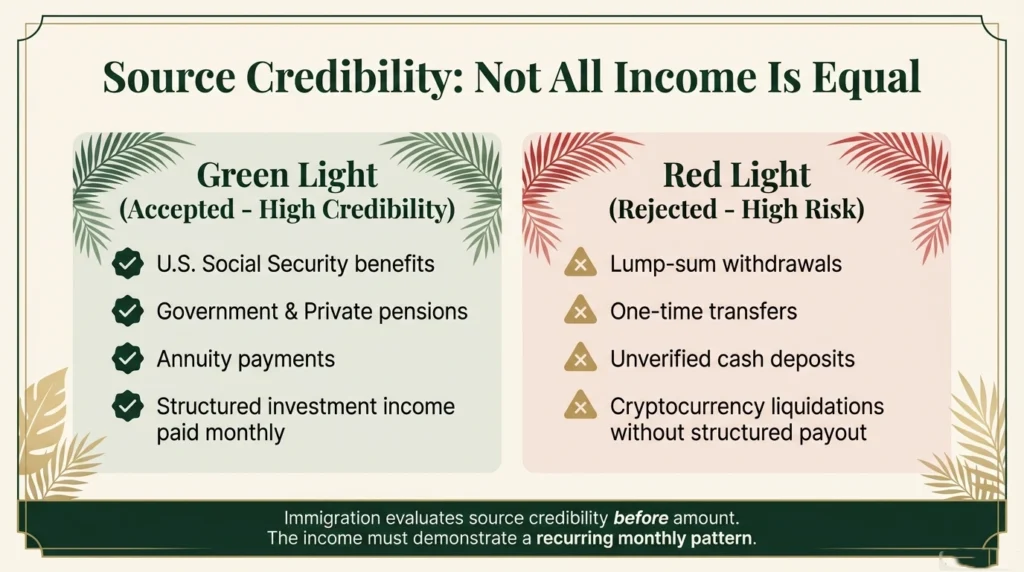
Immigration evaluates source credibility before amount.
Accepted income sources:
- U.S. Social Security benefits
- Government pensions
- Private pensions
- Annuity payments
- Structured investment income paid monthly
Not accepted alone:
- Lump-sum withdrawals
- One-time transfers
- Unverified cash deposits
Income must show recurring monthly pattern.
For full financial threshold details, review Thailand retirement visa financial requirements inside the Retirement & Long-Term Living section.
What documents are required to prove income?
Immigration requires certified documentation.
Required proof documents
- Official pension or Social Security letter
- Recent bank statements showing monthly deposits
- Same-day Thai bank certification letter
- Updated passbook pages
- Passport copies
Embassy income affidavits are no longer issued by some embassies. Bank deposit history is now the primary proof method.
How should income be transferred into Thailand?
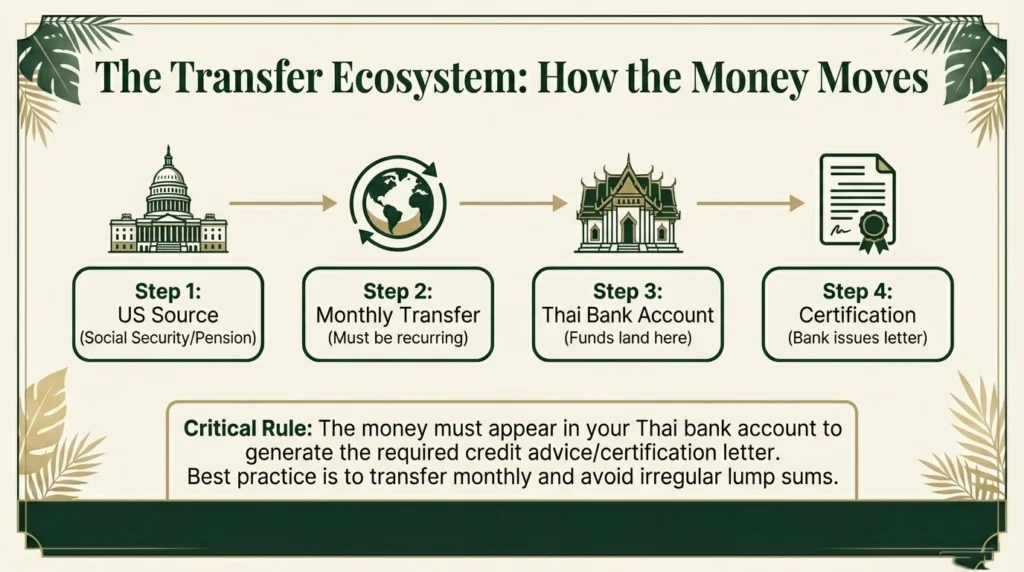
Income must appear in a Thai bank account.
Best practice:
- Transfer monthly into your Thai account
- Maintain deposit amount at or above 65,000 THB equivalent
- Avoid irregular lump-sum transfers
Exchange rate fluctuations can reduce deposit below required threshold.
Example:
If USD weakens, $1,800 may convert to less than 65,000 THB.
Consistent margin above minimum reduces risk.
Cost breakdown
of income-based retirement extension
Income qualification avoids locking $22,500 but still has costs.
Immigration and documentation cost
| – | THB | USD |
|---|---|---|
| Extension fee | 1,900 | $52 |
| Bank certification | 100–200 | $3–6 |
| Statement printing | 100 | $3 |
| Photos and copies | 100 | $3 |
Estimated annual compliance cost: $60–90
Income method vs savings method comparison
| Category | Income Method | Deposit Method |
|---|---|---|
| Monthly proof required | Yes | No |
| Capital lock | None | $22,500 |
| Scrutiny level | Higher | Lower |
| Exchange rate exposure | Yes | No |
| Liquidity impact | Low | High |
If comparing both methods, review Can Americans Use Savings for Thailand Retirement Visa for full breakdown.
What if your income fluctuates?
Immigration reviews recent months before renewal.
If any month falls below 65,000 THB equivalent:
- Officers may question qualification
- You may need to supplement with savings
- Renewal can be delayed
Maintaining $2,000 monthly equivalent provides safety margin.
Renewal rules for
income-based retirement
You must prove income every year.
Renewal requires:
- Updated pension statements
- Recent Thai bank statements
- Fresh bank certification letter
- Address verification
Past approval does not guarantee future approval.
Healthcare cost planning when using income method
Income qualification does not cover medical expenses.
Typical private hospital pricing:
| Treatment | USD |
|---|---|
| Doctor visit | $30–60 |
| MRI | $300–900 |
| Hospital night | $150–500 |
(Hospital pricing example.)
Insurance for retirees 60–70 often costs $1,600–3,000 annually.
Healthcare costs without insurance can exceed annual extension fees quickly.
Your entire annual extension costs around $60.
One MRI in a Bangkok private hospital costs $300 to $900.
That math is why most long-term residents do not stay uninsured past their first year. VisitorsCoverage is where most people start when pricing international health plans for Thailand.
You put in your age, see real monthly numbers, and know exactly what to budget before your next renewal cycle.
Tax clarity for Americans using income qualification
Income proof does not change tax obligations.
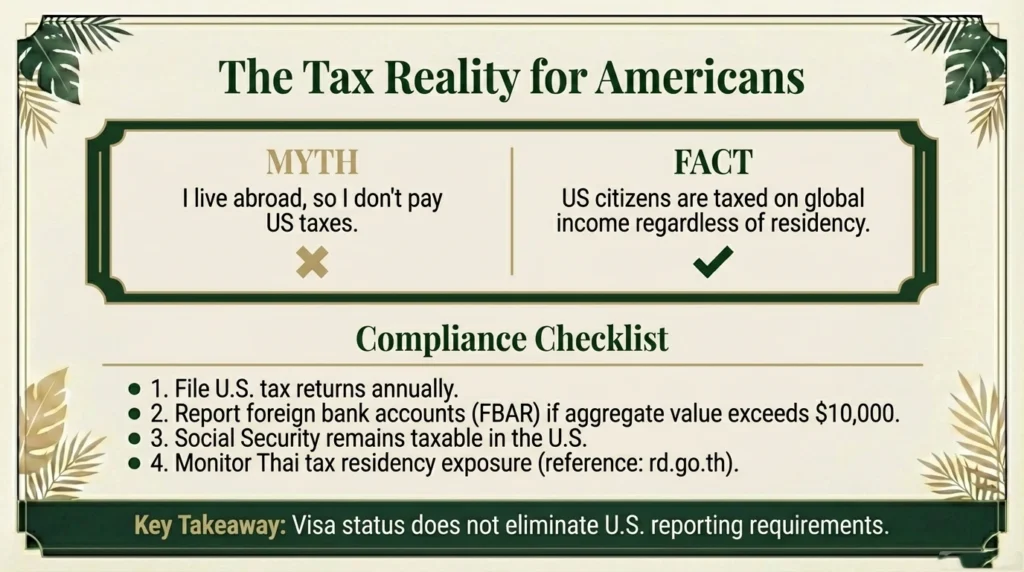
Americans must:
- File U.S. tax returns annually
- Report foreign bank accounts if required
- Monitor Thai tax residency exposure
(Thai Revenue Department reference.)
Social Security may remain taxable in the U.S. even if living abroad.
Visa status does not eliminate U.S. reporting requirements.
Real income scenarios
Scenario 1: Social Security only
Monthly benefit: $1,950
Converts above 65,000 THB
Qualifies if transferred monthly.
Scenario 2: Pension plus dividends
Pension: $1,200
Dividends: $800
Total: $2,000
Qualifies if both sources documented and deposited regularly.
Scenario 3: Irregular freelance income
Variable deposits
Often rejected due to inconsistency.
Income must appear structured and stable.
Common income proof mistakes
- Depositing once every few months
- Not maintaining Thai bank account
- Relying solely on U.S. statements
- Ignoring exchange rate drop
- Missing bank certification letter
Most income proof problems are not caused by earning too little.
They are caused by how the income is documented and transferred.
The most common mistake is irregular deposits.
Immigration expects to see a clear, consistent monthly pattern that aligns with the 65,000 THB requirement.
If you transfer money every two or three months in larger amounts, officers may question whether the income is truly structured retirement income or simply discretionary savings being moved around.
Another frequent issue is relying only on U.S. pension statements.
Showing a Social Security letter is not enough on its own.
Immigration wants to see the funds physically arriving in your Thai bank account.
Matching monthly deposits inside Thailand are critical.
Exchange rate fluctuation creates hidden risk.
If you transfer exactly $1,800 and the dollar weakens that month, your deposit may convert below 65,000 THB.
Even a small shortfall can complicate renewal.
Maintaining a margin above the minimum reduces exposure.
This is the part that catches people off guard every year.
Your pension did not change. Your lifestyle did not change. But one bad exchange rate day and your deposit lands at 63,800 THB instead of 65,000, and suddenly you are back at the immigration office explaining yourself.
The expats we see handling this cleanly use Wise for OUR monthly transfers. It converts at the real mid-market rate, shows you exactly what arrives before you send, and removes the guesswork that turns a routine renewal into a stressful one.
I have personally met retirees in Thailand who were fully qualified on paper.
They had legitimate pensions and long-term retirement visas.
But because they skipped a month of transfers, consolidated payments, or relied on irregular dividend income, renewal became stressful.
The income was real.
The pattern was not structured correctly.
Another mistake is failing to obtain a same-day bank certification letter.
Immigration officers do not rely solely on printed statements.
They often require official bank confirmation issued the day of application.
The underlying reality is simple.
Immigration evaluates consistency, traceability, and timing more than headline income amount.
A disciplined monthly transfer schedule, properly stamped statements, and proactive exchange rate monitoring prevent most income-based renewal problems before they start.
When income method makes more sense?
Income qualification works best if:
- You receive steady pension
- You prefer liquidity over large deposit
- You do not want $22,500 locked in Thai bank
- You are comfortable with annual documentation
If planning long-term retirement relocation, review the Thailand Relocation Guide before choosing income versus deposit method.
Frequently Asked Questions
How do I prove income for Thailand retirement visa?
You must show official pension or Social Security documents and matching monthly deposits of at least 65,000 THB into your Thai bank account.
Can I use Social Security as income proof?
Yes. Social Security qualifies if documented and deposited consistently.
What if exchange rates drop below 65,000 THB?
You may need to transfer additional funds. Falling below threshold can cause renewal problems.
Is embassy income affidavit required?
Not necessarily. Many immigration offices now rely primarily on bank deposit history.
Can I combine income and savings?
Yes. Annual income plus bank balance must equal 800,000 THB.
Is income method cheaper than deposit method?
Yes in liquidity terms. You avoid locking $22,500 but must provide stronger documentation yearly.

Thailand Retirement Visa Financial Requirements Explained
This guide explains Thailand retirement visa financial requirements for foreigners who need exact income thresholds, proof rules, cost structures, and…

Thailand Retirement Visa Income Requirement 2026
This guide explains Thailand retirement visa income requirement 2026, including exact monthly income thresholds, proof standards, document rules, cost implications,…

Can Americans Use Savings for Thailand Retirement Visa Financial Requirements?
This guide explains whether Americans can use savings for Thailand retirement visa financial requirements, how much is required, what proof…

Thailand Visa Extension Cost Breakdown for Americans in 2026
This guide explains the Thailand visa extension cost breakdown for Americans living long term, including official immigration fees, financial proof…