

Table of Contents
- Who qualifies based on income in 2026
- What monthly income is required in 2026
- What counts as acceptable income proof
- Documents required to verify income
- Income proof methods compared
- Cost of qualifying using income method
- Comparison with bank deposit method
- Real income scenarios immigration accepts
- Healthcare budgeting tied to income level
- Taxes on retirement income in Thailand
- Application timeline when qualifying by income
- Risks specific to income-based applicants
- Renewal rules for income qualification
- Comparison with other long-stay visas requiring income
- Real monthly living cost relative to income
- Internal planning resource
- Frequently Asked Questions
- Sources and Official References
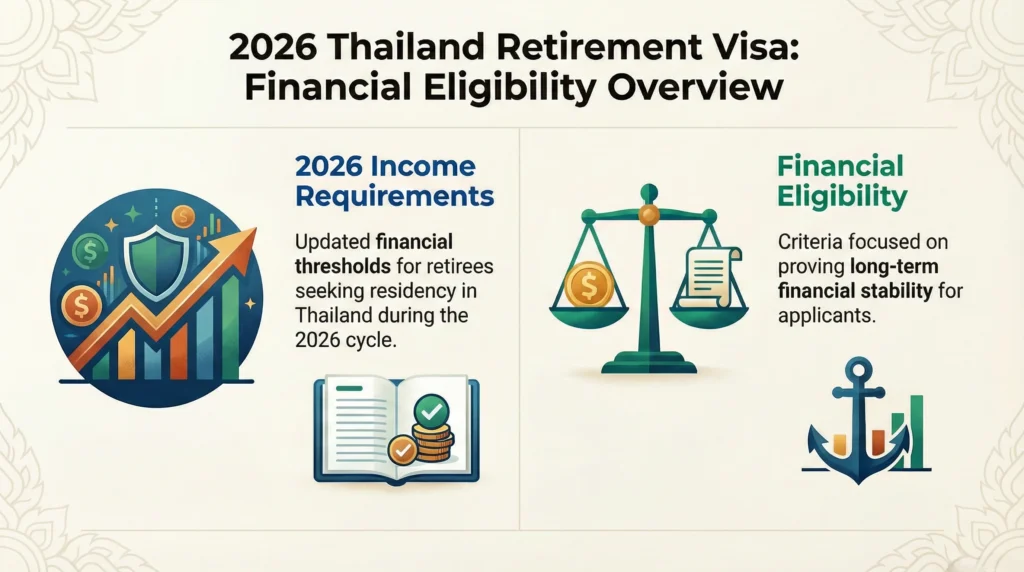
This guide explains Thailand retirement visa income requirement 2026, including exact monthly income thresholds, proof standards, document rules, cost implications, and how immigration evaluates financial eligibility for retirees.
Who qualifies based on income in 2026
Thailand allows foreigners age 50 or older to qualify for retirement status using income alone if they meet minimum verified earnings.
Eligibility basics:
- Age 50+
- Valid passport
- No criminal history
- Verified income meeting threshold
- Stable financial pattern
Income must be predictable and documented. Immigration focuses on consistency more than total wealth.
What monthly income is required in 2026
The income threshold for retirement qualification in 2026 remains the same.
To qualify using the income method, you must show:
65,000 THB per month
Approximately $1,800 USD per month
On an annual basis, that equals:
780,000 THB per year
Approximately $21,600 USD
This requirement applies to:
- Non-Immigrant O retirement extensions processed inside Thailand
- Non-Immigrant O-A retirement visas issued from abroad
There is no reduced income threshold for applicants over 60, 70, or older. Age does not lower the requirement.
What immigration looks for is consistency. The 65,000 THB must appear as structured monthly income, not irregular transfers.
For example, I met a retired American in Chiang Mai who relied entirely on Social Security.
His benefit was around $1,920 per month. On paper, he qualified comfortably. But during one renewal cycle, the exchange rate shifted, and one month’s transfer converted to slightly below 65,000 THB.
Immigration flagged it and asked for clarification. He had to transfer additional funds and provide updated bank documentation before approval was granted.
The income requirement itself is straightforward.
The practical risk is currency fluctuation and transfer timing.
Maintaining a buffer above the minimum, such as transferring the equivalent of $2,000 per month, reduces renewal stress and protects against exchange rate movement.
Most retirees who qualify by income use Wise to send their monthly transfers to Thailand.
It converts at the real exchange rate, which means your $2,000 actually arrives closer to $2,000 worth of baht instead of shrinking at the bank counter.
When immigration is counting every baht, that margin matters.
What counts as acceptable income proof
Immigration evaluates income source credibility before approving extensions.
Accepted income sources:
- Government pensions
- Social Security payments
- Employer pensions
- Annuities
- Documented investment income
Not accepted alone:
- Cash savings
- Unverified transfers
- Informal payments
Proof must show ongoing monthly payments, not a one-time deposit.
Documents required to verify income
Immigration offices expect originals or certified copies.
Required documentation:
- Official income letter or pension statement
- Bank statement showing deposits
- Embassy income affidavit if available
- Bank certification letter
- Updated passbook
Statements without matching deposits often trigger additional review.
Income proof methods compared
| Method | Reliability Rating | Immigration Preference | Notes |
|---|---|---|---|
| Embassy certification | High | Preferred | Not all embassies issue |
| Bank deposit history | Very High | Most accepted | Must show monthly pattern |
| Pension statements | High | Accepted | Must match transfers |
| Self-declared income | Low | Rarely accepted | Often rejected |
Immigration officers verify patterns. Consistency outweighs high totals.
Cost of qualifying using income method
Using the income method allows you to qualify without locking 800,000 THB in a Thai bank account.
That protects liquidity, but it does not eliminate compliance costs.
The base immigration fee remains 1,900 THB (about $52 USD) per year.
You will also pay for a same-day bank certification letter, printed statements, passport copies, and photos.
Individually these amounts are small, but they are required every renewal cycle.
Transport should also be factored in.
Whether it is fuel, taxi fares, or time off work, the visit to immigration has a real cost.
Below is a realistic annual breakdown for income-based qualification:
| – | Estimated Cost (USD) |
|---|---|
| Immigration extension fee | $52 |
| Bank certification letter | $4–6 |
| Statement printing & copies | $5–10 |
| Photos & small admin costs | $5 |
| Transportation | $10–20 |
| Estimated yearly total | $80–120 |
The income method is usually the cheapest legal path because you avoid tying up approximately $22,500 USD in capital.
However, it requires consistent monthly deposits, proper documentation, and attention to exchange rate fluctuations.
Financially cheaper does not mean administratively easier.
Comparison with bank deposit method
| Requirement Type | Income Method | Deposit Method |
|---|---|---|
| Monthly requirement | $1,800 | None |
| Savings requirement | None | $22,500 |
| Liquidity needed | Low | High |
| Flexibility | High | Low |
| Immigration scrutiny | Medium | Low |
Deposit method is simpler. Income method requires stronger documentation.
Real income scenarios immigration accepts
Scenario 1. U.S. retiree pension
Monthly pension: $2,300
Result: Meets requirement with margin.
Scenario 2. Social Security only
Monthly benefit: $1,750
Result: Below threshold. Must combine with savings.
Scenario 3. Mixed retirement income
Social Security: $1,200
Investment dividends: $900
Result: Qualifies if deposits verified monthly.
Healthcare budgeting tied to income level
Income determines practical healthcare planning.
Typical monthly medical budget:
| Income Level | Recommended Health Allocation |
|---|---|
| $1,800 | $120 |
| $2,500 | $200 |
| $3,500 | $300 |
Private hospitals charge:
- Doctor visit: $30 to $60
- Specialist consult: $80
- ER visit: $150
Retirees with minimal income often skip insurance. Higher income applicants usually maintain coverage.
Skipping coverage is a risk most retirees regret the first time they need a specialist or an overnight stay.
VisitorsCoverage lets you compare international health plans built for long-term residents in Thailand, starting at rates that fit comfortably inside a $1,800 monthly budget.
Getting a quote takes three minutes and gives you a real number to plan around.
Taxes on retirement income in Thailand
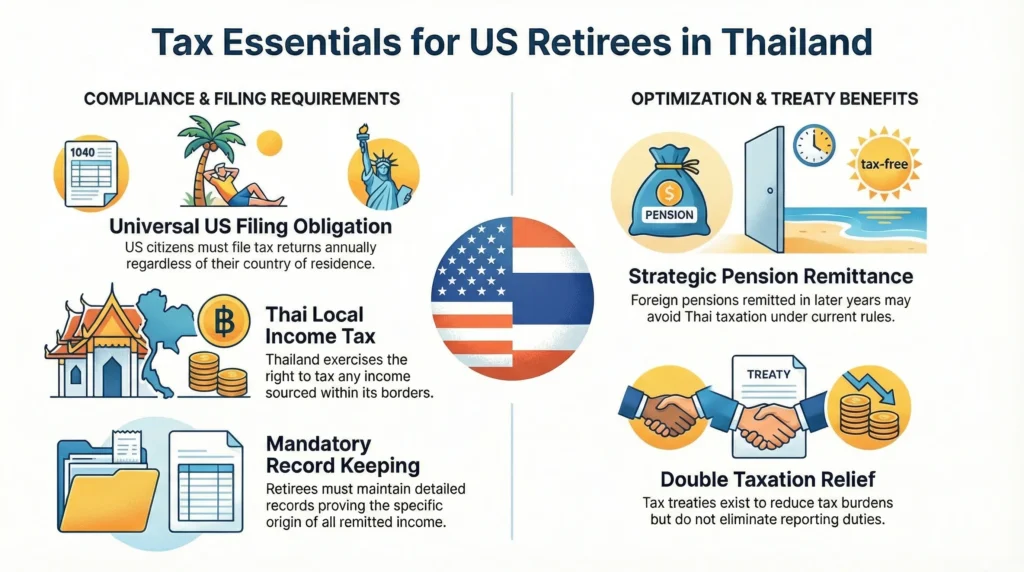
Income rules affect tax exposure.
Important facts for Americans:
- U.S. citizens must file annually regardless of residence
- Thailand taxes income sourced locally
- Foreign pension remitted in later years may avoid Thai tax under current interpretation
- Tax treaties reduce double taxation but do not eliminate reporting duties
Income method applicants must keep records proving income origin.
Application timeline when qualifying by income
Processing depends on document accuracy.
Typical timeline:
| Step | Duration |
|---|---|
| Collect income documents | 1 to 2 weeks |
| Bank deposit tracking | 1 to 3 months |
| Immigration review | Same day to 10 days |
Incomplete proof is the main delay cause.
Risks specific to income-based applicants
Income applicants face stricter scrutiny than deposit applicants.
Common rejection causes:
- Deposits below 65,000 THB in any month
- Missing bank certification
- Currency fluctuations dropping value
- Irregular transfer schedule
- Statements without official stamps
Immigration evaluates patterns across months, not single statements.
Renewal rules for income qualification
Income must be proven every year.
Renewal requirements:
- Updated statements
- Fresh bank letter
- Proof of current income
- Address verification
Past approval does not guarantee renewal.
Comparison with other long-stay visas requiring income
| Visa | Monthly Income Needed | Duration |
|---|---|---|
| Retirement | $1,800 | 1 year renewable |
| LTR Pensioner | $40,000 yearly | 10 years |
| Marriage visa | $1,200 | 1 year |
Retirement visa remains accessible but requires precise financial documentation.
Real monthly living cost relative to income
Minimum qualifying income does not equal comfortable living.
Budget examples:
| Income | Lifestyle |
|---|---|
| $1,800 | Modest city life |
| $2,500 | Comfortable |
| $4,000 | High comfort |
Typical $1,800 budget:
- Rent: $500
- Utilities: $90
- Food: $400
- Transport: $120
- Healthcare: $150
- Misc: $540
Internal planning resource
Before applying, review the full Thailand Relocation Guide for detailed banking, housing, healthcare, and immigration sequencing.
Frequently Asked Questions
What is the minimum income for a Thailand retirement visa in 2026?
You must show at least 65,000 THB per month or about $1,800 USD from a verified source. The amount must be documented and deposited regularly.
Can investment income qualify?
Yes if payments are regular and documented. Lump-sum withdrawals usually fail verification.
What happens if income drops below requirement?
Your extension can be denied at renewal. Immigration checks recent months before approval.
Can you combine income and savings?
Yes. Your annual income plus bank balance must equal 800,000 THB.
Do exchange rates affect qualification?
Yes. If currency value drops and deposits fall below 65,000 THB, you may no longer qualify.
Is income proof checked every year?
Yes. Financial eligibility must be demonstrated for every renewal.
Sources and Official References
Income requirements and verification standards referenced in this article are based on:
- Thai Immigration Bureau – Annual Extension Based on Retirement
https://www.immigration.go.th- Ministry of Foreign Affairs Thailand – Non-Immigrant O Visa Documentation
https://www.mfa.go.th- Royal Thai Embassy Los Angeles – Retirement Visa Income Requirement
https://thaiconsulatela.org- U.S. Social Security Administration – Benefit Verification Letters
https://www.ssa.gov- Thai Revenue Department – Foreign Income and Residency Tax Rules
https://www.rd.go.th- Bumrungrad International Hospital – Public Pricing Disclosure
https://www.bumrungrad.com
All income thresholds reflect the official 65,000 THB monthly requirement currently applied by Thai immigration authorities in 2026.
Recommended Thailand Relocation ResourcesIf you are planning a long-term move, retirement, or extended stay in Thailand, these are the tools and services that make the process smoother from banking to healthcare and compliance.
For a complete breakdown of relocation planning tools, visit:
👉 Takviewer.com/relocation-resources
Core Services I Use and Recommend for Long-Term Living:
• Transport: 12Go Asia(CLICK) – Best for every long rides in Thailand and Asia.• Tours & Activities: GetYourGuide / Klook – Best for booking a Activities.
• Insurance: VisitorsCoverage (CLICK) – Best for Asia!
• eSIM: Airalo (CLICK) – Best eSIM for travelers.
• Flights: Kiwi – Best for finding cheap flights / hotels etc..
• VPN: NordVPN – best for people who care about their online SEFLTY.

Can Americans Use Savings for Thailand Retirement Visa Financial Requirements?
This guide explains whether Americans can use savings for Thailand retirement visa financial requirements, how much is required, what proof…

Thailand Visa Extension Cost Breakdown for Americans in 2026
This guide explains the Thailand visa extension cost breakdown for Americans living long term, including official immigration fees, financial proof…
Thailand Overstay Fine Explained Real Costs for Americans
This guide explains the Thailand overstay fine real costs, including daily penalties, maximum caps, detention risk, deportation consequences, visa extension…

Thailand Retirement Visa vs Elite Visa 2026 Comparison
This guide explains the Thailand retirement visa vs Elite visa comparison, focusing on income requirements, upfront cost, long-term expenses, financial…