

Table of Contents
- Can Americans qualify using savings instead of income?
- What are the exact savings rules in 2026?
- What financial proof documents are required?
- What does it cost to qualify using savings?
- Savings method vs income method comparison
- Can Americans use U.S. savings accounts instead?
- What happens if the balance drops below 800,000 THB?
- Healthcare cost planning when using savings
- Tax clarity for Americans using savings
- Realistic financial scenario
- Risks Americans underestimate
- When savings method makes more sense
- Frequently Asked Questions

This guide explains whether Americans can use savings for Thailand retirement visa financial requirements, how much is required, what proof immigration accepts, the real cost structure, and how savings compare to income-based qualification.
Can Americans qualify using savings instead of income?
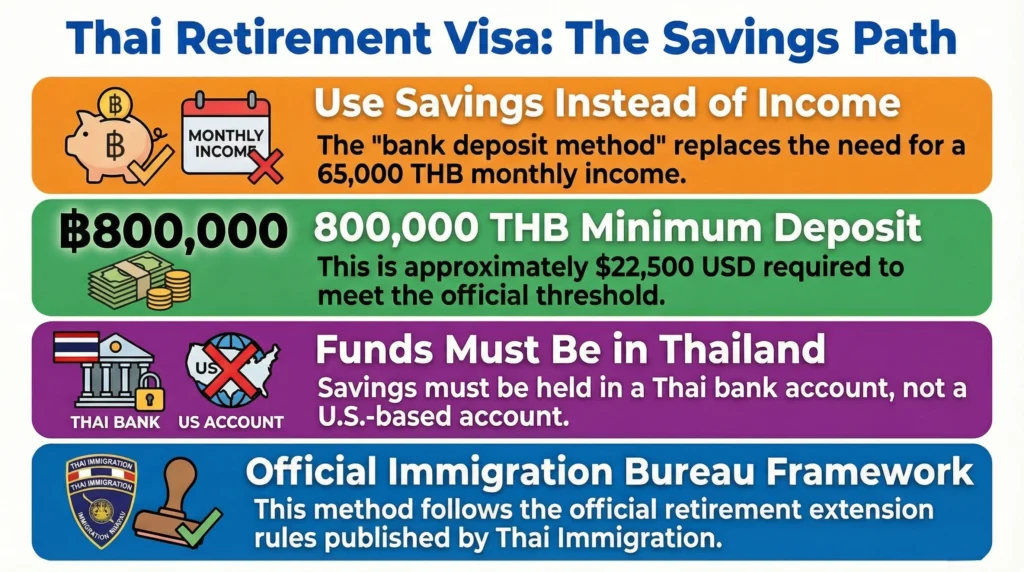
Yes. Americans can qualify using savings alone under the official retirement extension rules if they meet the deposit threshold set by Thai immigration.
The required amount:
800,000 THB in a Thai bank account
Approximately $22,500 USD
This method is often called the bank deposit method. It replaces the monthly income requirement of 65,000 THB.
Official immigration framework is published by the Thai Immigration Bureau.
Savings must be held inside Thailand, not in a U.S. bank.
What are the exact savings rules in 2026?
Immigration applies timing rules, not just balance totals.
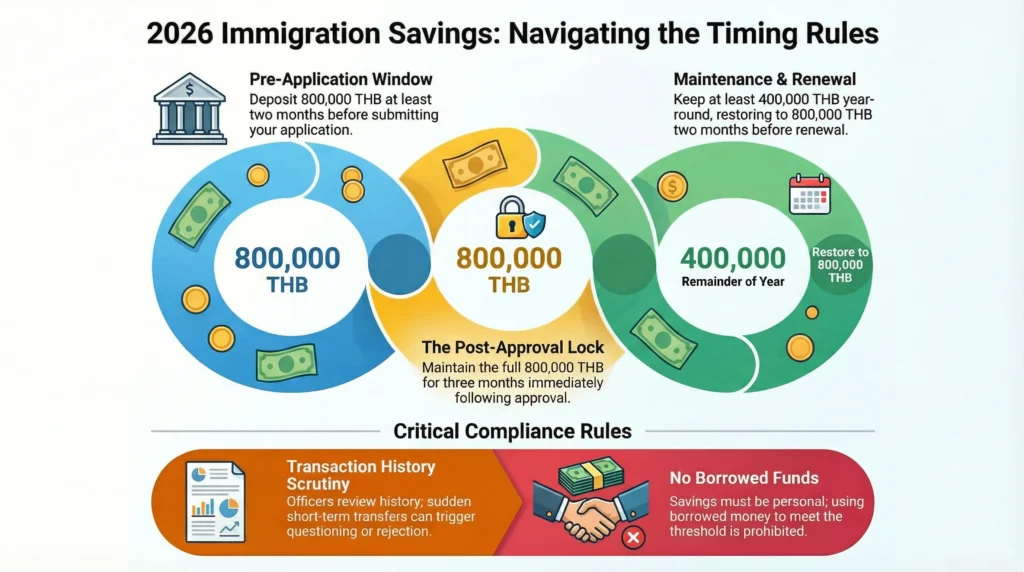
You must:
- Deposit 800,000 THB at least 2 months before application
- Keep full amount 3 months after approval
- Maintain at least 400,000 THB for remainder of year
- Restore to 800,000 THB 2 months before renewal
Officers review transaction history. Sudden short-term transfers can trigger questioning.
Savings cannot be borrowed funds.
What financial proof documents are required?
Immigration does not rely on screenshots. They require certified documentation.
Required bank documentation
- Same-day bank certification letter
- Updated passbook pages
- Official stamped bank statements
- Copy of passport and visa page
Some immigration offices verify balances directly with the bank.
Digital-only statements are frequently rejected.
What does it cost to qualify using savings?
Using savings avoids monthly income proof but does not eliminate costs.
Immigration and compliance costs
| – | THB | USD |
|---|---|---|
| Annual extension fee | 1,900 | $52 |
| Re-entry permit | 1,000 | $27 |
| Bank certification letter | 100–200 | $3–6 |
| Document copies | 100 | $3 |
Capital lock cost
| Requirement | Amount |
|---|---|
| Deposit required | $22,500 |
| Minimum maintained | $11,250 |
The real cost is liquidity restriction. Funds remain mostly unusable.
Savings method
vs
income method
comparison
| – | Savings Method | Income Method |
|---|---|---|
| Capital required | $22,500 | None |
| Monthly income needed | None | $1,800 |
| Scrutiny level | Lower | Higher |
| Currency risk | Low | Higher |
| Liquidity impact | High | Low |
Savings method is simpler administratively. Income method preserves liquidity.
If comparing both, review full breakdown in the Thailand retirement visa financial requirements guide inside the Retirement & Long-Term Living section.
Can Americans use U.S. savings accounts instead?
No. Funds must be in a Thai bank under your name.
International transfers must be traceable. Many retirees use Wise or direct SWIFT transfers to move funds.
If you are transferring $22,500 to a Thai bank, the difference between a bank wire and Wise is real money.
Most SWIFT transfers cost $25 to $50 per transaction plus a hidden exchange rate markup.
Wise converts at the mid-market rate and shows you the fee upfront. On a transfer this size, that is often $150 to $300 saved before you even open your account.
Opening a Thai account typically requires:
- Local address
- Visa entry stamp
- Passport
Branch discretion applies.
What happens if the balance drops below 800,000 THB?
The deposit rule is not flexible.
It is enforced based on transaction history, not intention.
After your retirement extension is approved using the deposit method, the full 800,000 THB must remain in your Thai bank account for the first 3 months.
If the balance drops below that level during this protected period, even briefly, immigration can treat it as non-compliance.
After those initial 3 months, you may reduce the balance.
However, the account must never fall below 400,000 THB for the remainder of the year.
Then, at least 2 months before your next renewal, the balance must be restored to 800,000 THB again, and maintained until approval.
Immigration does not check only the final balance on the day you apply.
They review the full bank statement history.
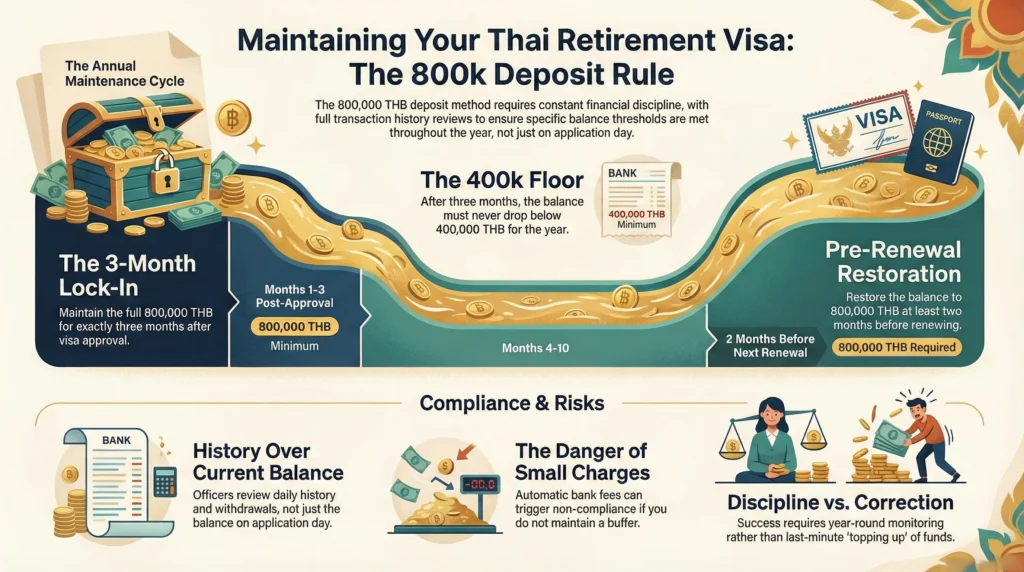
Officers look at:
- Daily balance levels
- Timing of large withdrawals
- Short-term deposits made just before renewal
- Any dip below the 400,000 THB minimum
If the balance falls below required thresholds during restricted periods, consequences may include:
- Renewal delay
- Additional financial proof requests
- Forced switch to income method
- Denial of extension
Many Americans assume that as long as they “top it up” before renewal, everything is fine.
That assumption is incorrect.
Even small automatic bank charges can push the account below 400,000 THB if no buffer is maintained.
Keeping a safety margin above the minimum is basic risk control.
For a full breakdown of the deposit timing rules and income alternatives, review Thailand Retirement Visa Financial Requirements Explained.
To understand how immigration verifies compliance during renewal, see the step-by-step process in Thailand Visa Renewal Process for Americans (Step-by-Step Financial Guide).
The deposit method is simple on paper.
In practice, it requires year-round financial discipline, not last-minute corrections.
Healthcare cost planning when using savings
Savings qualification often appeals to retirees without large monthly income. Healthcare costs must still be considered.
Typical private hospital pricing:
| Treatment | USD |
|---|---|
| Doctor visit | $30–60 |
| MRI | $300–900 |
| Hospital night | $150–500 |
| Minor surgery | $1,200–4,000 |
(Reference example)
Retirees using savings must allocate funds for:
- Insurance premiums
- Out-of-pocket treatment
- Emergency reserves
The fastest way to get a real number for your healthcare budget is to price a plan before you commit to a monthly spending structure.
VisitorsCoverage lets you compare international health plans for Thailand in minutes, filter by age and coverage level, and see exactly what you are paying before you land.
For retirees locking up $22,500 in a deposit account, knowing your monthly insurance cost in advance is basic financial planning
Insurance for retirees 60–70 often costs $1,600 to $3,000 annually.
For a broader medical cost breakdown, see healthcare costs without insurance in Thailand.
Tax clarity for Americans using savings
Savings themselves are not taxable.
However:
- U.S. citizens must file U.S. tax returns annually
- Interest earned in Thai banks may be subject to Thai withholding tax
- Thai tax treatment of foreign income depends on remittance timing
(Official Thai Revenue Department reference)
Savings qualification does not eliminate tax reporting obligations.
Realistic financial scenario
Scenario 1: American retiree with $60,000 savings
- Transfers $25,000 to Thai bank
- Maintains $22,500 deposit
- Uses remainder as living reserve
Monthly living cost example in Thailand:
| – | USD |
|---|---|
| Rent | $600 |
| Utilities | $90 |
| Food | $400 |
| Healthcare | $150 |
| Transport | $120 |
| Misc | $400 |
| Total | $1,760 |
Minimum qualifying savings does not equal sustainable retirement planning. Review cost of living in Thailand for detailed budget models.
Risks Americans underestimate
- Currency fluctuations during transfer
- Bank compliance delays
- Deposit timing mistakes
- Using borrowed funds
- Forgetting renewal seasoning period
Most denials occur due to timing errors, not insufficient funds.
When savings method makes more sense
Savings qualification is practical if:
- You lack steady monthly income
- You prefer simplified documentation
- You have capital not needed for liquidity
- You want lower scrutiny from immigration
Income method is preferable if:
- You rely on pension deposits
- You want to avoid tying up $22,500
Strategic planning should start with the full Thailand Relocation Guide to understand banking, tax, and residency sequencing before moving funds.
Frequently Asked Questions
How much savings do Americans need for Thailand retirement visa qualification?
You must hold 800,000 THB or about $22,500 USD in a Thai bank account under your name, following timing rules before and after approval.
Can savings replace income for retirement extension?
Yes. Savings fully replace the 65,000 THB monthly income requirement if deposit conditions are met.
Can you withdraw money after approval?
After three months, balance may drop to 400,000 THB but must return to 800,000 THB before renewal.
Do U.S. savings accounts count?
No. Funds must be transferred into a Thai bank and verified locally.
Is the savings method cheaper than income method?
Administrative costs are similar. The main difference is locking $22,500 in capital versus showing $1,800 monthly income.
Does Thailand tax retirement savings?
Thailand may tax Thai-sourced interest. U.S. citizens must continue filing U.S. tax returns regardless of residence.

Thailand Visa Extension Cost Breakdown for Americans in 2026
This guide explains the Thailand visa extension cost breakdown for Americans living long term, including official immigration fees, financial proof…
Thailand Overstay Fine Explained Real Costs for Americans
This guide explains the Thailand overstay fine real costs, including daily penalties, maximum caps, detention risk, deportation consequences, visa extension…

Thailand Retirement Visa vs Elite Visa 2026 Comparison
This guide explains the Thailand retirement visa vs Elite visa comparison, focusing on income requirements, upfront cost, long-term expenses, financial…

How to Show Income Proof for Thailand Retirement Visa
This guide explains how to show income proof for Thailand retirement visa, including accepted income sources, document standards, bank verification…