
Table of Contents
- What is the financial difference between Retirement and Elite visas?
- Total 5-year cost comparison
- Liquidity and capital impact
- Income requirements and financial proof comparison
- Healthcare insurance obligations
- Extension and renewal complexity
- Tax clarity for Americans
- Realistic 5-year financial scenario
- Which option is cheaper long term?
- Risk factors Americans overlook
- Long-term residency positioning
- Frequently Asked Questions
This guide explains the Thailand retirement visa vs Elite visa comparison, focusing on income requirements, upfront cost, long-term expenses, financial proof, healthcare obligations, tax clarity, and practical differences for Americans planning extended residence.
This is a financial and compliance comparison, not a lifestyle review.
What is the financial difference between Retirement and Elite visas?
The core financial difference is structural.
The retirement visa is based on demonstrated financial stability, not payment to the government.
You either maintain 800,000 THB inside a Thai bank account or prove 65,000 THB in consistent monthly income.
That money remains yours, but it must be traceable, seasoned correctly, and maintained under strict timing rules.
In practical terms, this means tying up approximately $22,500 in capital or proving about $1,800 per month in structured income.
Immigration reviews documentation every year.
Compliance is ongoing.
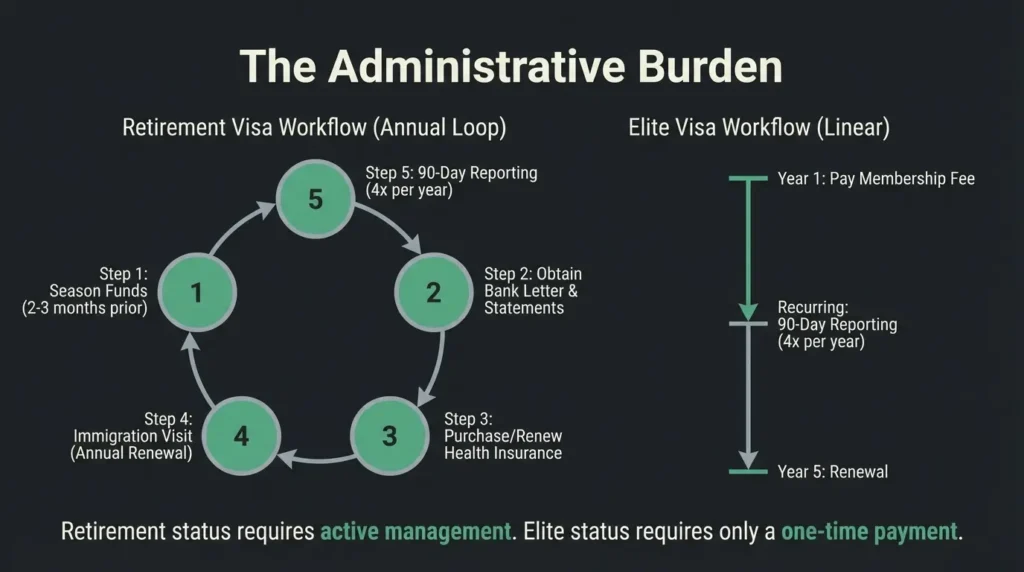
The Elite visa operates differently.
There is no income verification and no deposit seasoning requirement.
Instead, you pay a fixed membership fee upfront.
The financial burden is higher initially, but administrative scrutiny is lower.
One model tests liquidity and documentation discipline.
The other tests willingness to pay for convenience.
The retirement extension is based on financial proof. The Elite visa is based on a membership fee.
Retirement visa financial requirement
You must show one of the following:
- 800,000 THB deposit in a Thai bank
- 65,000 THB monthly income
Approximately:
- $22,500 savings, or
- $1,800 monthly income
(Details are outlined by the Thai Immigration Bureau)
Elite visa cost structure
Elite is a long-term privilege visa issued through Thailand Privilege Card.
Current base package:
- 900,000 THB membership fee
- Approximately $25,000 USD
- Valid for 5 years
No income proof required. No deposit requirement.
Total 5-year cost comparison
| – | Retirement Visa | Elite Visa |
|---|---|---|
| Upfront capital | $22,500 deposit | $25,000 fee |
| Refundable? | Yes | No |
| Annual extension fees | $52/year | Included |
| Re-entry permit | $27–105 | Included |
| Financial proof yearly | Required | Not required |
| 5-year estimated cost | $260 + opportunity cost | $25,000 |
Retirement deposit remains your money. Elite fee is non-refundable.
Liquidity and capital impact
Retirement visa
- Capital remains in Thai bank
- Must maintain balance thresholds
- Funds mostly restricted
Elite visa
- No capital lock requirement
- Full liquidity of personal savings
- Large non-refundable payment
From a pure liquidity standpoint, retirement is less expensive long term.
Income requirements and financial proof comparison
| Requirement | Retirement | Elite |
|---|---|---|
| Income proof | Required if not using deposit | Not required |
| Bank documentation | Required yearly | Not required |
| Annual renewal process | Yes | No |
| Scrutiny level | Moderate | Low |
Elite removes annual financial scrutiny.
Retirement requires yearly proof.
For deeper breakdown, see Thailand retirement visa financial requirements in the Retirement & Long-Term Living section.
Healthcare insurance obligations
Retirement O-A visa holders
Must maintain health insurance.
Estimated annual premium:
| Age | USD |
|---|---|
| 50–60 | $800–1,500 |
| 60–70 | $1,600–3,000 |
| 70+ | $3,500+ |
Elite visa holders
No mandatory insurance requirement.
Healthcare costs remain personal responsibility.
(link : Private hospital pricing)
Healthcare costs without insurance can exceed immigration costs quickly.
One night in a Bangkok private hospital without coverage can cost more than your entire annual extension fee.
That is the math most retirees ignore until they are sitting in an ER doing it in their head.
VisitorsCoverage is what most long-term residents use to compare international health plans before committing to anything. You filter by age, see real monthly prices, and know your number before you land. Takes about three minutes and saves a lot of guessing.
Extension and renewal complexity
Retirement visa
- Annual extension required
- 90-day reporting required
- Financial proof required yearly
- Re-entry permit required when traveling
Elite visa
- 5-year stay stamp issued
- 90-day reporting still required
- No annual financial re-verification
- Re-entry privileges included
Elite reduces annual immigration office visits.
Tax clarity for Americans
Neither visa changes U.S. tax obligations.
Americans must:
- File annual U.S. tax returns
- Report foreign bank accounts if required
- Monitor Thai tax residency rules
(Thai Revenue Department reference)
Visa type does not automatically determine tax residency. Time spent in Thailand does.
For full tax positioning strategy, review the moving to Thailand from USA planning guide before choosing a visa path.
Realistic 5-year financial scenario
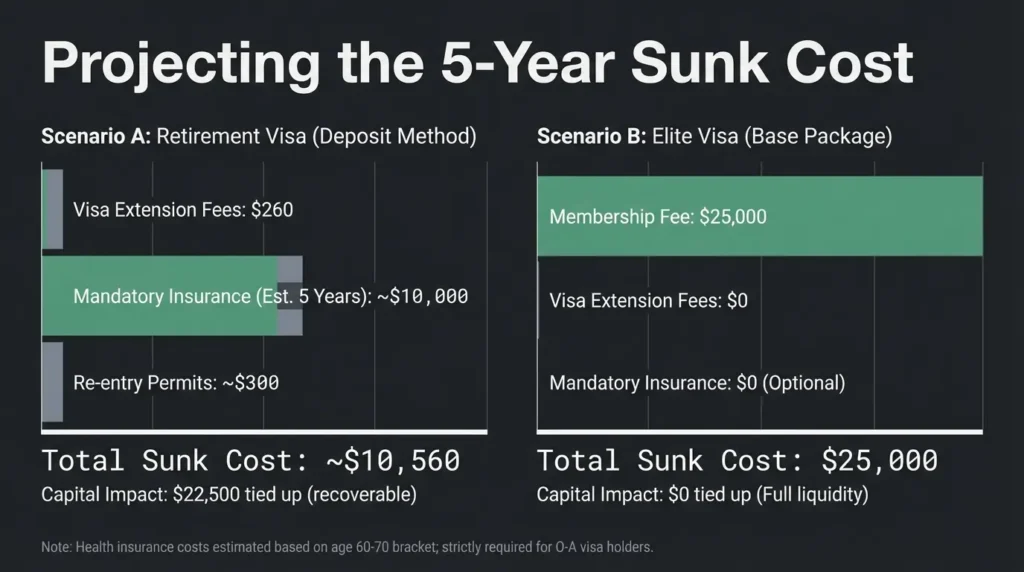
Scenario 1: Retirement visa using deposit method
- $22,500 held in Thai bank
- $260 total extension fees over 5 years
- Insurance average $2,000 per year
5-year estimated compliance cost:
| – | USD |
|---|---|
| Extension fees | $260 |
| Insurance | $10,000 |
| Opportunity cost | Variable |
| Total | $10,260 + capital lock |
Capital remains accessible if rules followed.
Scenario 2: Elite visa
- $25,000 paid upfront
- No annual extension fee
- Insurance optional
5-year estimated cost:
| – | USD |
|---|---|
| Membership | $25,000 |
| Insurance | Optional |
| Total | $25,000+ |
Elite costs more upfront but simplifies compliance.
Which option is cheaper long term?
If you look at the numbers over five to ten years, the retirement route is usually far cheaper.
With a retirement extension, the 800,000 THB stays in your bank account.
You are not paying that money to anyone.
Your real costs are the annual 1,900 THB extension fee, possible re-entry permits, and health insurance.
Even over several years, those administrative costs stay relatively small compared to a large upfront membership payment.
The Elite visa works the opposite way.
You pay a large fee at the beginning and that money is gone.
There is no refund and no capital sitting in your account.
In exchange, you avoid annual financial proof and most paperwork stress.
In practical terms, if you already have stable pension income and do not mind visiting immigration once a year with organized documents, retirement is usually the smarter financial move.
If you dislike paperwork, travel frequently, and prefer not to worry about bank balance timing rules, Elite can feel easier, but you are paying a premium for that simplicity.
The decision often comes down to this:
Are you comfortable managing financial compliance each year, or would you rather pay once and remove that annual checklist?
Risk factors Americans overlook
When comparing risk, most Americans focus only on cost and overlook practical exposure.
With a retirement visa, currency fluctuations can quietly affect income qualification.
If you rely on the 65,000 THB monthly income method and the dollar weakens, your transfer may fall below the required threshold without you realizing it.
That is the part most people do not think about until their renewal gets flagged.
You did not change anything. Your pension is the same. But the exchange rate moved and suddenly you are scrambling to transfer extra funds and reissue bank letters.
Most expats we know switched to Wise specifically because it converts at the real mid-market rate, so your monthly transfer actually arrives at what you planned, not what the bank decided to give you that day.
That creates renewal stress even if your pension amount in USD has not changed.
Timing mistakes are another common issue.
Deposit seasoning rules require funds to sit in the account for a specific period before renewal.
Missing that window by even a few days can delay approval.
Documentation errors also matter.
An outdated bank letter or incomplete statements can lead to a second immigration visit or temporary denial.
The risk is administrative, not financial.
With the Elite visa, the risks are different.
The membership fee is non-refundable.
Once paid, that capital is permanently gone.
If policies change or your situation changes, you cannot recover the payment.
There is also the simple reality of a high upfront cost.
Paying $25,000 at once limits flexibility compared to keeping savings liquid.
Both visa types still require 90-day reporting compliance.
Elite does not remove that obligation.
Failure to report on time can create compliance history issues regardless of visa category.
The retirement route carries operational discipline risk.
The Elite route carries capital commitment risk.
Retirement visa risks:
- Currency fluctuations affecting income qualification
- Timing errors with deposit seasoning
- Renewal documentation mistakes
Elite visa risks:
- Non-refundable membership
- Policy changes
- High upfront cost
Both require 90-day reporting compliance.
Long-term residency positioning
Retirement visa aligns with:
- Pension-based relocation
- Fixed income planning
- Cost-controlled retirement
Elite aligns with:
- Liquidity preference
- Simplified immigration management
- High income flexibility
Strategic planning should begin with the full Thailand Relocation Guide to evaluate sequencing, banking setup, healthcare planning, and tax exposure.
Frequently Asked Questions
Is Elite visa better than retirement visa financially?
No. Retirement visa is significantly cheaper over time because the 800,000 THB deposit remains your money. Elite requires a non-refundable membership fee.
Do Elite visa holders need income proof?
No. Elite visa does not require income or deposit verification.
Can retirement visa holders travel freely?
Yes, but they must obtain a re-entry permit before leaving Thailand or their extension becomes void.
Is health insurance required for Elite visa?
No mandatory requirement. Retirement O-A visa holders must carry insurance.
Which visa is easier to maintain?
Elite is administratively simpler. Retirement requires annual financial documentation and renewal.
Does either visa give permanent residency?
No. Both are long-stay visas. Permanent residency requires separate qualification.

Thailand Retirement Visa Financial Requirements Explained
This guide explains Thailand retirement visa financial requirements for foreigners who need exact income thresholds, proof rules, cost structures, and…

Can Americans Use Savings for Thailand Retirement Visa Financial Requirements?
This guide explains whether Americans can use savings for Thailand retirement visa financial requirements, how much is required, what proof…

Thailand Visa Extension Cost Breakdown for Americans in 2026
This guide explains the Thailand visa extension cost breakdown for Americans living long term, including official immigration fees, financial proof…
Thailand Overstay Fine Explained Real Costs for Americans
This guide explains the Thailand overstay fine real costs, including daily penalties, maximum caps, detention risk, deportation consequences, visa extension…