
Table of Contents
- What is the official Thailand visa extension fee in 2026?
- What additional immigration costs should Americans expect?
- Retirement extension cost breakdown
- Marriage visa extension cost breakdown
- Long-Term Resident LTR visa cost comparison
- Hidden costs Americans underestimate
- Cost comparison: Income method vs deposit method
- Tax implications tied to visa extensions
- Real annual cost example for a retired American
- Common mistakes that increase extension cost
- Is extending cheaper than applying for a new visa?
- Frequently Asked Questions
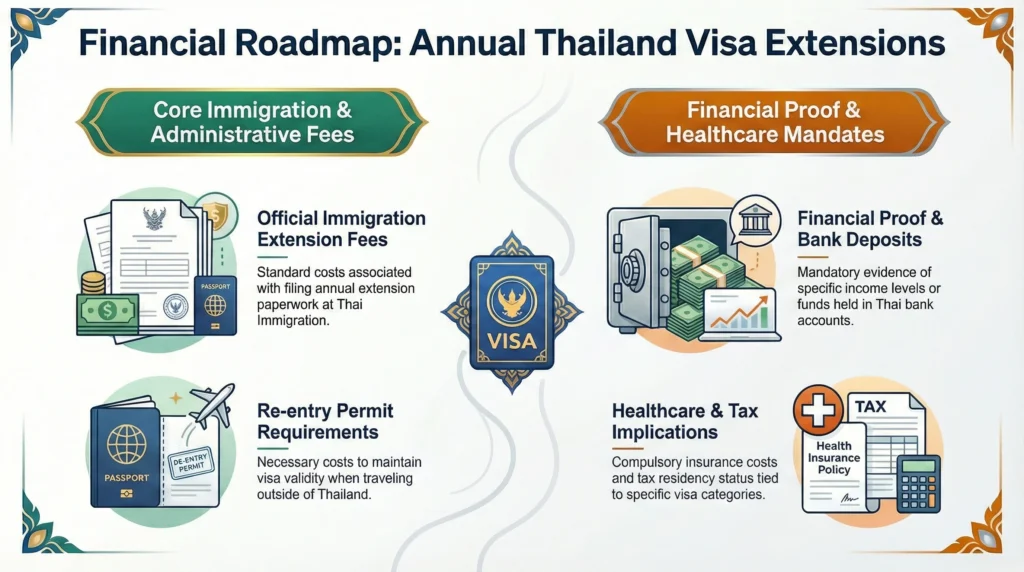
This guide explains the Thailand visa extension cost breakdown for Americans living long term, including official immigration fees, financial proof requirements, re-entry permits, healthcare costs, and tax implications tied to extension status.
This is not about tourist overstays. It focuses on legal annual extensions under retirement, marriage, and long-stay categories.
What is the official Thailand visa extension fee in 2026?
For most long-stay extensions inside Thailand, the standard immigration fee is ->1,900 THB per extension
(Approximately $52 USD)
This applies to:
- Retirement extension
- Marriage extension
- Dependent extension
- Certain business extensions
(Official reference: Thai Immigration Bureau)
The fee is paid per year. It does not include re-entry permits or document costs.
What additional immigration costs should Americans expect?
The 1,900 THB fee is only the base cost.
Re-entry permit fees
If you leave Thailand during your extension period:
| Permit Type | THB | USD |
|---|---|---|
| Single re-entry | 1,000 | $27 |
| Multiple re-entry | 3,800 | $105 |
Without a re-entry permit, your extension becomes void upon departure.
90-day reporting cost
Every long-stay visa holder must report their address every 90 days.
| Method | Cost |
|---|---|
| Online | Free |
| In person | Free |
| Late fine | 2,000 THB or $55 |
Missing reports leads to fines, not cancellation, but repeat violations create scrutiny.
Retirement extension cost breakdown
If extending based on retirement, financial proof affects total cost.
Required financial threshold
You must show:
- 800,000 THB deposit, or
- 65,000 THB monthly income
For full financial rules, see the Thailand retirement visa financial requirements guide inside the Retirement & Long-Term Living section.
Annual retirement extension cost summary
| – | Estimated USD |
|---|---|
| Extension fee | $52 |
| Bank certification | $4 |
| Statement copies | $5 |
| Photos and documents | $5 |
| Re-entry permit (single) | $27 |
| Total minimum | $93 |
For Americans renewing under a retirement extension, the immigration fee is only one component.
You must also maintain either 800,000 THB in a Thai bank account or prove 65,000 THB in monthly income.
If using the deposit method, the financial impact is the capital tied up rather than a direct payment.
If using the income method, consistent monthly transfers must be maintained. In addition, some retirement categories require health insurance, which can range from $800 to over $3,000 per year depending on age.
When combining extension fees, documentation, re-entry permits, and insurance, the true annual compliance cost can easily exceed $2,000 USD, even though the immigration fee itself remains low.
Marriage visa extension cost breakdown
Marriage extensions require lower financial thresholds but similar administrative costs.

Financial requirement
- 400,000 THB bank deposit, or
- 40,000 THB monthly income
Annual cost summary
| – | USD |
|---|---|
| Extension fee | $52 |
| Bank documents | $8 |
| Home visit verification | $0 |
| Re-entry permit | $27 |
| Total | $87–110 |
Marriage extensions have the same 1,900 THB immigration fee but lower financial thresholds.
Applicants must show 400,000 THB in a Thai bank account or 40,000 THB monthly income.
While the administrative cost is similar to retirement, marriage extensions often involve additional documentation such as household registration, photographs of the residence, and occasional home visits by immigration officers.
Financially, the annual direct cost remains modest, usually under $150 USD excluding living expenses, but the compliance process can be more document-heavy. The real expense is not the fee itself but maintaining consistent financial proof and complete paperwork each year.
Long-Term Resident LTR visa cost comparison
The LTR visa operates differently.
| – | LTR Visa |
|---|---|
| Validity | 10 years |
| Fee | 50,000 THB |
| Approx USD | $1,400 |
LTR avoids annual extensions but requires higher income thresholds.
(Official Board of Investment reference)
Hidden costs Americans underestimate
Extension costs go beyond immigration fees.
Banking-related costs
| – | USD |
|---|---|
| International transfer fee | $15–40 |
| Exchange rate spread | Variable |
| Bank letter | $3–6 |
Currency fluctuation can affect income-based qualification.
Most Americans paying extension-related transfers through a standard bank lose money on the exchange rate before the fee even hits.
Wise converts at the real mid-market rate with a flat fee you see upfront.
On recurring annual transfers, that difference adds up to real money over time.
Healthcare insurance costs
Retirement O-A extensions require insurance coverage.
Typical annual premium:
| Age | USD |
|---|---|
| 50–60 | $800–1,500 |
| 60–70 | $1,600–3,000 |
| 70+ | $3,500+ |
(Private hospital pricing example)
For uninsured retirees, medical costs can exceed annual extension fees quickly.
The extension fee is $52.
One uninsured ER visit in Bangkok can cost $300 or more.
VisitorsCoverage lets you compare plans built for long-term residents in Thailand, filter by age, and lock in a monthly rate before your next renewal cycle.
Cost comparison: Income method vs deposit method
When choosing how to qualify financially for a retirement extension, the real difference is not the 1,900 THB immigration fee. It is how your money is structured.
Under the income method, you must prove at least 65,000 THB per month in consistent deposits.
There is no large capital lock, which keeps liquidity high. However, documentation requirements are stricter.
Immigration reviews monthly transfer patterns, exchange rate impact, and bank certification letters each year.
Administrative complexity is moderate, and renewal scrutiny tends to be higher because officers verify ongoing income stability.
Under the deposit method, you must maintain 800,000 THB, roughly $22,500 USD, in a Thai bank account.
Liquidity impact is high because the funds must remain within defined thresholds during the year.
The administrative process is generally simpler.
Once the deposit timing rules are satisfied, renewal scrutiny is typically lower compared to income-based qualification.
| – | Income Method | Deposit Method |
|---|---|---|
| Liquidity impact | Low | High |
| Capital tied up | None | $22,500 |
| Admin complexity | Medium | Low |
| Renewal scrutiny | Higher | Lower |
Financial planning matters more than extension fee itself.
For structured relocation planning, see the Thailand Relocation Guide before committing to a visa strategy.
Tax implications tied to visa extensions
Holding an extension does not equal tax exemption.
Americans must:
- File U.S. tax returns annually
- Report foreign bank accounts if required
- Monitor Thai tax residency rules
(Official Thai Revenue Department)
Tax obligations often exceed immigration costs.
Real annual cost example for a retired American
Scenario: Retirement extension using deposit method
| – | USD |
|---|---|
| Extension fee | $52 |
| Multiple re-entry | $105 |
| Bank documentation | $10 |
| Insurance | $2,200 |
| Total annual compliance | $2,367 |
The immigration fee is minor compared to insurance and healthcare budgeting.
For full retirement cost analysis, review cost of living in Thailand and healthcare costs without insurance for long-term residents.
Common mistakes that increase extension cost
- Missing 90-day reporting
- Letting balance drop below required level
- Failing to purchase mandatory insurance
- Traveling without re-entry permit
- Using incorrect financial proof
Most penalties come from procedural errors, not fee increases.
Is extending cheaper than applying for a new visa?
In most cases, yes.
Extension inside Thailand:
- 1,900 THB fee
- Minimal paperwork if documents prepared
Applying abroad:
- Embassy visa fee
- Travel cost
- Accommodation during application
Extensions reduce disruption and cost.
Frequently Asked Questions
How much does a Thailand visa extension cost in 2026?
The base immigration fee is 1,900 THB or about $52 USD. Additional costs include re-entry permits and document certification.
Is the extension fee refundable if denied?
No. Immigration fees are not refunded once processed.
Do you pay 1,900 THB every year?
Yes. Most long-stay extensions must be renewed annually unless holding an LTR visa.
Is insurance included in extension cost?
No. Insurance is separate and can cost $800 to $3,000 annually depending on age.
What is the cheapest long-term extension option?
Retirement and marriage extensions have similar immigration fees. Financial thresholds determine actual cost.
Can you extend multiple times?
Yes. Extensions can be renewed annually if financial and legal conditions are maintained.

Thailand Retirement Visa Financial Requirements Explained
This guide explains Thailand retirement visa financial requirements for foreigners who need exact income thresholds, proof rules, cost structures, and…

Can Americans Use Savings for Thailand Retirement Visa Financial Requirements?
This guide explains whether Americans can use savings for Thailand retirement visa financial requirements, how much is required, what proof…
Thailand Overstay Fine Explained Real Costs for Americans
This guide explains the Thailand overstay fine real costs, including daily penalties, maximum caps, detention risk, deportation consequences, visa extension…

Thailand Retirement Visa vs Elite Visa 2026 Comparison
This guide explains the Thailand retirement visa vs Elite visa comparison, focusing on income requirements, upfront cost, long-term expenses, financial…