

Table of Contents
- Income Requirements
- Savings Requirement Option
- Income vs Savings Comparison
- Application Process
- Renewal Cost Over 4 Years
- Tax Implications for Retirees
- Timeline: Approval to Residency Card
- Common Rejection Reasons
- Strategic Planning Before You Apply
- Frequently Asked Questions
- How These Estimates Are Calculated
- Who This Guide Is For
- Final Perspective
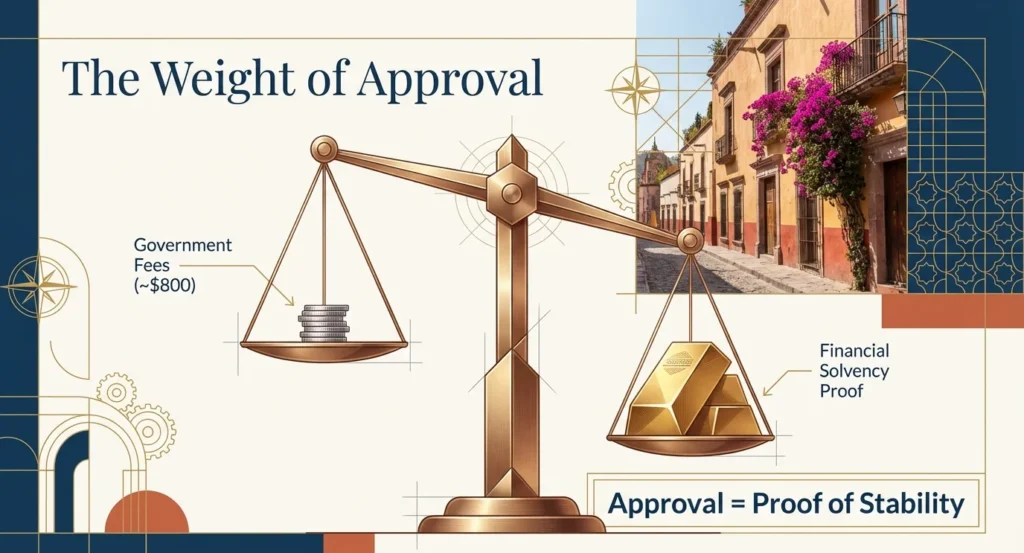
Understanding the real mexico retirement visa cost starts with one fact: approval is based almost entirely on financial proof. Government fees are minor compared to income thresholds and savings requirements.
If you plan to retire in Mexico, your approval depends on meeting official mexico retirement visa requirements through either income or savings. Therefore, before looking at property or lifestyle changes, you must understand the financial structure behind the visa.
Official rules are published by Instituto Nacional de Migración – INM and applied through Mexican consulates such as https://consulmex.sre.gob.mx.
For relocation context beyond the visa itself, read how to retire in Mexico and review your full Mexico cost breakdown before applying.
Income Requirements
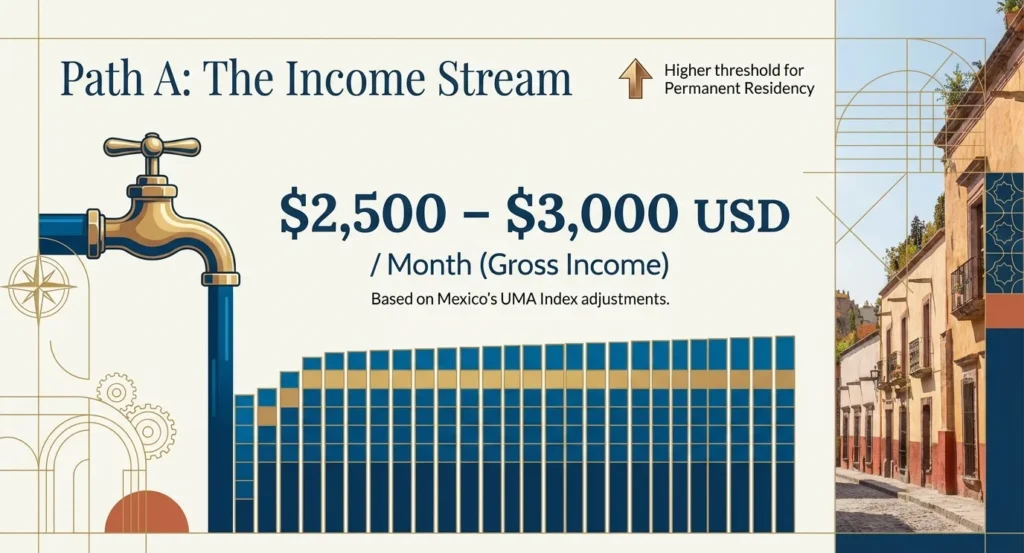
The most common way to qualify is through recurring income. The required amount is based on Mexico’s UMA index, which adjusts annually.
Although exact thresholds vary slightly by consulate, most U.S.-based consulates currently require approximately:
• $2,500–$3,000 USD per month for Temporary Resident based on retirement
• Higher income levels for direct Permanent Resident approval
These numbers refer to gross income.
What Counts as Income?
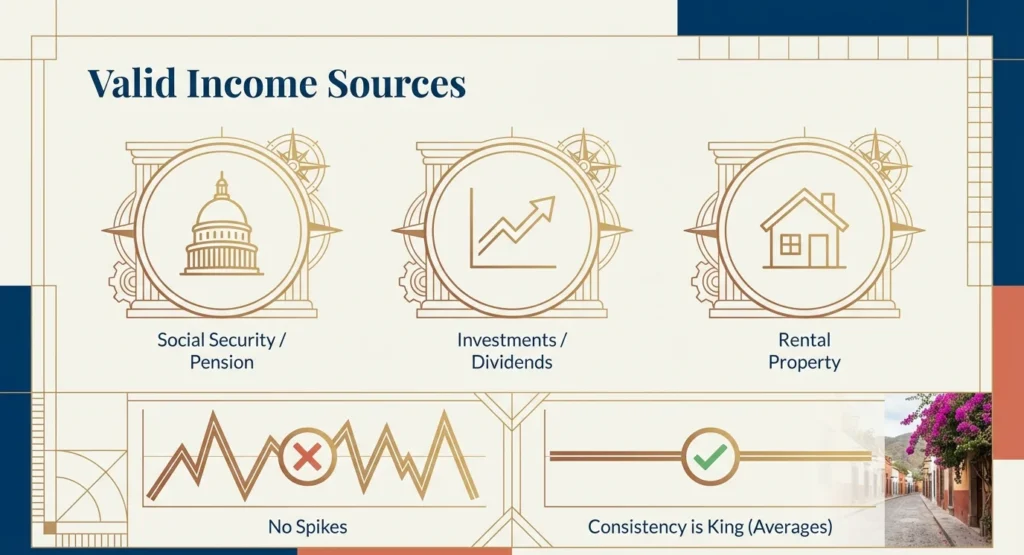
Acceptable sources usually include:
• Social Security
• Pension payments
• Retirement account distributions
• Dividend or investment income
• Rental property income
Consulates typically require 6–12 months of official statements.
The key factor is consistency. A single strong month is not enough. Officers review averages.
If your income sits right at the threshold, approval risk increases.
Savings Requirement Option
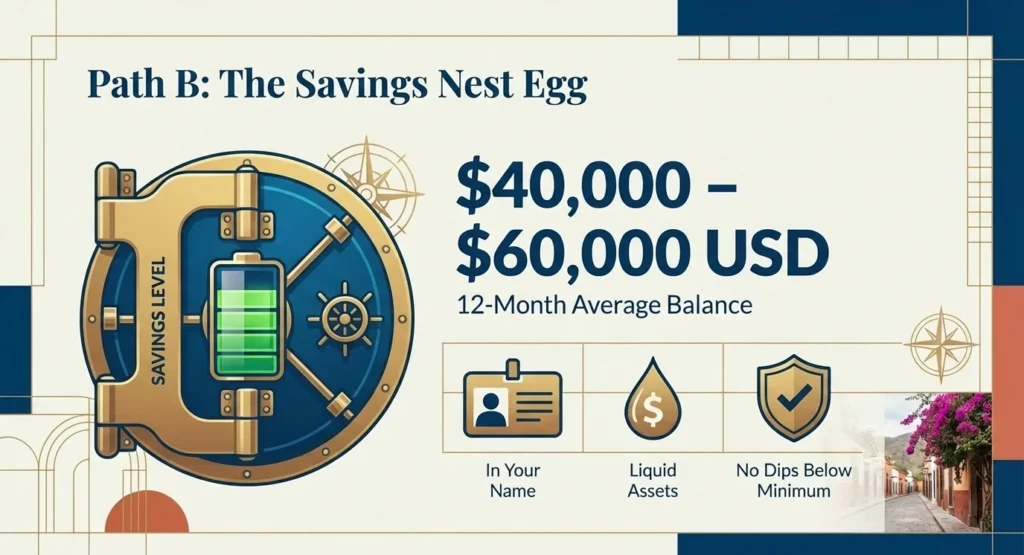
If you do not meet the income requirement, you may qualify using savings.
This falls under broader mexico visa financial requirements.
Most consulates require proof of $40,000–$60,000 USD maintained consistently over the previous 12 months.
Savings must be:
• In your name
• Liquid
• Maintained above the minimum during the full review period
Large last-minute deposits often raise concerns.
Consistency is more important than a temporary high balance.
Income vs Savings Comparison
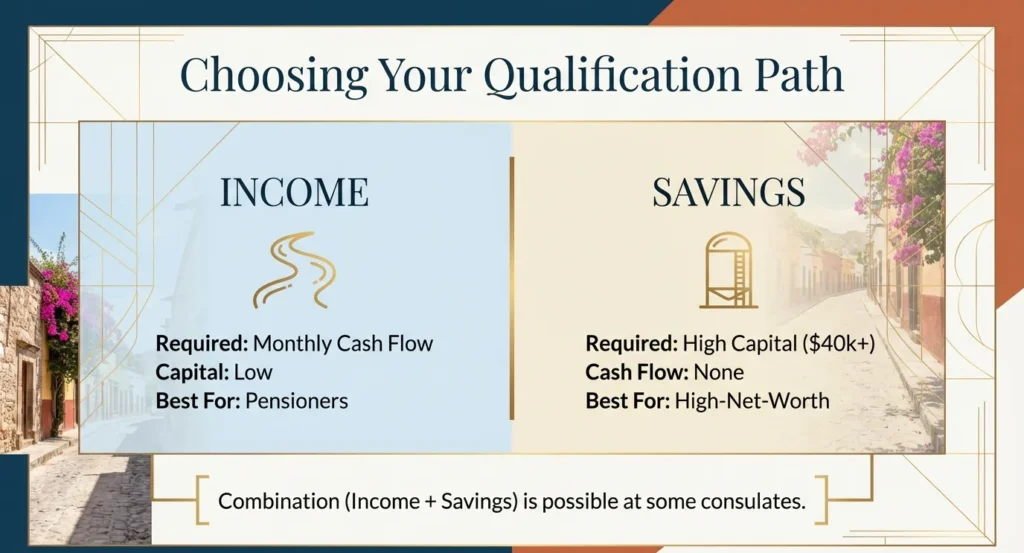
Choosing between income qualification and savings qualification changes both approval risk and financial strategy.
| Factor | Income Method | Savings Method |
|---|---|---|
| Monthly Cash Flow Required | Yes | No |
| Capital Required | Low | High ($40k–$60k+) |
| Consistency Review | 6–12 months income | 12 months balance history |
| Risk of Fluctuation | Income variability | Balance dropping below threshold |
| Long-Term Sustainability | Strong if pension stable | Depends on preserving capital |
| Best For | Pensioners / Social Security | High-savings applicants |
Income approval is usually simpler if your monthly amount clearly exceeds the threshold.
Savings approval works well for applicants with strong capital but lower recurring income.
In some cases, a combination of stable income plus strong savings improves approval confidence, depending on the consulate.
Application Process
The process happens in two stages.
Step 1: Consulate Appointment
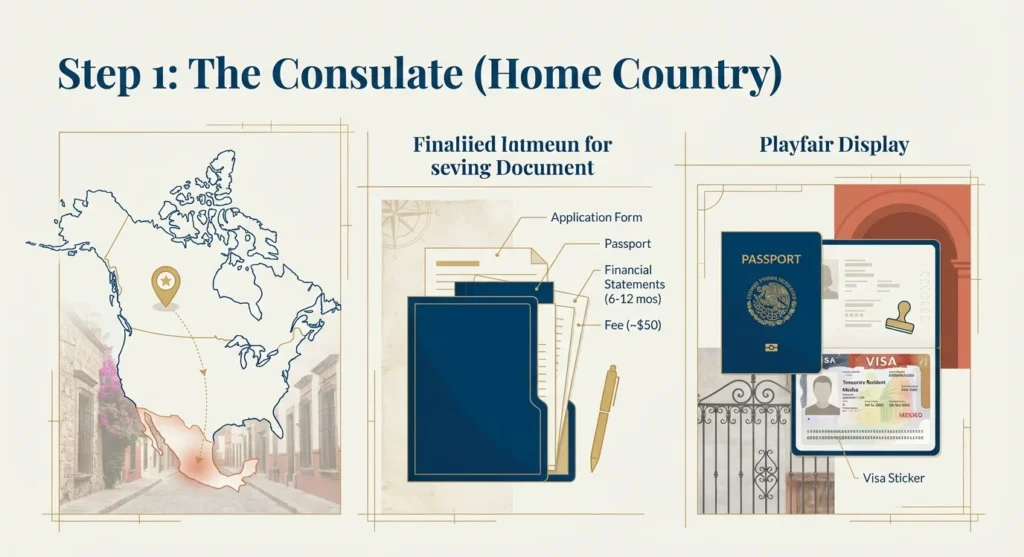
You apply at a Mexican consulate outside Mexico.
You submit:
• Application form
• Passport
• Income or savings documentation
• Photos
• Application fee (around $50 USD)
If approved, you receive a visa sticker in your passport.
Most retirees moving money across borders during this process find that fees add up faster than expected.
Wise handles international transfers at real exchange rates, straightforward, with no hidden costs buried in the conversion.
Step 2: Finalize Residency in Mexico
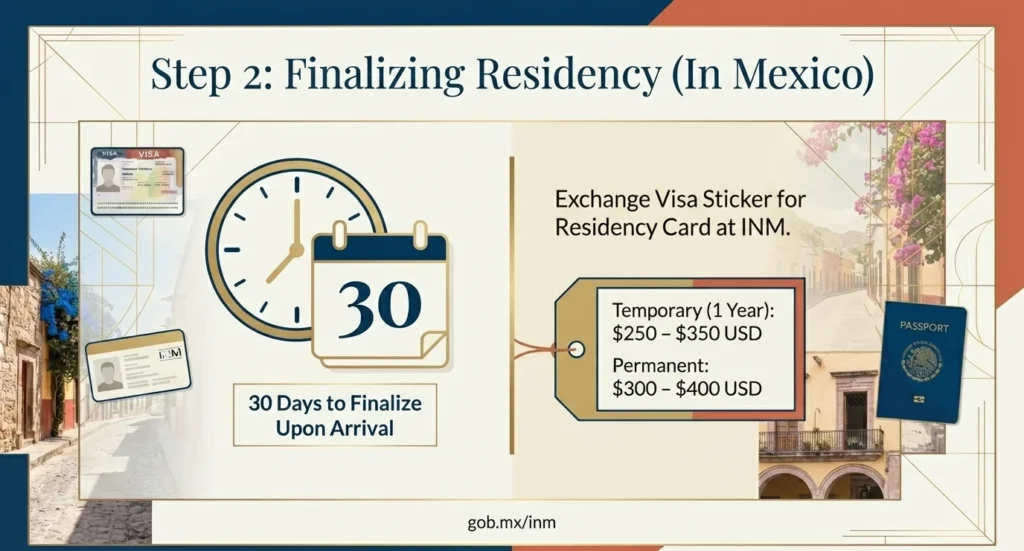
After entering Mexico, you have 30 days to complete the process at INM.
Current residency card fees are listed at https://www.gob.mx/inm.
Typical costs:
• Temporary Resident (1 year): roughly $250–$350 USD equivalent
• Multi-year Temporary: higher
• Permanent Resident: roughly $300–$400 USD equivalent
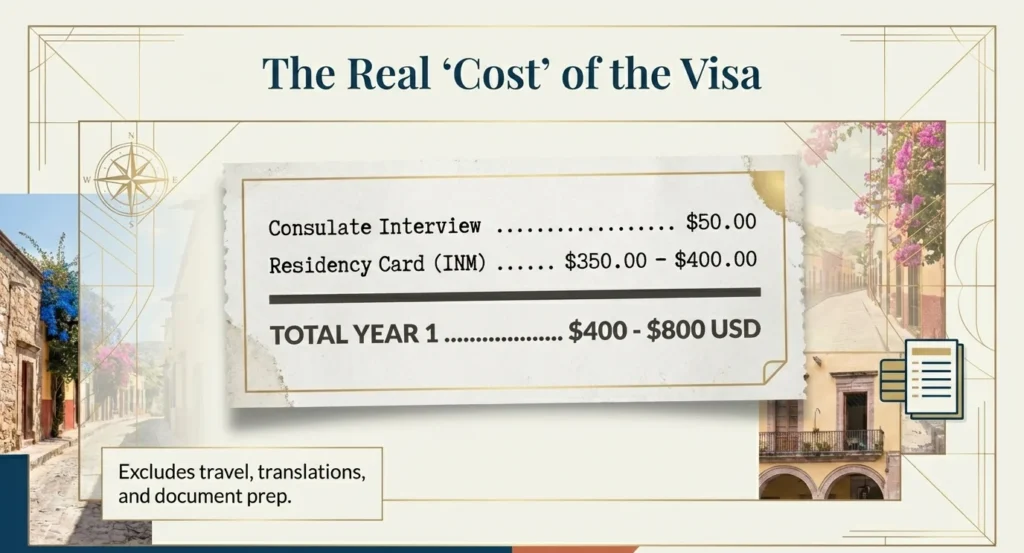
Total first-year mexico retirement visa cost typically falls between $400 and $800 USD, excluding travel or document preparation
For help structuring your full monthly budget around these costs, see monthly budget in Mexico.
Renewal Cost Over 4 Years
When calculating the real mexico retirement visa cost, many applicants focus only on the first year. However, renewal fees over four years change the total financial picture.
A Temporary Resident visa is typically issued for one year first. After that, you can renew for up to three additional years.
Current government renewal fees (paid in pesos at INM and converted approximately to USD equivalent) usually follow this structure:
• Year 1: $250–$350
• 2-year renewal: $400–$500
• 3-year renewal: $550–$650
If you choose to renew year-by-year instead of selecting a multi-year option, the total cost is usually higher.
A realistic 4-year total for Temporary Resident status often lands between $1,200 and $1,800 USD, excluding travel, legal assistance, translations, or document updates.
After four years of Temporary status, you may apply for Permanent Residency without re-proving income at the same threshold. That transition typically involves an additional government fee of roughly $300–$400 USD equivalent.
The key planning insight is this: while the initial visa fee looks small, the long-term residency structure increases the total mexico retirement visa cost meaningfully over time.
Tax Implications for Retirees
Visa approval does not automatically define your tax obligations.
Mexico taxes individuals based on tax residency, not visa category.
If you spend more than 183 days per year in Mexico, you may be considered a Mexican tax resident under SAT (Mexico’s tax authority) rules. Official tax guidance is published by Servicio de Administración Tributaria (SAT) at https://www.sat.gob.mx.
What This Means for Retirees
If you are classified as a tax resident:
• Worldwide income may become reportable in Mexico
• Pension income may be treated differently depending on treaty rules
• Investment income may trigger Mexican reporting obligations
However, the United States and Mexico have a tax treaty to avoid double taxation. U.S. retirees generally continue filing U.S. tax returns regardless of residence.
The practical reality is this:
Many retirees maintain U.S.-sourced income such as Social Security and pensions. Social Security is often taxed primarily by the U.S., while other income categories may require coordination.
Tax treatment varies by income type, so professional advice is recommended before relocating permanently.
The important takeaway is that the mexico visa financial requirements are separate from tax residency rules. Visa approval does not eliminate tax planning responsibilities.
Timeline: Approval to Residency Card
Understanding the timeline reduces stress and prevents compliance mistakes.
Below is a simplified step-by-step structure from approval to final residency card.
Step 1 – Consulate Appointment (Week 0)
Submit income or savings proof at a Mexican consulate.
If approved, a visa sticker is placed in your passport.
AND Step 2 – Enter Mexico (Within Visa Validity Window)
The visa sticker is typically valid for 180 days to enter Mexico.
the Step 3 – Begin INM Process (Within 30 Days of Entry)
After arriving in Mexico, you must visit a local INM office within 30 days to start residency card processing.
Step 4 – Biometrics and Payment (Weeks 2–4)
You submit fingerprints, photos, and pay the residency card fee.
Step 5 – Residency Card Issued (2–6 Weeks Total Processing Time)
Processing times vary by city, but most applicants receive their residency card within several weeks.
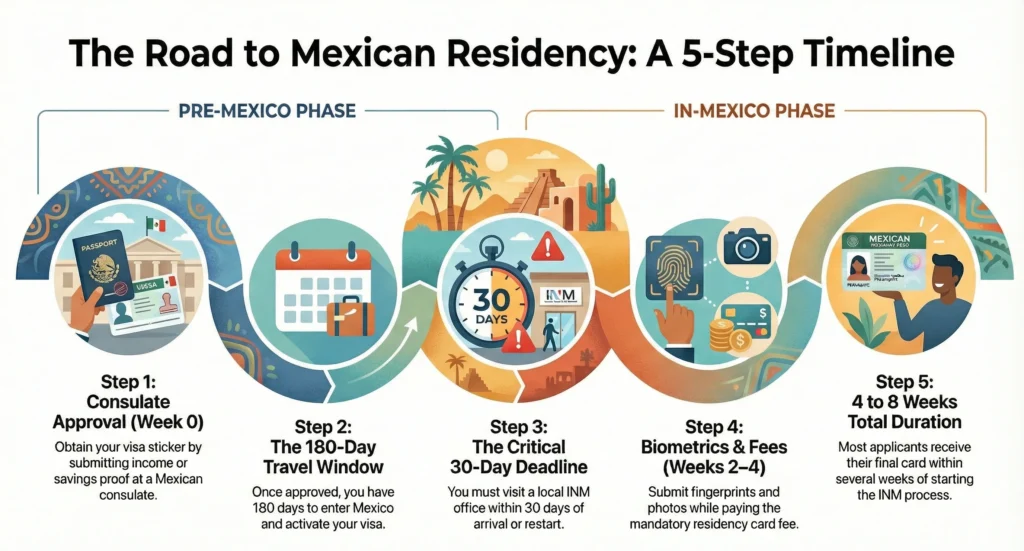
From consulate approval to holding your residency card in hand, the full process typically spans 4 to 8 weeks, depending on appointment availability and local INM processing speed.
Planning travel and housing arrangements around this timeline is critical.
There is a real coverage gap between visa approval and your residency card.
VisitorsCoverage fills that window with flexible plans built for people in exactly this transition, without locking you into a long-term commitment before you are settled.
Missing the 30-day INM deadline can invalidate your visa entry and force you to restart the process.
While managing your timeline, it is also a good moment to research long-term housing. For realistic pricing by city and lease strategy, see full guide to rent in Mexico.
Common Rejection Reasons
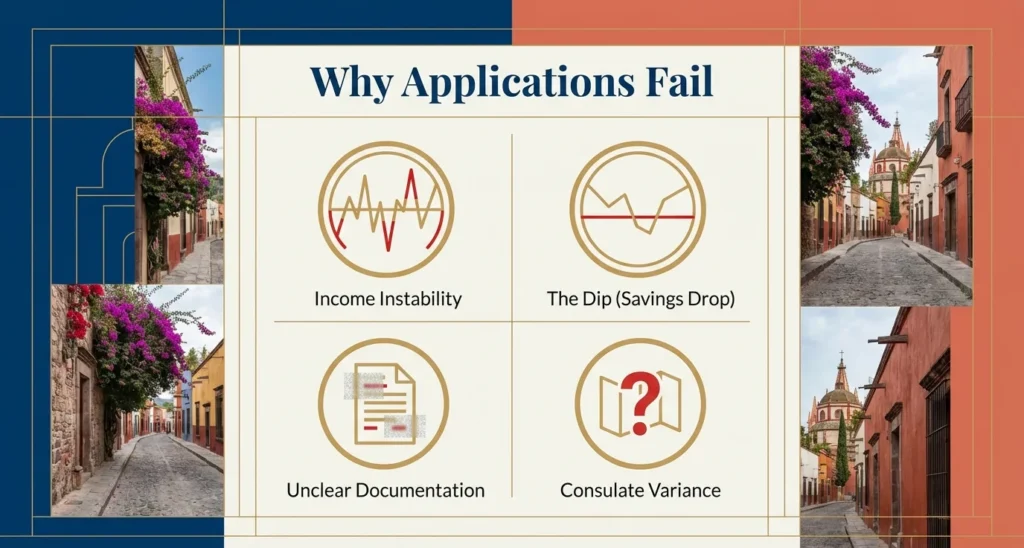
Most denials happen due to financial inconsistencies.
Income Instability
Applicants may technically meet the threshold but fail to show consistent income history.
Savings Dropping Below Requirement
Even a temporary dip can trigger rejection.
Documentation Issues
Statements must clearly display your name, account number, and transaction history.
Consulate-Specific Interpretation
Each consulate applies national policy with slight procedural differences. Some require 6 months of statements. Others require 12.
Always verify requirements directly with your specific consulate.
Weak Overall Financial Planning
Approval is only step one. If your income barely meets the requirement, long-term sustainability may feel tight once living costs begin.
Review your full projected Mexico cost breakdown before committing.
Choosing a lower-cost city can meaningfully reduce pressure on your income threshold. For a ranked breakdown, see cheapest cities in Mexico.
Strategic Planning Before You Apply
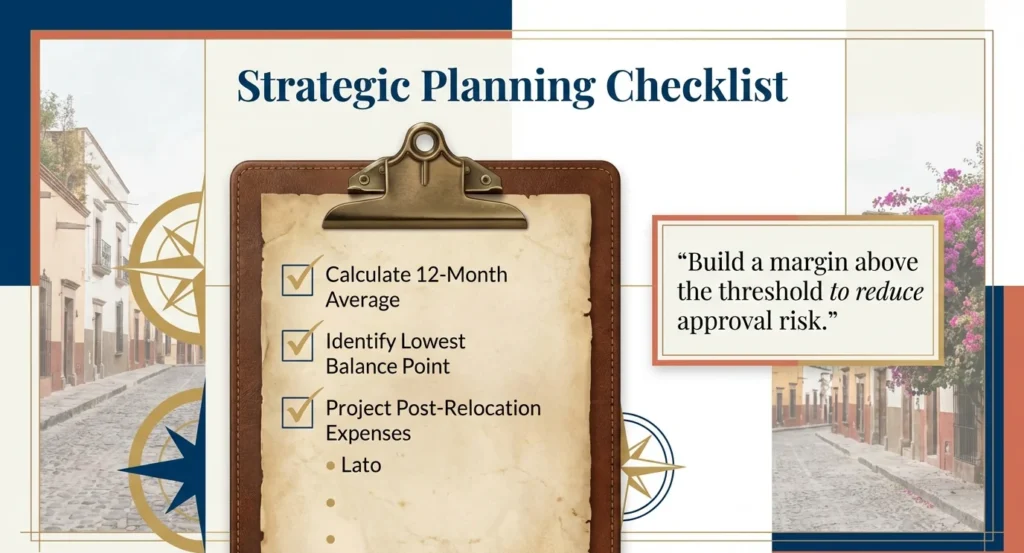
Before booking a consulate appointment, calculate clearly:
- Average monthly income over the past 12 months
- Lowest balance point during the last year
- Expected living expenses after relocation
Applicants who build margin above the threshold face far fewer approval risks.
Frequently Asked Questions
What is the total mexico retirement visa cost including fees?
Government fees typically total $400–$800 USD for the first year. Additional costs may include travel, translations, and renewals.
Can I retire in Mexico using Social Security only?
Yes, if your monthly Social Security exceeds the required threshold and is documented consistently.
Do mexico retirement visa requirements change yearly?
Yes. Because they are tied to UMA adjustments, thresholds may increase annually.
Is savings safer than income qualification?
Not automatically. Savings require long-term balance stability. Income requires consistent monthly flow. Risk depends on your financial structure.
How These Estimates Are Calculated
The Mexico cost models are based on long-term rental listings in major cities, expat-reported monthly expenses, officially published visa income requirements, and current healthcare provider pricing in both private and public systems. Financial thresholds are cross-checked against Mexican government publications and consulate guidance. Multiple data sources are reviewed to reduce promotional bias and reflect realistic long-term sustainability rather than short-term travel pricing.
Who This Guide Is For
This guide is written for Americans considering moving to Mexico for retirement, long-term residency, or financially sustainable relocation. It is intended for readers evaluating income requirements, healthcare costs, tax exposure, and structured cost of living analysis. It is not designed for short-term tourism planning.
Final Perspective

The true mexico retirement visa cost is not the application fee. It is the financial structure behind approval.
Income consistency matters.
Savings stability matters.
Documentation clarity matters.
When your financial proof clearly exceeds official mexico retirement visa requirements, approval becomes procedural rather than stressful.
Visa approval is step one.
Long-term financial stability determines whether retiring in Mexico remains comfortable.
Best Things to Do in Pattaya Beyond Nightlife (2026 Edition)
Introduction Pattaya is often reduced to its nightlife, but that only tells part of the story. If you are searching for…

Can You Really Live in Mexico on $2,000 a Month? (2026 Comfortable Lifestyle Breakdown)
If you’re researching whether you can realistically live in Mexico on 2000 a month, you are probably asking a deeper…
How to Avoid Tourist Scams in Pattaya (2026 Safety Guide)
Don’t let scams ruin your Pattaya trip. In this 2025 guide, discover the most common tourist traps from overpriced taxis…

What Is Pattaya Famous For? Attractions, Nightlife & Beaches (2026)
Introduction If you ask most people what Pattaya is famous for?, they usually mention nightlife first. That reputation is real, but…