
Table of Contents
- What does “visa renewal” actually mean in Thailand?
- When should Americans apply for renewal?
- What financial requirements must be met at renewal?
- Required documents for retirement renewal
- Cost breakdown for visa renewal
- Step-by-step renewal process
- Income proof verification during renewal
- Healthcare insurance requirement at renewal
- Tax clarity during renewal
- Renewal vs applying for new visa abroad
- Common renewal mistakes Americans make
- Real renewal scenario
- Long-term planning beyond annual renewal
- Frequently Asked Questions
This guide explains the Thailand visa renewal process for Americans, including required financial proof, extension costs, income requirements, bank documentation, healthcare obligations, tax clarity, and common renewal mistakes that lead to denial.
This applies to retirement, marriage, and long-stay extensions inside Thailand.
What does
“visa renewal”
actually mean in Thailand?
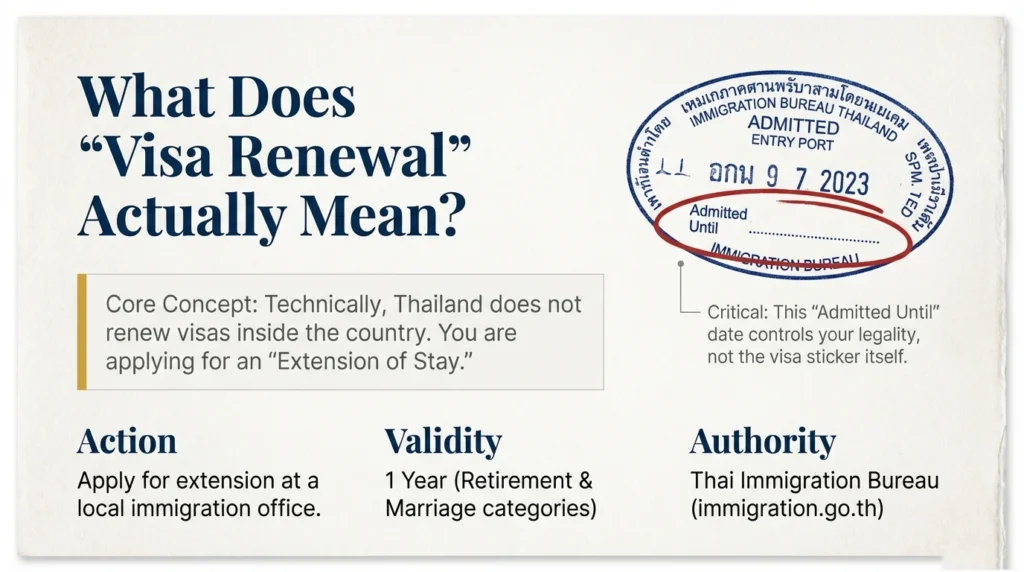
Technically, Thailand does not renew visas inside the country.
You apply for an extension of stay at a local immigration office before your permitted stay expires.
The standard extension validity:
- 1 year for retirement and marriage
- Shorter periods for certain categories
Official authority:
Thai Immigration Bureau
Your passport stamp shows “Admitted Until” date.
That date controls legality.
When should Americans apply for renewal?
Apply 2–4 weeks before expiration.
Applying late increases risk of:
- Overstay fines
- Financial proof timing errors
- Insurance lapses
Overstay penalties are 500 THB per day, capped at 20,000 THB.
Do not wait until final days unless documents are fully prepared.
What financial requirements must be met at renewal?
Financial proof depends on visa category.
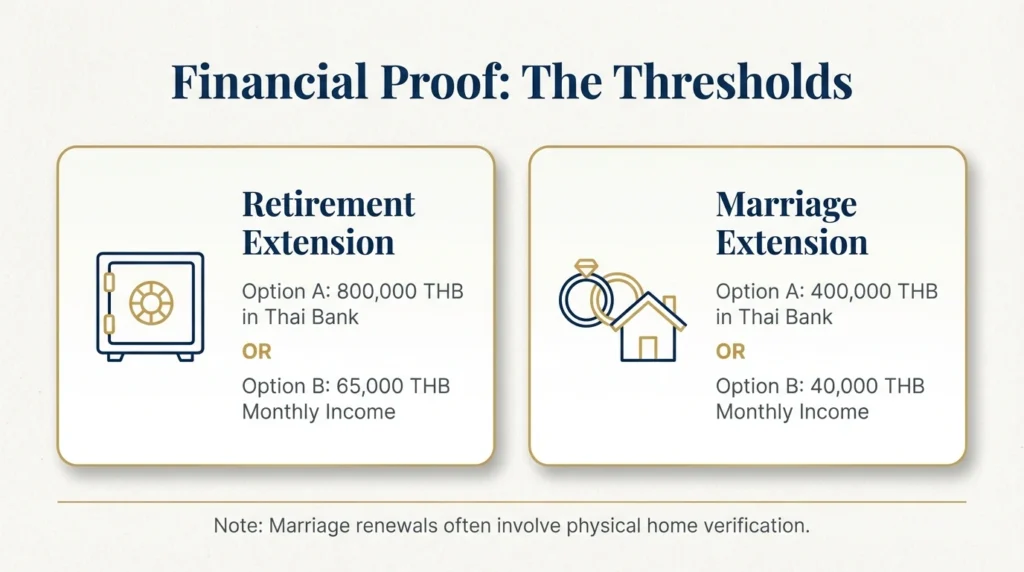
Retirement extension
You must show either:
- 800,000 THB in Thai bank, or
- 65,000 THB monthly income
Full breakdown is covered in Thailand retirement visa financial requirements.
Marriage extension
You must show:
- 400,000 THB bank deposit, or
- 40,000 THB monthly income
Marriage renewals often involve home verification.
Required documents for retirement renewal
Immigration requires original, certified documentation.
Standard document list
- TM7 extension form
- Passport copies
- 4×6 cm photo
- Bank certification letter
- Updated passbook
- Stamped bank statements
- Proof of residence
- Insurance certificate if required
Bank letter must be issued same day as application.
Documentation errors are the most common cause of delays.
Cost breakdown for visa renewal
Basic immigration fees
| – | THB | USD |
|---|---|---|
| Extension fee | 1,900 | $52 |
| Single re-entry | 1,000 | $27 |
| Multiple re-entry | 3,800 | $105 |
Additional documentation costs
| – | USD |
|---|---|
| Bank certification | $3–6 |
| Statement copies | $3 |
| Photos and printing | $5 |
| Transport | $10–20 |
Estimated total annual renewal cost: $60–150, excluding insurance.
Step-by-step renewal process
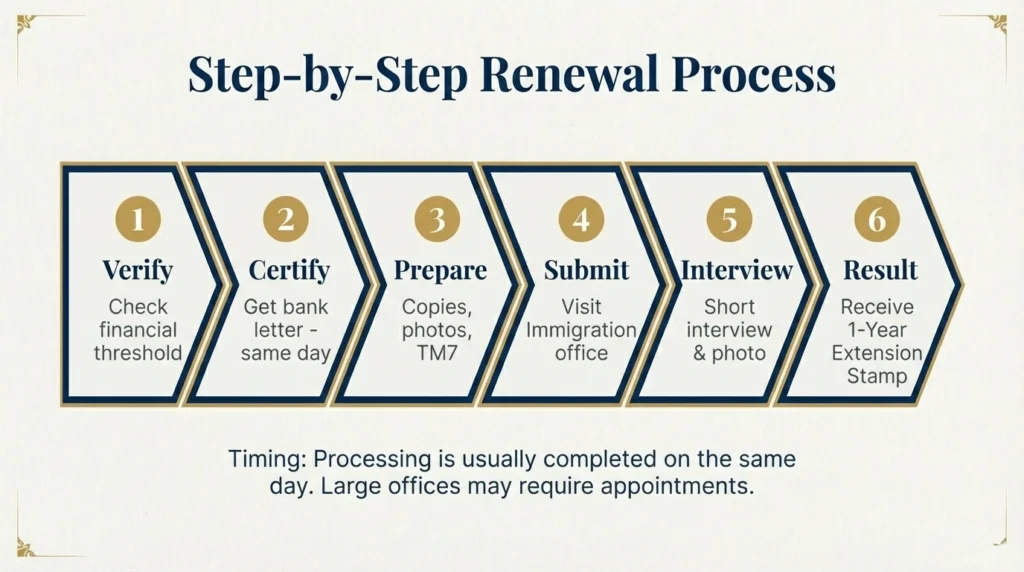
- Verify financial threshold compliance
- Obtain bank certification letter
- Prepare copies and forms
- Submit application at immigration
- Attend short interview
- Receive 1-year extension stamp
Processing time is usually same day.
Large offices like Bangkok may require queue appointments.
Income proof verification during renewal
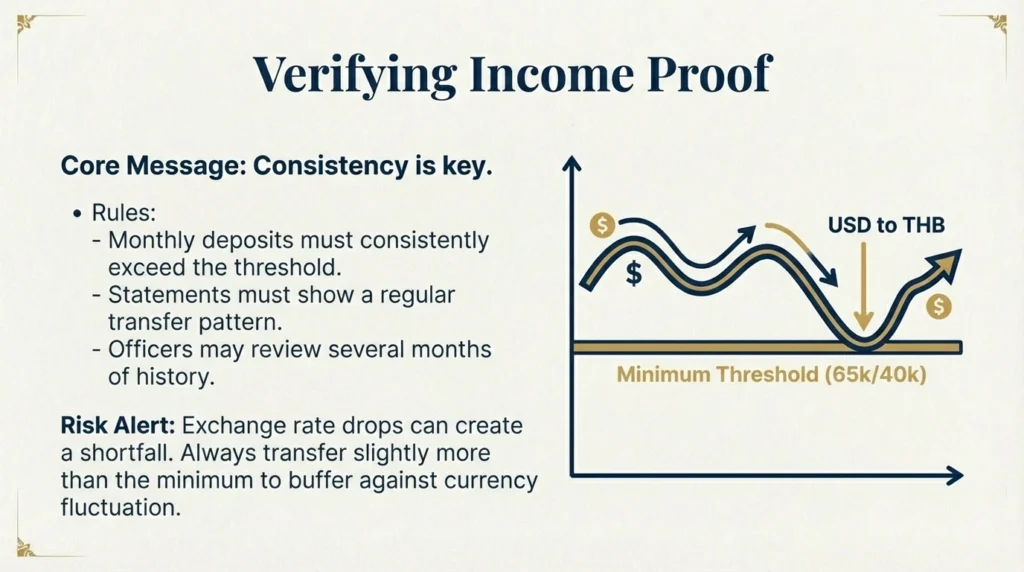
If qualifying by income:
- Monthly deposits must consistently exceed 65,000 THB equivalent
- Statements must show regular transfer pattern
- Exchange rate drops can create shortfall
That shortfall does not come from your pension changing. It comes from your bank taking a cut on the conversion before the money even lands in Thailand.
Most expats who have been through one stressful renewal already switched to Wise for their monthly transfers. It converts at the real mid-market rate, shows you exactly what arrives in baht before you confirm the transfer, and removes the one variable that turns a routine renewal into a second immigration visit.
Income documentation details are explained in How to Show Income Proof for Thailand Retirement Visa.
Officers may review several months of statements.
Healthcare insurance requirement at renewal
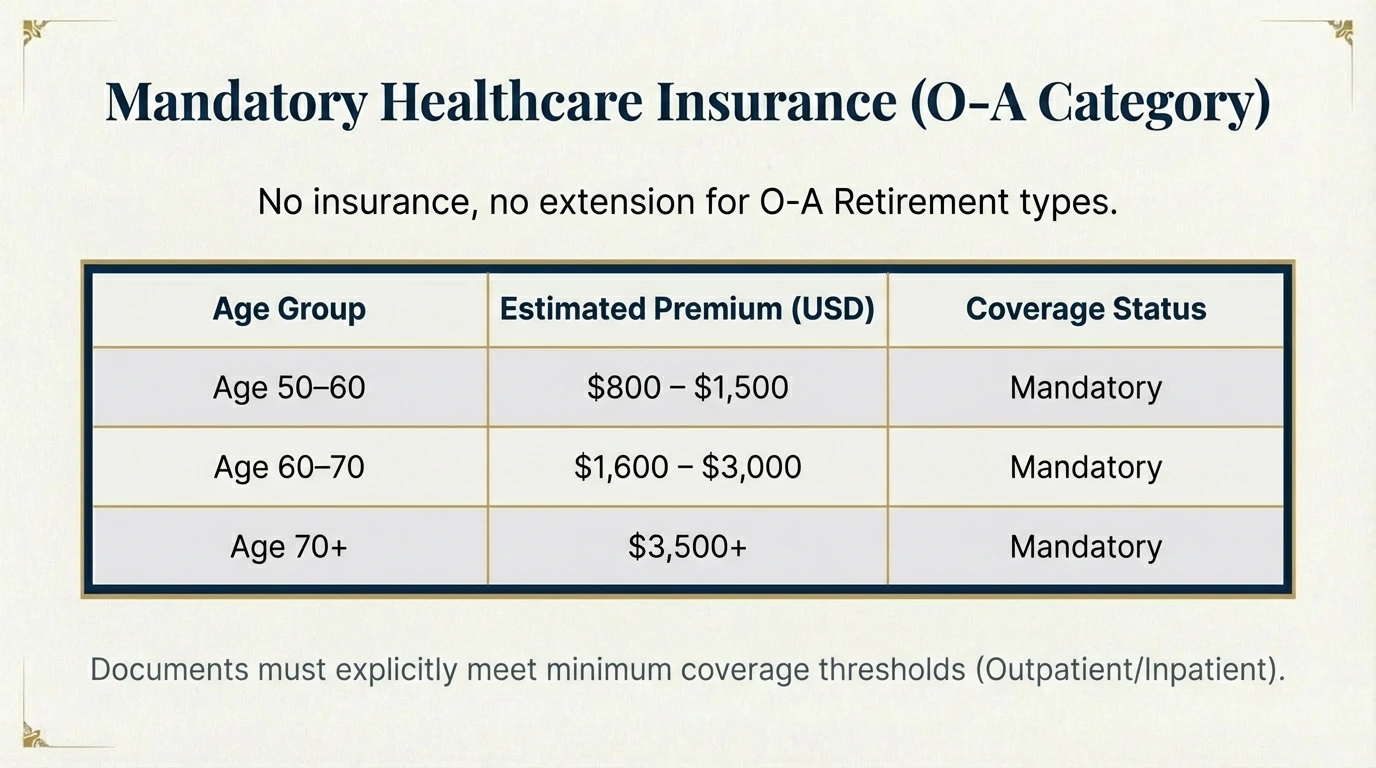
notice – Insurance is mandatory.
(Private hospital for checking pricing.)
For Americans renewing under the O-A retirement category, health insurance is not a formality.
Immigration checks whether your policy meets minimum inpatient and outpatient coverage thresholds before approving the extension.
If the policy does not meet the required limits, renewal can be denied even if financial requirements are satisfied.
Most people spend weeks preparing their bank documents and forget to check whether their insurance policy still meets the minimum thresholds until they are standing at the counter.
That is the mistake that sends you home without an approval stamp despite having everything else in order.
VisitorsCoverage is where most long-term residents in Thailand compare and renew international health plans before renewal season.
You filter by age, verify coverage limits, and arrive at immigration with a policy that actually clears the requirement, not one that looks close enough.
Annual premiums typically range from $800 to $1,500 for ages 50–60, $1,600 to $3,000 for ages 60–70, and $3,500 or more for applicants over 70.
Policies must remain active for the full extension period.
Retirees relying on low monthly income should calculate insurance cost as part of total renewal expense, not as a separate optional item.
Tax clarity during renewal
Visa renewal does not affect U.S. tax filing obligations.
Americans must:
- File annual U.S. returns
- Report foreign bank accounts if required
- Monitor Thai tax residency exposure
(Thai Revenue Department reference)
Staying over 180 days may trigger Thai tax residency considerations.
Visa extension and tax residency are separate issues.
Renewal vs applying for new visa abroad
| Category | Renewal Inside Thailand | New Visa Abroad |
|---|---|---|
| Travel cost | None | Required |
| Processing time | Same day | Several days |
| Financial proof | Required | Required |
| Disruption | Low | High |
Renewing inside Thailand is usually the lower-risk cheaper and efficient.
You avoid international flights, hotel costs, embassy scheduling delays, and re-entry uncertainty.
The financial proof requirement does not disappear if you apply abroad. You still must show income or deposit compliance.
Processing inside Thailand is often completed the same day.
Applying abroad can take several days, sometimes longer depending on embassy workload.
There is also disruption cost.
Flights, temporary accommodation, missed rental days, and schedule changes add real expense.
If your financial documentation is already compliant, renewal inside Thailand is typically the more efficient and financially controlled route.
Common renewal mistakes Americans make
- Allowing bank balance to drop below threshold
- Waiting too late to apply
- Using outdated bank letter
- Missing 90-day report
- Traveling without re-entry permit
Most renewal denials are procedural, not financial.
Allowing your bank balance to fall below the required threshold is a common error.
Immigration reviews transaction history, not just the current balance.
If funds drop below the permitted minimum during the restricted period, renewal can be refused.
Waiting too late to apply creates unnecessary risk.
If seasoning rules were not met exactly on time, there may be no opportunity to correct the issue before expiration.
Overstay fines begin immediately at 500 THB per day.
Using an outdated bank certification letter is another frequent mistake.
Most immigration offices require a same-day bank letter.
Older documentation can result in rejection and a second visit.
Missing a 90-day report or traveling without a re-entry permit also complicates renewal.
Without a re-entry stamp, your extension becomes void upon departure.
In most cases, approval depends less on income level and more on procedural accuracy.
Real renewal scenario
Retirement deposit method example
- Maintains 800,000 THB for required period
- Applies 3 weeks before expiration
- Pays 1,900 THB
- Obtains multiple re-entry permit
Total cost: ~$157 including re-entry permit and documentation.
Financial preparation prevents delays.
Long-term planning beyond annual renewal
Annual renewals require:
- Financial discipline
- Insurance planning
- Address reporting
- Currency monitoring
If considering long-term relocation strategy, review the Thailand Relocation Guide before committing to a visa structure.
Also review moving to Thailand from USA for full sequencing guidance.
Frequently Asked Questions
How early can I renew my Thailand visa?
Typically 30 days before expiration. Exact timing depends on immigration office.
Do I need to show financial proof every year?
Yes. Retirement and marriage extensions require financial documentation at each renewal.
What happens if my renewal is denied?
You may need to leave Thailand before your permitted stay expires to avoid overstay penalties.
Is renewal fee refundable?
No. The 1,900 THB fee is not refunded if application is rejected.
Do I need a re-entry permit after renewal?
Yes if you plan to leave Thailand. Without it, your extension becomes void upon departure.
Does renewing affect my tax status?
No. Tax residency is based on days present and income structure, not visa type.

Thailand Retirement Visa Financial Requirements Explained
This guide explains Thailand retirement visa financial requirements for foreigners who need exact income thresholds, proof rules, cost structures, and…

Can Americans Use Savings for Thailand Retirement Visa Financial Requirements?
This guide explains whether Americans can use savings for Thailand retirement visa financial requirements, how much is required, what proof…

Thailand Visa Extension Cost Breakdown for Americans in 2026
This guide explains the Thailand visa extension cost breakdown for Americans living long term, including official immigration fees, financial proof…
Thailand Overstay Fine Explained Real Costs for Americans
This guide explains the Thailand overstay fine real costs, including daily penalties, maximum caps, detention risk, deportation consequences, visa extension…