

Table of Contents
- Monthly Cost Overview
- Housing & Rent Breakdown
- Food & Daily Expenses
- Healthcare Considerations
- Financial Requirements or Visa Rules
- One-Time Relocation Expenses Mexico Requires
- How Much Money Do You Need to Move to Mexico? Realistic Scenarios
- Mistakes to Avoid When Moving to Mexico
- Advantages and Financial Tradeoffs
- What You Actually Need Before You Get on the Plane
- Frequently Asked Questions
- The Honest Reality
If you’re researching how much money do you need to move to mexico, you are not just asking about rent. You are asking about runway. Savings. Visa requirements. Setup costs. Healthcare. Financial risk.
This 2026 guide breaks down real relocation expenses Mexico requires, including one-time moving costs, monthly living budgets, visa financial thresholds, and realistic cash reserves Americans should plan before relocating.
This is not a vacation estimate. This is a relocation model.
Monthly Cost Overview
The first layer of understanding move to Mexico cost is monthly burn rate.
In most inland Mexican cities, a realistic monthly budget for one person ranges from $1,500 to $2,000 depending on rent and healthcare structure. Coastal or premium areas often require $2,200 to $3,000 for comparable comfort.
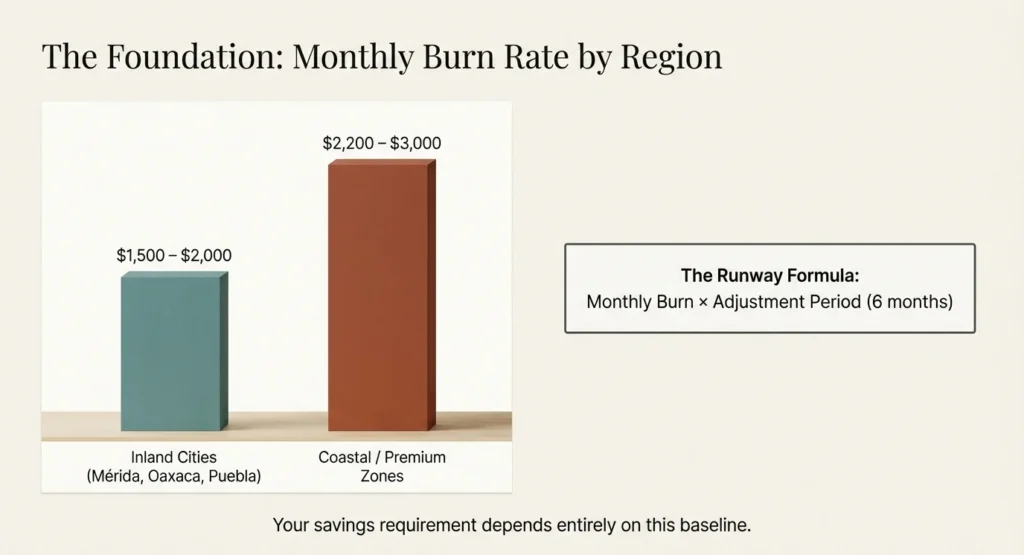
That means your monthly living cost becomes the foundation of how much money you need to move to Mexico successfully.
If your planned monthly lifestyle costs $1,800, then a six-month runway requires $10,800 in accessible funds before considering visa fees, deposits, and relocation expenses.
For broader regional breakdowns, see our full Cost of Living in Mexico pillar:
https://takviewer.com/cost-of-living/mexico/cost-of-living-in-mexico-2026-breakdown
Key principle: your savings requirement depends on your monthly burn rate multiplied by your adjustment period.
Housing & Rent Breakdown
Housing is your largest recurring expense and your largest upfront cash requirement.
Monthly Rent (2026 Ranges)
- Mérida: $500 to $800
- Oaxaca: $450 to $750
- Querétaro: $600 to $900
- Puebla: $600 to $900
- Mexico City mid-tier: $900 to $1,500
- Premium coastal zones: $1,000 to $1,800
Upfront Rental Costs
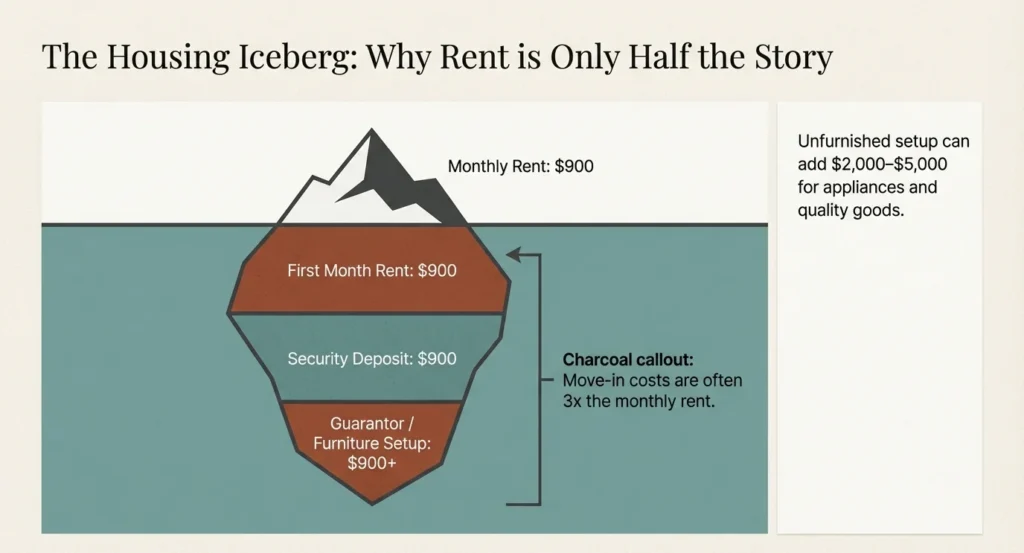
Most Mexican landlords require:
- First month rent
- Security deposit equal to one month
- In some cases a guarantor or additional deposit
That means a $900 apartment may require $1,800 to $2,700 upfront.
Furnished rentals reduce furniture purchases but increase rent slightly.
If you choose unfurnished housing, initial setup costs can range from $2,000 to $5,000 depending on quality.
Reality check: many relocation budgets fail because people calculate monthly rent but ignore deposits and setup costs.
Food & Daily Expenses
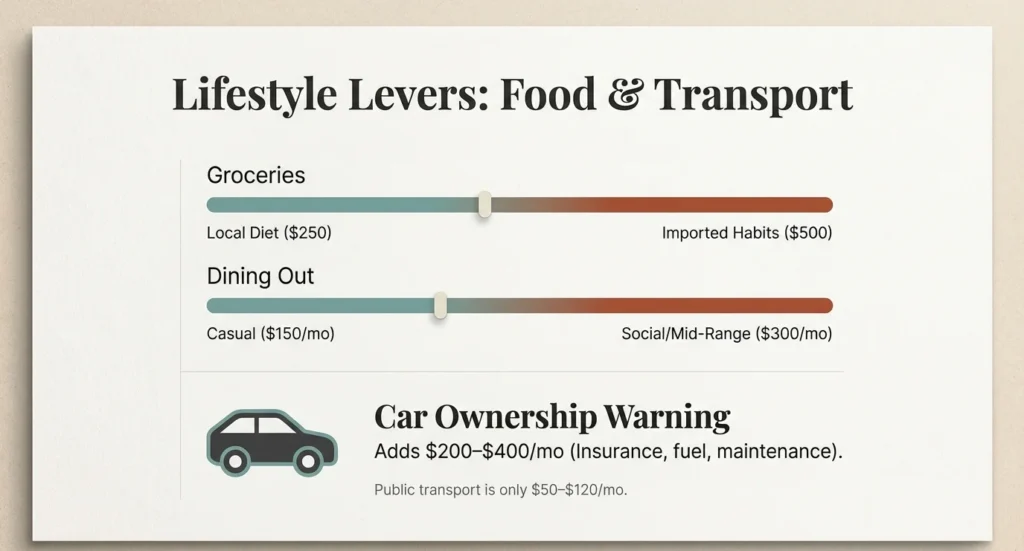
Food costs in Mexico remain lower than the United States, but imported habits increase spending.
Groceries
A realistic grocery budget for one person:
- Local-focused diet: $250 to $350
- Mixed local and imported goods: $350 to $500
Dining Out
- Casual meals: $8 to $15
- Mid-range dining: $15 to $25
A moderate lifestyle with weekly dining out often adds $150 to $300 per month.
Transportation
If you avoid owning a car:
- Public transport and ride-share: $50 to $120 monthly
If you own a vehicle:
- Insurance, fuel, maintenance: $200 to $400 monthly
Owning a car significantly changes how much money you need to move to Mexico long term.
Healthcare Considerations
Healthcare planning directly affects relocation expenses Mexico requires.
Private doctor visits typically cost $30 to $60 per appointment in many cities.
International private health insurance averaged approximately $5,485 annually according to Pacific Prime’s reported figures, or roughly $450 per month.
Insurance premiums increased in 2026 due to medical inflation.
This creates three relocation strategies:
- Full international insurance
- High deductible policy plus cash reserve
- Out-of-pocket care with catastrophic backup
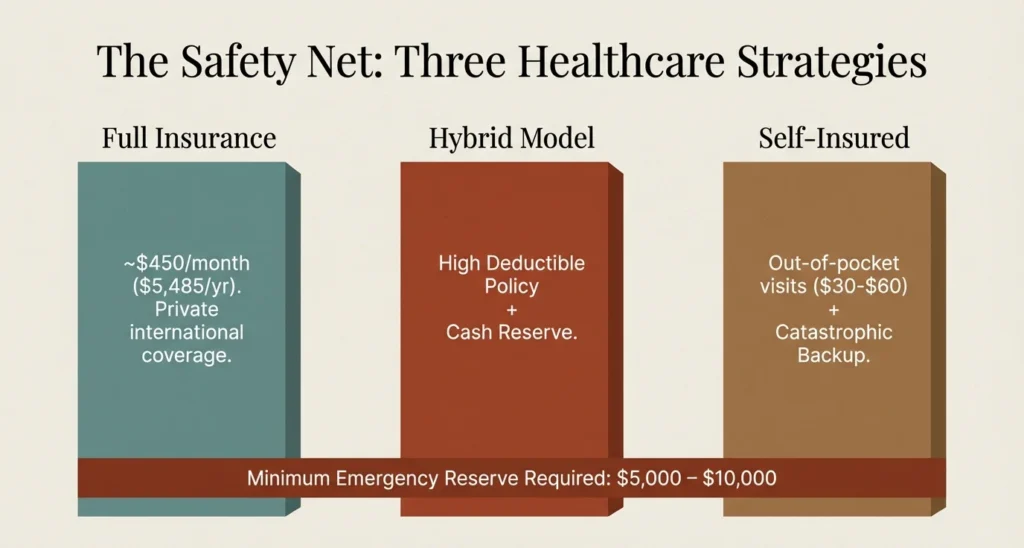
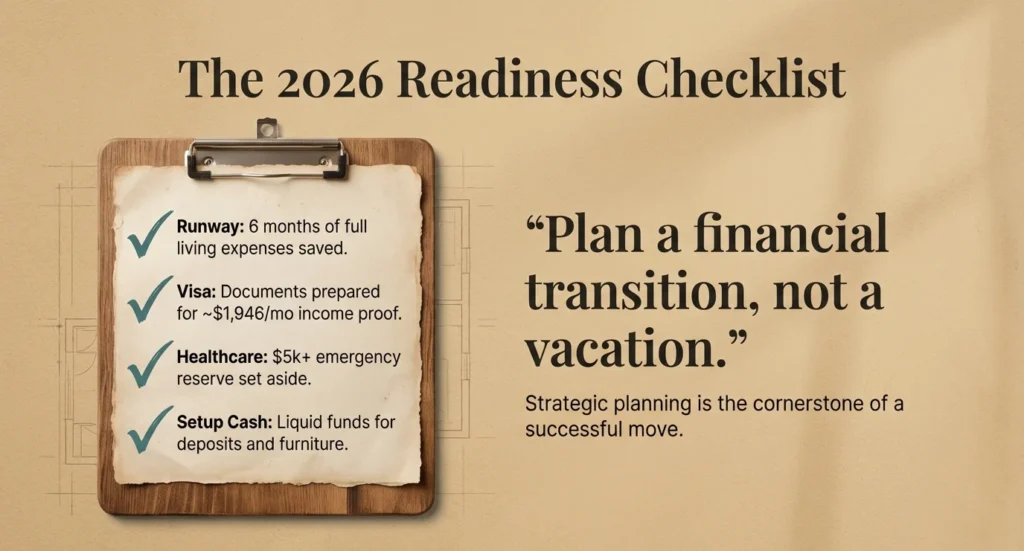
At minimum, new movers should hold $5,000 to $10,000 emergency healthcare reserves.
Some short-term movers and remote workers use flexible global coverage like SafetyWing when they first arrive:
https://takviewer.com/go/Safetywing
Others compare travel medical plans through VisitorsCoverage before transitioning to long-term residency insurance:
https://takviewer.com/go/Visitorscoverage
For structural breakdowns, see:
https://takviewer.com/taxes-and-financial/healthcare-costs-in-mexico
Financial Requirements or Visa Rules
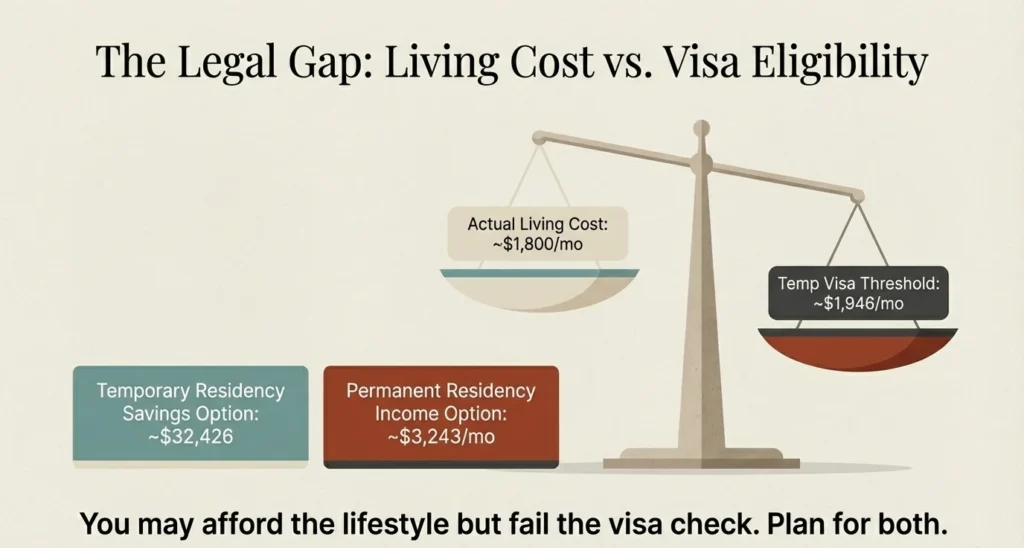
Visa thresholds determine whether your income qualifies you to live in Mexico legally.
According to MEXLAW’s 2026 update, Temporary Residency requires proof of approximately $1,946 monthly income or $32,426 in savings. Permanent Residency requires roughly $3,243 monthly income or $130,000 in savings.
(Source)
This means relocation savings and visa eligibility are separate calculations.
You may have enough to live month to month, but not enough to qualify.
For full breakdowns see:
Mexico Temporary Resident Visa Income Requirement
https://takviewer.com/retirement-long-term-visa/mexico-temporary-resident-visa-income-requirement
Mexico Permanent Resident Visa Financial Requirements
https://takviewer.com/retirement-long-term-visa/mexico-permanent-resident-visa-financial-requirements
Visa Application Costs
- Consulate application fees: approximately $50 to $60
- Temporary residency card issuance in Mexico: approximately $150 to $300
- Legal assistance if used: $1,000 to $3,000
These are one-time costs but must be budgeted.
One-Time Relocation Expenses Mexico Requires
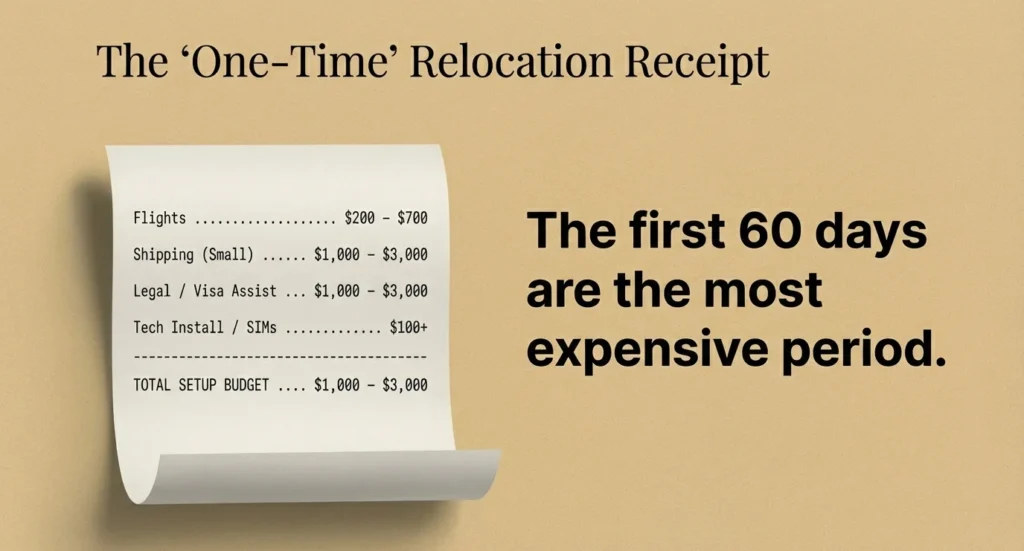
Beyond rent and visas, relocation expenses Mexico includes:
Flights
- One-way ticket: $200 to $700 depending on season
Shipping Personal Belongings
- Small shipment: $1,000 to $3,000
- Full container relocation: $5,000 to $10,000
Many expats sell furniture and rebuy locally to reduce cost.
Initial Setup Costs
- SIM cards and internet installation
- Household goods
- Bank account setup travel
Expect $1,000 to $3,000 in miscellaneous setup spending.
How Much Money Do You Need to Move to Mexico? Realistic Scenarios
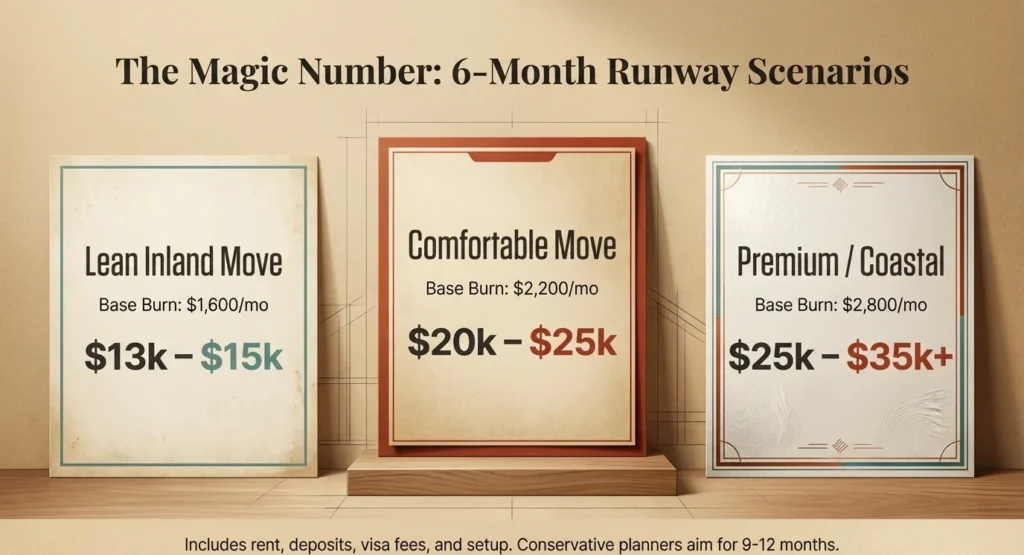
Scenario 1: Lean Inland Move
- Monthly burn: $1,600
- 6 month runway: $9,600
- Rent deposits and setup: $3,000
- Visa fees and travel: $1,000
Minimum savings target: $13,000 to $15,000
Scenario 2: Comfortable Move
- Monthly burn: $2,200
- 6 month runway: $13,200
- Housing setup: $4,000
- Visa and legal: $2,000
Savings target: $20,000 to $25,000
Scenario 3: Coastal or Premium City Move
- Monthly burn: $2,800
- 6 month runway: $16,800
- Setup and deposits: $5,000+
Savings target: $25,000 to $35,000
The more flexible your income, the lower your required reserves.
Mistakes to Avoid When Moving to Mexico
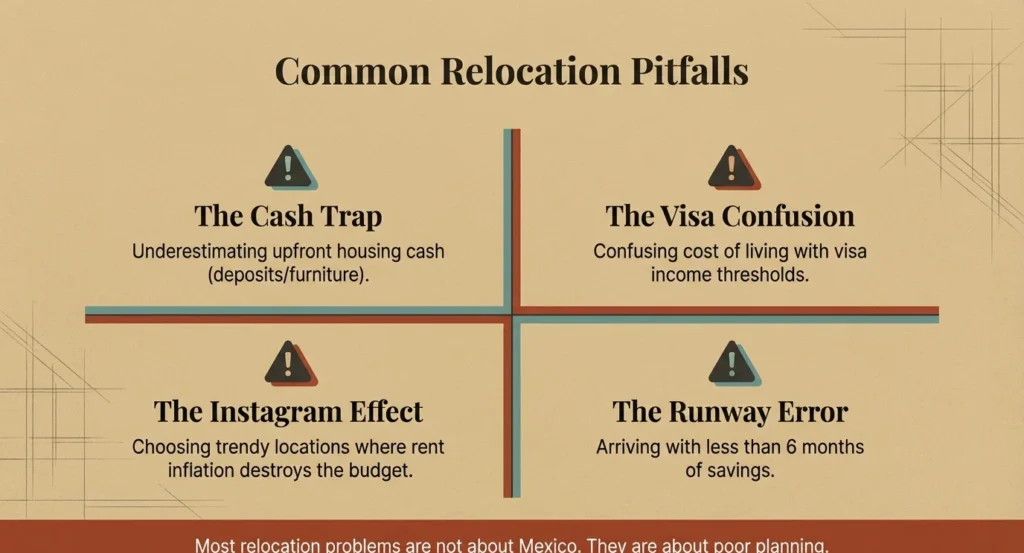
If I were explaining this to a friend over coffee, I would say this clearly. Most relocation problems are not about Mexico. They are about poor planning.
| Mistake | What Happens | Why It Hurts |
|---|---|---|
| Underestimating upfront cash needs | You budget for monthly rent but ignore deposits, furniture, and setup costs. | The first 60 days become the most expensive period and drain savings faster than expected. |
| Confusing cost of living with visa qualification | You can live comfortably on $1,800 per month. | You may still fail to meet official income thresholds for residency approval. |
| Moving without healthcare structure | You rely on low doctor visit prices. | A single emergency can disrupt your entire financial plan. |
| Choosing location based on Instagram | You pick a tourist-heavy or trendy area. | Rent pressure rises quickly and reduces your cost advantage. |
| Arriving with no runway | You relocate with minimal savings. | Financial stress builds fast. Six months is minimum. Nine to twelve months creates stability. |
Relocation works best when it is treated like a financial transition, not a lifestyle experiment.
Advantages and Financial Tradeoffs
Advantages
- Lower housing costs in most inland cities
- Reduced service expenses
- More predictable medical pricing
- Ability to stretch fixed retirement income
Tradeoffs
- Currency risk for dollar-based retirees
- Visa financial thresholds above living costs
- Imported goods increase spending
- Private insurance premiums rising
Savings exist. Structure determines outcome.
What You Actually Need Before You Get on the Plane
To answer clearly: how much money do you need to move to mexico in 2026?
Minimum lean relocation: $13,000 to $15,000
Comfortable relocation: $20,000 to $25,000
Premium relocation: $25,000 to $35,000+
These numbers assume six months of runway.
More conservative movers often prefer nine to twelve months of savings.
Frequently Asked Questions
1. Is this realistic for a single person?
Yes. A single person relocating to an inland city can realistically move with $15,000 to $20,000 in total savings if monthly costs remain under control.
2. Is this budget realistic for a couple?
Couples typically require 30 to 50 percent more monthly spending and larger deposits. A comfortable couple relocation often requires $25,000 to $40,000 depending on city.
3. Which cities are most affordable under this scenario?
Mérida, Oaxaca, Puebla, and Querétaro consistently show lower rental pressure and balanced infrastructure.
4. Does this include healthcare and insurance?
Yes. These estimates include either private insurance allocation or emergency healthcare reserves.
5. Are these numbers realistic for 2026?
Yes. Figures reflect 2026 rent ranges, insurance reports, and current visa thresholds.
6. Can you move to Mexico with $10,000?
Possible but risky. That amount leaves little runway for unexpected costs or delays in income generation.
7. Do you need to show savings to move to Mexico?
Yes for residency visas. Temporary residency requires documented income or savings thresholds.
8. What is the biggest unexpected relocation expense?
Housing deposits and furnishing costs surprise most new movers.
9. How long should you have savings before moving?
At minimum six months of full living expenses. Conservative planners prefer nine to twelve months.
10. Is moving to Mexico cheaper than staying in the United States?
In most inland markets, yes. Housing and service costs remain structurally lower than comparable U.S. cities.
The Honest Reality
Moving to Mexico requires more than a monthly rent estimate. You need runway, visa qualification, emergency healthcare reserves, and structured housing deposits.
Plan the move like a financial transition, not a vacation, and your relocation becomes sustainable rather than stressful.