

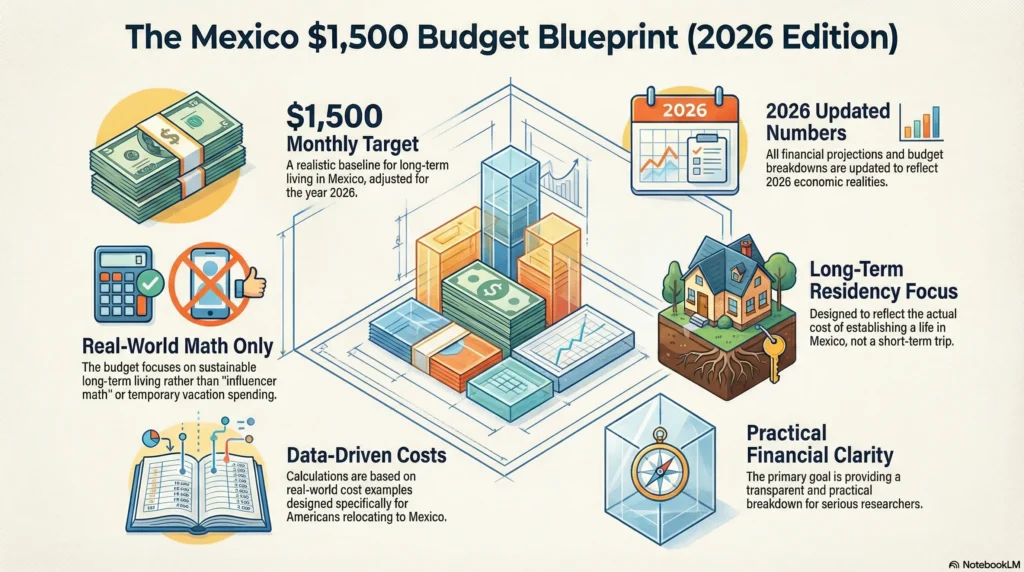
If you’re researching whether you can realistically live in Mexico on 1500 a month, this guide provides updated 2026 numbers, real cost examples, and practical financial breakdowns for Americans considering relocation. The goal here is clarity . not influencer math, not vacation budgets, but what long‑term living actually costs.
Monthly Cost Overview
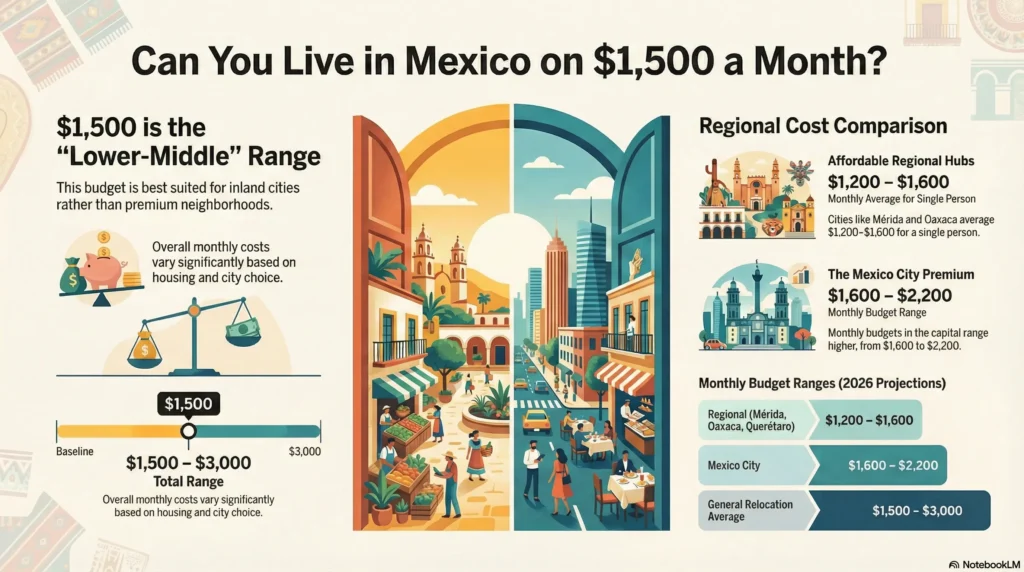
Living in Mexico on $1,500 per month is possible . but only in specific cities and with controlled housing costs.
According to Lexidy’s 2026 cost comparison, regional cities like Mérida, Oaxaca, and Querétaro show average single‑person monthly budgets between $1,200–$1,600, while Mexico City ranges from $1,600–$2,200 depending on lifestyle and rent (Lexidy, 2026).
That means $1,500 sits at the lower‑middle range for affordable inland cities . and below the comfort range for premium coastal or central neighborhoods.
Mexico Relocation Guide estimates overall monthly living costs for singles or couples between $1,500 and $3,000, depending heavily on housing and city choice (Mexico Relocation Guide, 2026).
Typical Budget Allocation
Based on relocation data:
- Housing: 40–50%
- Food: 20–30%
- Healthcare: 10–20%
- Transportation: 5–10%
Housing is the deciding factor. Keep rent controlled and $1,500 works. Choose a tourist zone, and it doesn’t.
For broader country comparisons, see our full Cost of Living hub and the detailed breakdown of Cheapest Cities in Mexico:
https://takviewer.com/cost-of-living/mexico/cheapest-cities-mexico
Housing & Rent Breakdown
Housing determines whether this budget succeeds or fails.
Rent by City (2026 Realistic Ranges)
From Lexidy’s 2026 data:
- Mérida: $400–$600 (1‑bed center)
- Oaxaca: $400–$600
- Querétaro: $450–$650
- Puebla: $450–$700
- Mexico City: $700–$1,400
(Source: Lexidy Cost Comparison 2026)
In coastal expat cities like Playa del Carmen or Puerto Vallarta, rents typically range from $600–$1,200 for a 1‑bedroom in a good area (American Industrial Magazine, 2026).
At $1,500 total budget, rent should ideally stay under $700.
Utilities & Internet
Utilities typically range between $60–$120 per month, depending on AC usage and city (American Industrial Magazine, 2026).
Internet averages $25–$40 per month in major cities.
How to Lower Rent
Mexico Relocation Guide notes that living outside tourist zones and avoiding expat‑heavy areas significantly reduces rent pressure (Mexico Relocation Guide, 2026).
The difference between a beach zone and a local neighborhood can be $300–$500 monthly.
Food & Daily Expenses
Food is manageable within this budget.
Groceries
Average monthly groceries for one person:
- United States: $400–$600
- Mexico: $200–$350
(Source: American Industrial Magazine, 2026)
Shopping at local markets reduces costs further.
Dining Out
Mid‑range dinner:
- United States: $25–$40
- Mexico: $10–$20
Transportation
Public transportation is inexpensive. Many expats live without a car.
Mexico Relocation Guide estimates transportation costs at roughly 5–10% of monthly budget (Mexico Relocation Guide, 2026).
A realistic allocation: $50–$100 per month.
Healthcare Considerations

Healthcare remains one of Mexico’s cost advantages, but structure matters. Private doctor visits typically cost $30–$60 per appointment according to American Industrial Magazine’s 2026 comparison.
Compare visitor health plans starting under $50/month → Visitors Coverage
International private insurance averaged $5,485 annually in 2024, or about $457 per month, based on Pacific Prime data, with reported premium increases in 2026 due to medical inflation.
At a $1,500 monthly budget, full international coverage consumes a large share of cash flow.
Many expats instead combine out of pocket routine care with high‑deductible or selective coverage for major events.
SafetyWing offers flexible nomad coverage BEST designed for long-term expats → SafetyWing
For a deeper breakdown of pricing structures, public options, and insurance strategy, see our detailed guide on Healthcare Costs in Mexico. This keeps protection in place without breaking the budget.
Mexico News Daily reports 2026 premium increases between 20–40% due to medical inflation (Mexico News Daily, 2026).
At a $1,500 monthly budget, full international insurance significantly tightens margins. Many retirees instead combine savings with selective coverage.
For full income qualification details, see:
Mexico Temporary Resident Visa Income Requirement
https://takviewer.com/retirement-long-term-visa/mexico-temporary-resident-visa-income-requirementand our main Retirement & Visa hub:
https://takviewer.com/retirement-long-term-visa/
Financial Requirements or Visa Rules
Living in Mexico long term often requires residency.
According to MEXLAW’s 2026 update, Temporary Residency requires:
- $1,946 monthly income (6 months statements), or
- $32,426 in savings (12 months balance)
Permanent Residency requires:
- $3,243 monthly income, or
- $130,000 in savings
(Source: MEXLAW, 2026)
This matters because living on $1,500 monthly does not automatically mean you qualify for residency.
Is Living in Mexico on $1,500 a Month Worth It? Pros, Risks, and Tradeoffs
Advantages
- Housing 30–70% lower than many U.S. cities (Lexidy, 2026)
- Lower food and service costs
- Accessible private healthcare pricing
- Walkable neighborhoods in many cities
Constraints
- Tourist zones push rents upward
- Private insurance premiums rising in 2026
- Residency income requirements exceed $1,500
- Imported goods cost more
The savings depend on location discipline.
Final Budget Summary
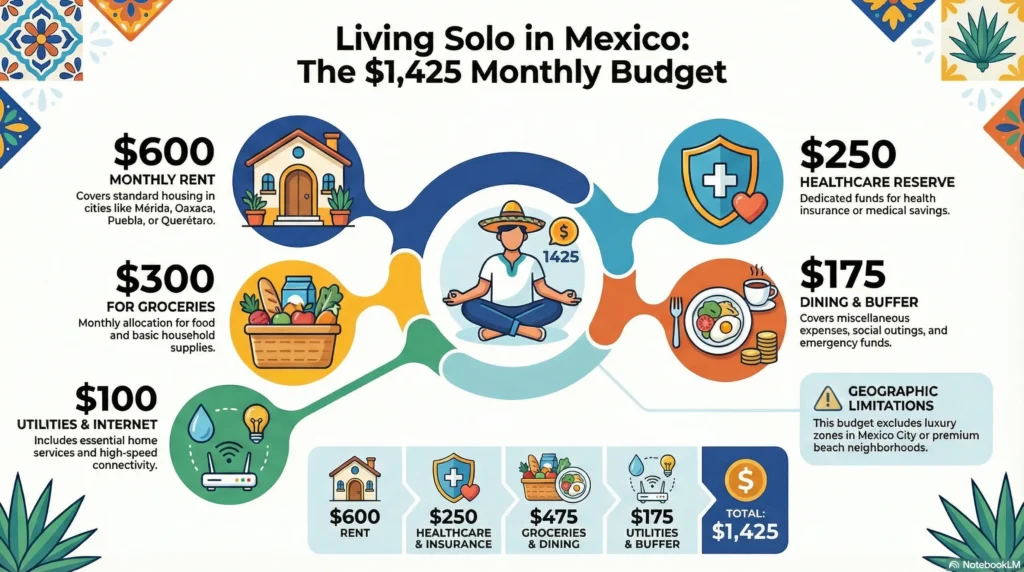
Example $1,500 Budget (Single Person – Inland City)
- Rent: $600
- Utilities + Internet: $100
- Groceries: $300
- Transportation: $75
- Healthcare reserve / insurance: $250
- Miscellaneous / dining / buffer: $175
Total: $1,500
This works in cities like Mérida, Oaxaca, Puebla, or Querétaro. It does not support luxury zones in Mexico City or premium beach neighborhoods.
For deeper tax considerations, see our Taxes & Financial hub.
Who This $1,500 Budget Is Not For
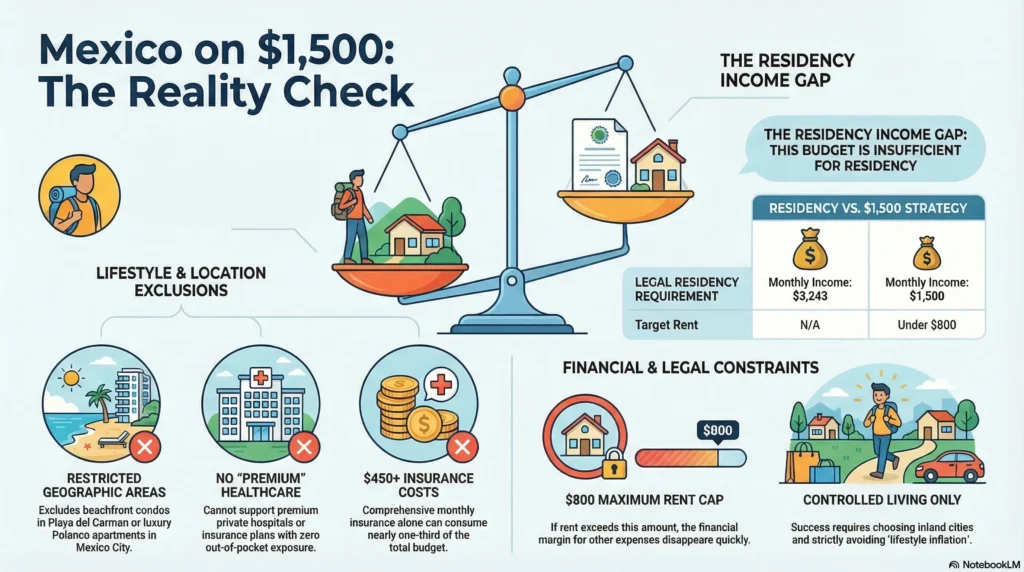
This budget works for disciplined spending in inland cities. It does not support beachfront condos in Playa del Carmen, Polanco apartments in Mexico City, or full international insurance combined with frequent travel.
If rent exceeds $800, the margin disappears quickly. If you require premium private hospitals with zero out of pocket exposure, monthly insurance alone can exceed $450 based on Pacific Prime’s 2024–2026 averages.
It is also not sufficient for permanent residency income qualification, which currently requires $3,243 monthly income according to MEXLAW’s 2026 update (https://mexlaw.com/financial-requirements-increase-for-residency-visa-in-mexico/).
The $1,500 model is a controlled living scenario. Choose city carefully, cap rent aggressively, and avoid lifestyle inflation.
Frequently Asked Questions
1. Is $1,500 realistic for a single person?
Yes, in inland cities where rent stays under $700. Lexidy’s 2026 data confirms $1,200–$1,600 monthly budgets in regional cities. Coastal and premium zones require more.
2. Is this budget realistic for a couple?
Mexico Relocation Guide estimates $1,500–$3,000 for singles or couples depending on lifestyle (Mexico Relocation Guide, 2026). A couple should realistically budget $2,400–$3,000.
3. Which cities are most affordable under this scenario?
Mérida, Oaxaca, Puebla, and Querétaro show the strongest $1,200–$1,600 monthly averages.
4. Does this include healthcare and insurance?
Basic out‑of‑pocket care is affordable ($30–$60 per visit), but full international insurance averages over $450 per month.
5. Are these numbers realistic for 2026?
All data cited reflects 2026 reporting from relocation law firms, insurance providers, and national publications including Lexidy, Mexico News Daily, and MEXLAW.
6. Can you qualify for residency on $1,500 income?
No. Temporary residency currently requires $1,946 monthly income according to MEXLAW’s 2026 figures.
7. Does this budget assume no car?
Yes. Owning a car increases total monthly expenses significantly.
8. What about currency fluctuations?
Budgets depend on USD/MXN exchange rates. A stronger dollar increases purchasing power; volatility reduces predictability.
Bottom Line:
You can live in Mexico on $1,500 a month in 2026 but only in the right cities, with controlled housing, and without premium lifestyle assumptions.