

Table of Contents
If you’re researching whether you can realistically live in Mexico on 2000 a month, you are probably asking a deeper question. Not just about numbers, but about lifestyle. Can you rent a modern apartment, eat well, access private healthcare, and still feel financially stable? This 2026 breakdown walks through real pricing data, rent ranges, healthcare costs, and daily expenses so you can see what $2,000 actually buys in Mexico today.
Monthly Cost Overview
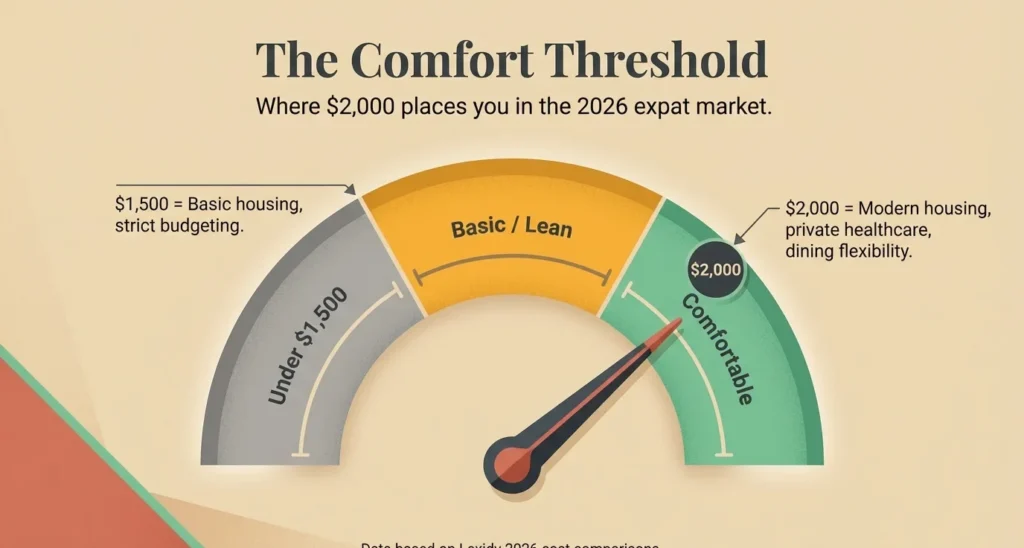
Living in Mexico on $2,000 a month allows for a noticeably more comfortable lifestyle compared to a $1,500 budget. In most inland cities, this range supports modern housing, dining out, private healthcare access, and discretionary spending.
According to Lexidy’s 2026 cost comparison, regional cities such as Mérida, Oaxaca, and Querétaro show single-person monthly living ranges between $1,200 and $1,600, while Mexico City averages $1,600 to $2,200 depending on rent and lifestyle (Lexidy, 2026).
That means $2,000 places you above the median expat spending level in most non-coastal cities and within a comfortable range even in stronger markets.
For broader country comparisons, visit our main Cost of Living in Mexico hub.
If you want to compare this to a leaner scenario, see our full breakdown of living on $1,500 per month.
Housing & Rent Breakdown
Housing remains the largest expense inside a Mexico expat budget of 2000 dollars per month.
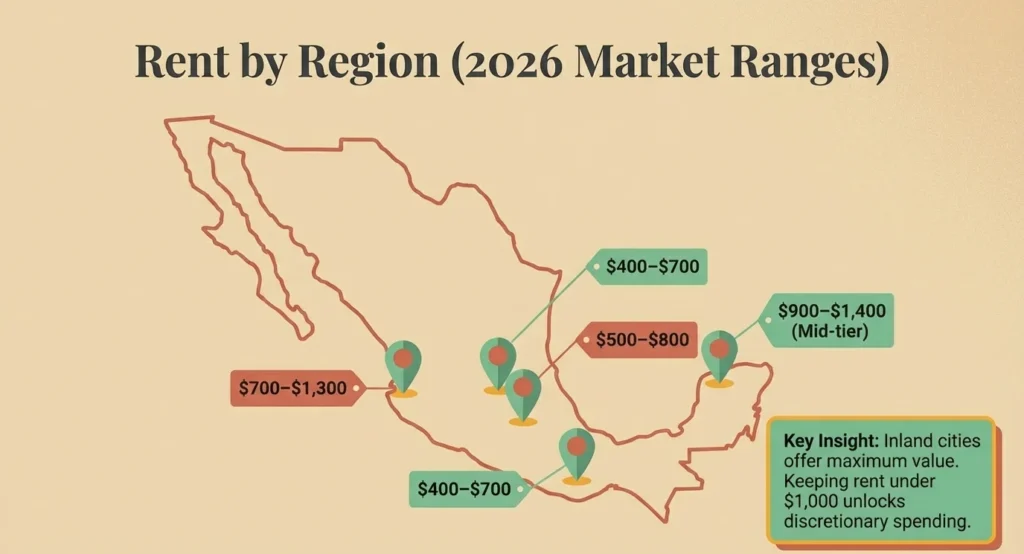
Rent by City (2026 Market Ranges)
Based on 2026 comparisons from Lexidy:
- Mérida: $400–$700
- Oaxaca: $400–$700
- Querétaro: $500–$750
- Puebla: $500–$800
- Mexico City (mid-tier areas): $900–$1,400
(Source: https://www.lexidy.com/)
In coastal expat cities like Playa del Carmen or Puerto Vallarta, rent typically ranges from $700 to $1,300 depending on proximity to the beach .
At a $2,000 monthly budget, keeping rent under $1,000 leaves room for discretionary spending and savings.
Utilities and Internet
Utilities generally range from $80 to $150 per month depending on air conditioning use. Internet averages $25 to $40 per month in most cities.
Food & Daily Expenses
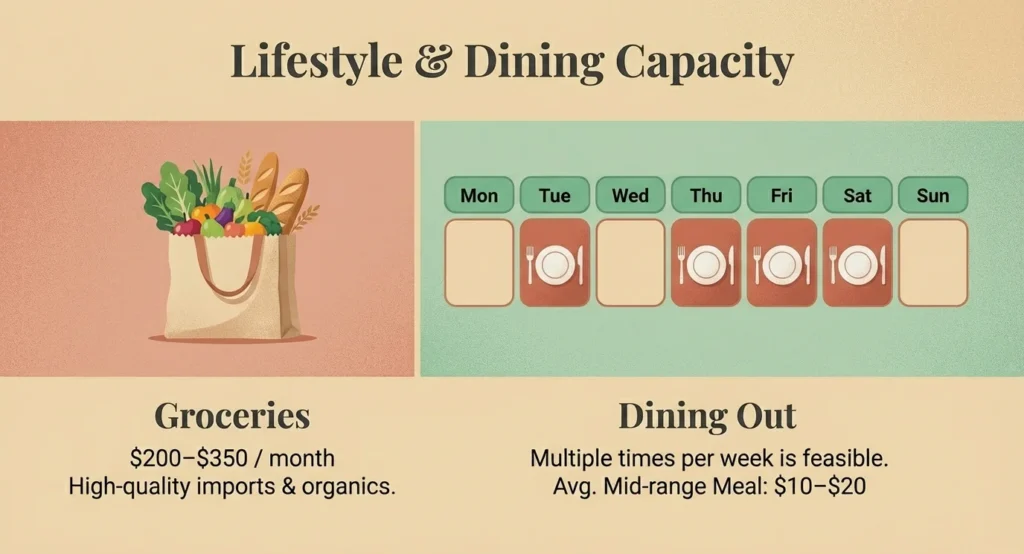
Food quality and dining flexibility increase significantly at the $2,000 level.
Groceries
Monthly grocery costs in Mexico average $200 to $350 for one person, compared to $400 to $600 in many U.S. cities (American Industrial Magazine, 2026).
This allows room for higher-quality imports, organic items, and specialty products without exceeding budget.
Dining and Lifestyle
Mid-range restaurant meals typically cost $10 to $20 per person. A $2,000 budget comfortably supports dining out multiple times per week.
Transportation costs remain modest. Mexico Relocation Guide estimates transportation at roughly 5 to 10 percent of monthly spending (source).
Healthcare Considerations
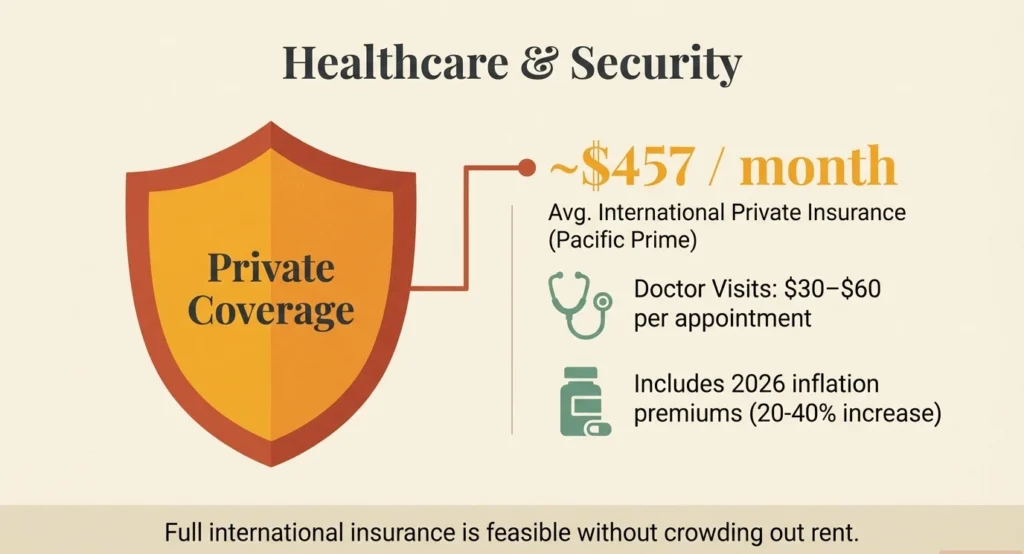
Healthcare becomes easier to structure at $2,000 per month.
Private doctor visits typically range from $30 to $60 per appointment according to American Industrial Magazine’s 2026 cost comparison.
International private health insurance averaged $5,485 annually in 2024, or roughly $457 per month, according to Pacific Prime .
Mexico News Daily reported premium increases of 20 to 40 percent in 2026 due to medical inflation (source).
At a $2,000 monthly level, full international insurance becomes more feasible without crowding out rent and food. Many short-term movers and digital nomads use providers like SafetyWing for flexible global coverage (https://takviewer.com/go/Safetywing), while longer-stay visitors often compare plans through VisitorsCoverage for travel medical protection (https://takviewer.com/go/Visitorscoverage).
For a full breakdown of pricing and insurance options, see our Healthcare Costs in Mexico guide:
https://takviewer.com/taxes-and-financial/healthcare-costs-in-mexico
Financial Requirements or Visa Rules
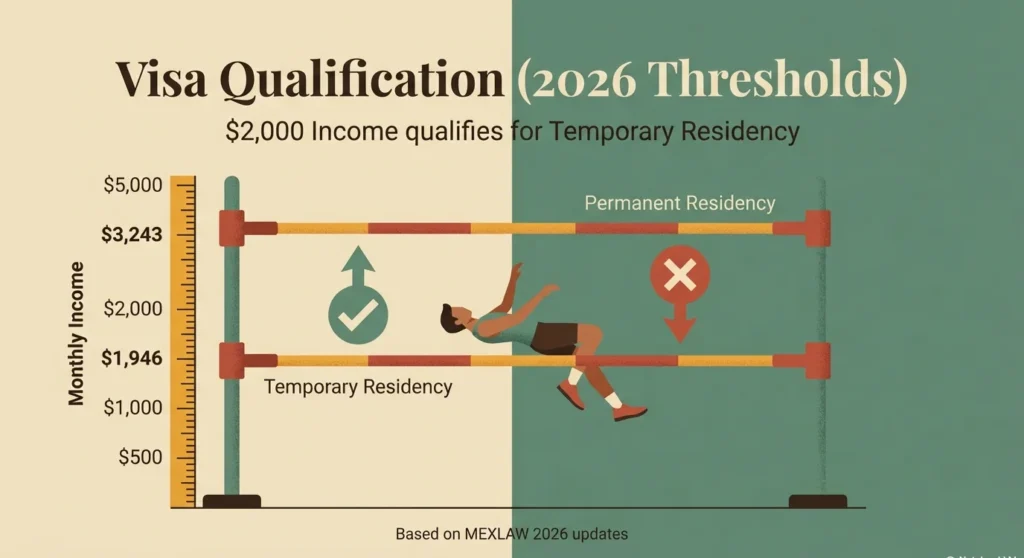
Long-term living in Mexico often requires residency status.
According to MEXLAW’s 2026 update, Temporary Residency requires proof of approximately $1,946 in monthly income or $32,426 in savings. Permanent Residency requires approximately $3,243 in monthly income or $130,000 in savings (source).
A $2,000 monthly income level generally satisfies temporary residency thresholds but does not meet permanent residency income requirements.
For deeper qualification details, see:
Mexico Temporary Resident Visa Income Requirement
https://takviewer.com/retirement-long-term-visa/mexico-temporary-resident-visa-income-requirement
Mexico Permanent Resident Visa Financial Requirements
https://takviewer.com/retirement-long-term-visa/mexico-permanent-resident-visa-financial-requirements
$1,500 vs $2,000 in Mexico: What Changes?
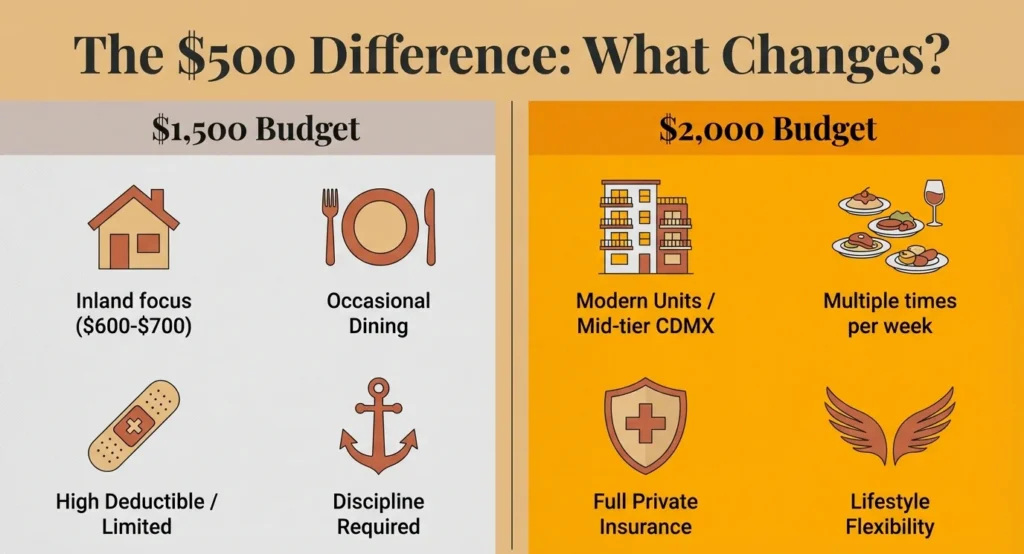
Below is a practical comparison of how lifestyle shifts between a controlled $1,500 budget and a more flexible $2,000 budget.
| Category | $1,500 Budget | $2,000 Budget |
|---|---|---|
| Rent | $600–$700 inland | $800–$1,000 modern unit |
| Dining Out | Occasional | Multiple times per week |
| Healthcare | Limited or high deductible | Full private insurance feasible |
| Savings Buffer | Tight | Moderate flexibility |
| City Options | Inland focus | Inland + mid-tier Mexico City |
At $1,500, discipline is required. At $2,000, you gain breathing room. Housing quality improves. Insurance becomes realistic. Dining becomes lifestyle, not a calculation.
Advantages and Financial Tradeoffs of Living in Mexico on $2,000 a Month
Advantages
- Modern rental options in most inland cities
- Regular dining out and entertainment flexibility
- Access to private healthcare and insurance
- Ability to absorb currency fluctuations
Tradeoffs
- Premium beach zones may still exceed budget
- Permanent residency income thresholds remain higher
- Imported goods and luxury services raise spending quickly
A $2,000 budget offers stability, not luxury excess.
Final Budget Summary
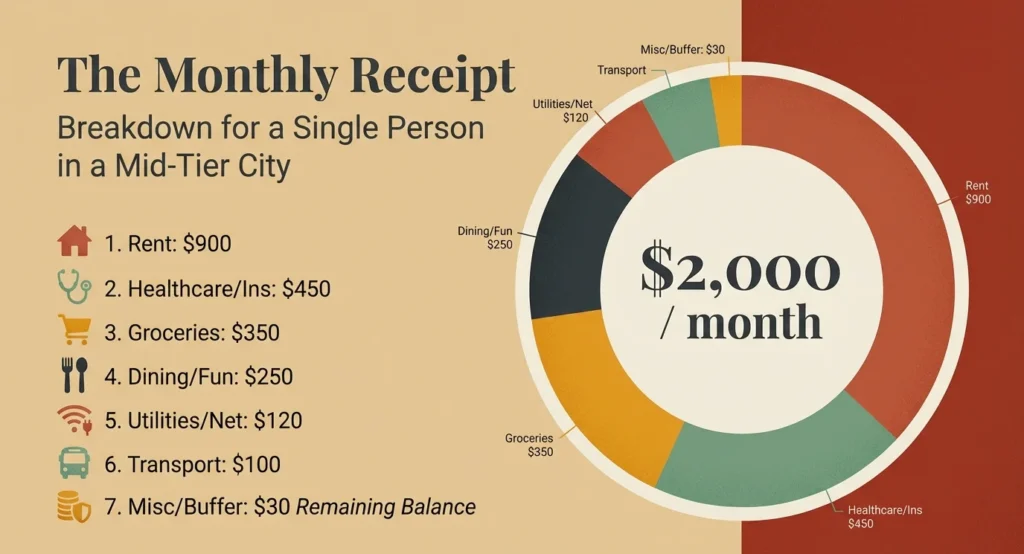
Example Comfortable $2,000 Budget (Single Person)
- Rent: $900
- Utilities and Internet: $120
- Groceries: $350
- Dining and Entertainment: $250
- Transportation: $100
- Healthcare / Insurance: $450
- Miscellaneous / Buffer: $180
Total: $2,000
This level supports comfortable living in Mérida, Oaxaca, Puebla, Querétaro, and mid-tier neighborhoods in Mexico City.
For tax exposure and reporting considerations, visit our Taxes and Financial hub:
https://takviewer.com/taxes-and-financial/
Frequently Asked Questions
1. Is $2,000 realistic for a single person?
Yes. In most inland cities, $2,000 supports modern housing, private healthcare, and discretionary spending based on 2026 cost comparisons from Lexidy.
2. Is this budget realistic for a couple?
A couple can live modestly on $2,000 in lower-cost cities, but a more comfortable couple budget ranges from $2,800 to $3,500 depending on rent and insurance structure.
3. Which cities are most affordable under this scenario?
Mérida, Oaxaca, Puebla, and Querétaro consistently show strong cost-to-comfort ratios based on 2026 relocation comparisons.
4. Does this include healthcare and insurance?
Yes. The example budget includes a private insurance allocation of roughly $450 per month, based on Pacific Prime’s reported averages.
5. Are these numbers realistic for 2026?
All figures referenced reflect 2026 reporting from relocation law firms, insurance providers, and cost comparison publications.
6. Can you retire in Mexico on $2,000 a month?
Yes. Many retirees structure housing under $1,000 and allocate the remainder toward healthcare and lifestyle spending.
7. Is $2,000 enough for Mexico City?
In mid-tier neighborhoods, yes. In luxury central districts, rent alone may exceed $1,500.
8. What about taxes for Americans living in Mexico?
U.S. citizens remain subject to U.S. tax reporting obligations even while living abroad. See our Taxes and Financial hub for clarity.
9. Does this assume no car ownership?
The example assumes limited car usage. Owning a vehicle increases monthly expenses through insurance, fuel, and maintenance.
10. How does exchange rate volatility affect a $2,000 budget?
A stronger dollar increases purchasing power. Currency volatility can reduce planning predictability, especially for retirees living on fixed income.
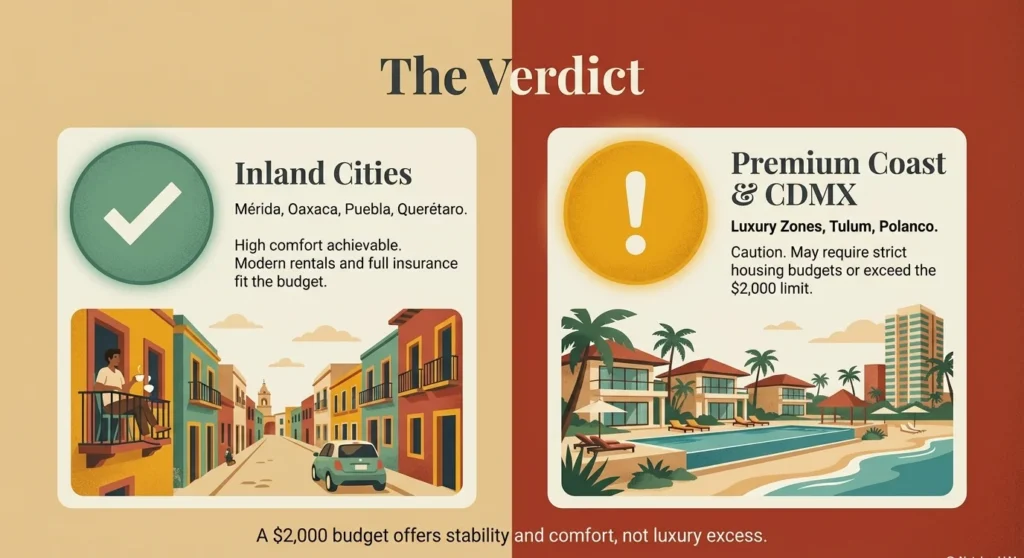
anyways You can live in Mexico on $2,000 a month in 2026 with a comfortable lifestyle in most inland cities and selective coastal areas, provided housing costs remain controlled and healthcare is structured properly.